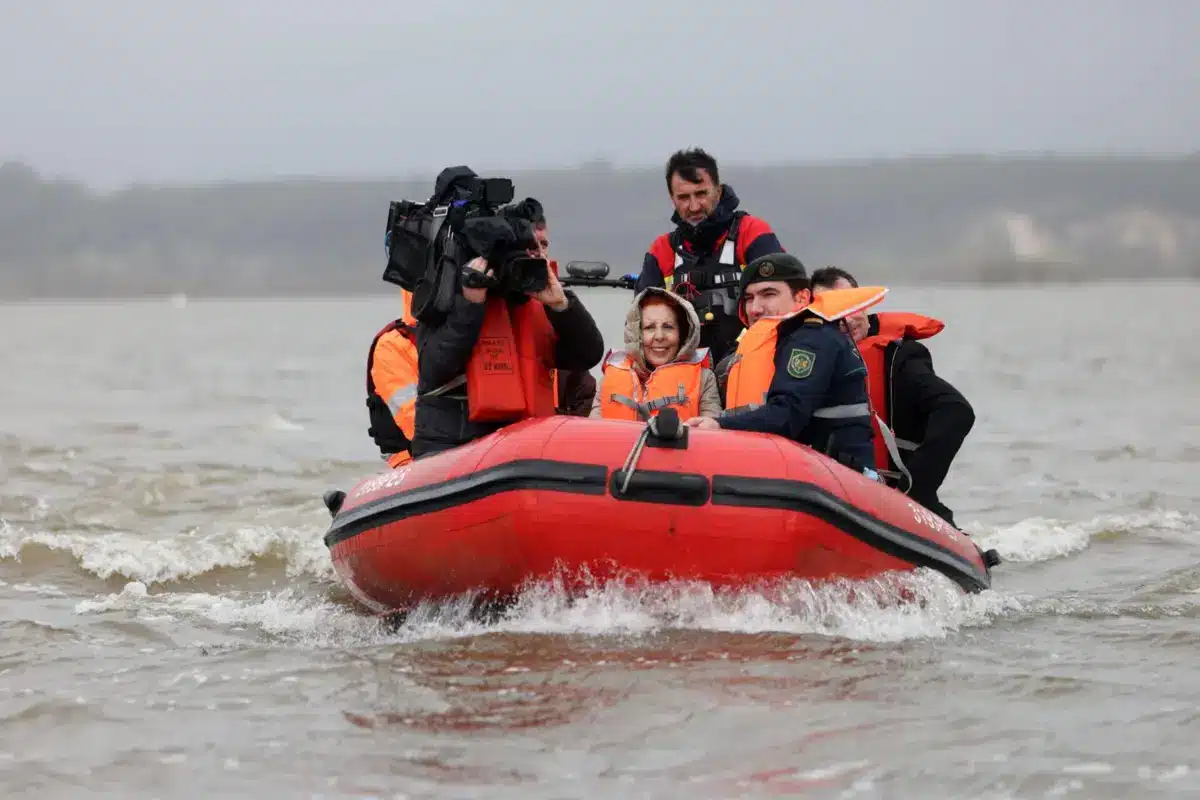
Minister of the Environment, Maria da Graça Carvalho, has “affirmed today that the government will have to redirect money from European funding to respond to the damages provoked by successive depressions”.
This is the opening sentence of text from Lusa state news agency today which will give hope to all the civic/ environmental movements that have been campaigning to save parts of the country threatened by large-scale government-backed projects.
It is clearly too early to ‘launch fireworks’ – and the minister has given little in the way of clues.
But she did tell reporters in Valada, Cartaxo municipality, today that the government is going to analyse the funds available (Cohesion Fund, Environmental and PRR – plan for recovery and resilience) to ‘redirect priorities and finance urgent work’.
She also said that this analysis would be done “with the support of the local authorities”. This is another moment for ‘hope’ for those whose antipathy to some projects comes with the full support of their local authorities.
Maria da Graça Carvalho is one of the few ministers who has emerged from the government’s ‘handling’ of the ‘carousel of storms’ with flying colours. She has been judged as ‘empathetic’ and ‘effective’. She is also the minister who admitted in June last year that it is “practically impossible” to carry out projects “against the wishes of an entire population”.
“One of the political guidelines is that it is very important to listen to the people (…) It is very difficult to develop a tourism, agricultural, mining or industrial project against the will of everyone around us,” she told journalists at the time.
Thus campaigners fighting to save landscapes, trees, agricultural pasture, rural ways of life, and even traditional livelihoods, can only hope – and await further announcements.
The good thing is that the damages that need repairing are seen as ‘urgent’: they apply to channels/ dykes, cliffs and small scale dams.
Minister Carvalho also explained that a full assessment of damages (already estimated nationally by the prime minister as ‘in excess of €4 billion) has not been concluded, due to the continuing intense rain in several parts of the country. But she admitted that there are damages to be fixed “along practically the whole coastline” – especially along cliffs where landslides “are quick” (unlike flooding) and give no time for people to be evacuated.
Regarding payments coming through to victims of the storms, these are all “starting to be paid”, she said.
It is a process that is not as quick as the government made out, but which at least is starting. Households whose damages run to ‘around €5,000’ are expected to receive this money within three days, writes Lusa today. Those hoping for the full €10,000 promised by the government last week will have to wait more like two weeks.
Answering questions on perceived ‘fragilities’ of dykes along the Tejo river, Minister Carvalho stressed that regular maintenance on them has been done – and that the dyke in Valada (currently flooded and physically cut off from the rest of the country for days) which “presented problems during the peak of last week’s flooding” will be subjected to “priority intervention”.
“We have to guarantee that it can resist the next assaults, because unfortunately we are going to have more”, she said.
There then followed questions that might make older journalists want to throw their notebooks (if they still use them) up in the air in exasperation: why did the government hand out diesel generators to flood-soaked regions? Did these compromise Portugal’s goals for decarbonisation?
Fortunately, the minister had an answer: the government has launched a tender with money from the PRR fund for “renewable energy units, with batteries, designed for self-consumption and energy resilience in remote areas”.
Source material: LUSA