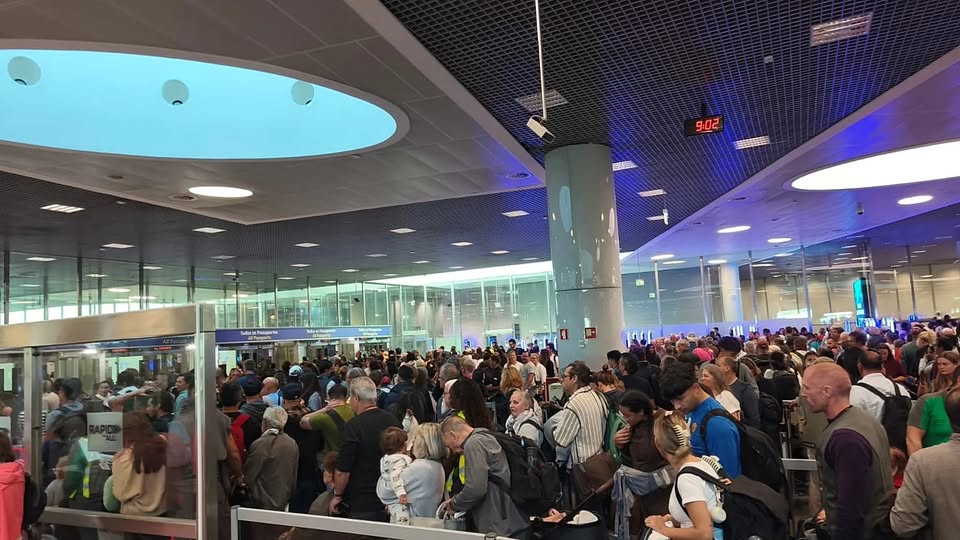
Portugal’s association of hoteliers, AHP, has had enough of standing by as authorities fail to cope with the new European Entry/ Exit system (EES) at Lisbon airport (the problem is slightly less glaring at Faro airport).
In a letter to the government, AHP warns of a possible breakdown altogether in Lisbon.
Entitled “Portugal cannot be held hostage by its border”, the association expresses its “deep concern”, stressing the “terrible image” of Portugal’s ‘gateway’.
Talking to Lusa today, AHP president Bernade Trindade said: “The situation at Lisbon airport is far from satisfactory and the Portuguese state, which is not the state of this government or the state of the previous government, is the state that, overall, has failed and fails on a daily basis” in “timely border control, generating endless queues, failing in security, failing in its role as a concessionaire under a concession contract and, above all, failing to take care of Portugal’s image.”
The appeal thus is that ‘things are made to happen’ (namely more border control inspectors are drafted in).
In the letter, the AHP refers to “the lack of adequate human and technical resources for (the) implementation” (of EES) “causing unacceptable delays in arrivals and departures, with severe impacts on airport operations, the country’s image and the confidence of travellers”.
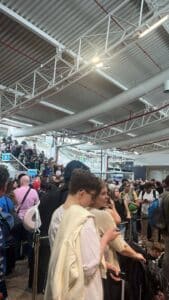
Lisbon airport, “has long been operating at overload”, says the association. It is now in a “state of serious dysfunction (…) the endless queues that are now seen at border controls, both on arrival and departure” are the “predictable and regrettable consequence of an implementation model without sufficient resources or effective coordination”.
“Multiple” consequences of this debacle include “the loss of air connections and direct risk to the TAP hub, viability of which depends on the fluidity of connection times”, delays “cascading” in both departures and arrivals, “saturation of baggage carousels and ground operations” as well as a “worrying deterioration” in ‘the visitor experience’.
Tourism accounts for “around 12% of national GDP – and the Lisbon region is responsible for more than a quarter of the country’s tourist demand. “One of the main sources of economic growth and international prestige” is now at “risk (…) through administrative inefficiency”, rails AHP.
“The situation is all the more serious as this is only the first phase of the EES,” the association adds.
In December “a more demanding stage will begin, with mandatory biometric collection at self-service kiosks for around 35% of international passengers”.
In the letter, the AHP warns that “if human and technical resources are not quickly reinforced, the system will collapse in the face of the foreseeable increase in complexity and volume”, indicating that “beyond the aforementioned impact on the country’s economy and image, this collapse will generate, among other victims, Portuguese citizens themselves who necessarily use the airport, namely those of the new generation of the diaspora”.
The association proposes the immediate reinforcement of police personnel assigned to border control and adequate planning for periods of increased traffic, the immediate repair/activation of eGates and RAPID machines, and the “public definition of maximum acceptable waiting times for passengers from third countries and regular monitoring of results”.
AHP also wants the “approval of a national contingency plan for traffic peaks, with temporary reinforcements and additional posts when necessary” and “transparent communication with passengers and tour operators”, coordinated with the Portuguese Tourism Authority, as well as the “continuous evaluation of the implementation of the EES”, including a “quarterly report from the airports managing company, ANA, to the government (and available to the public) on the status of implementation, number of active posts, number of passengers processed, average and percentile of waiting times, technical failures recorded and correction plan”.
While these demands are processed, queues and frustrations will inevitably continue.
Source material: LUSA