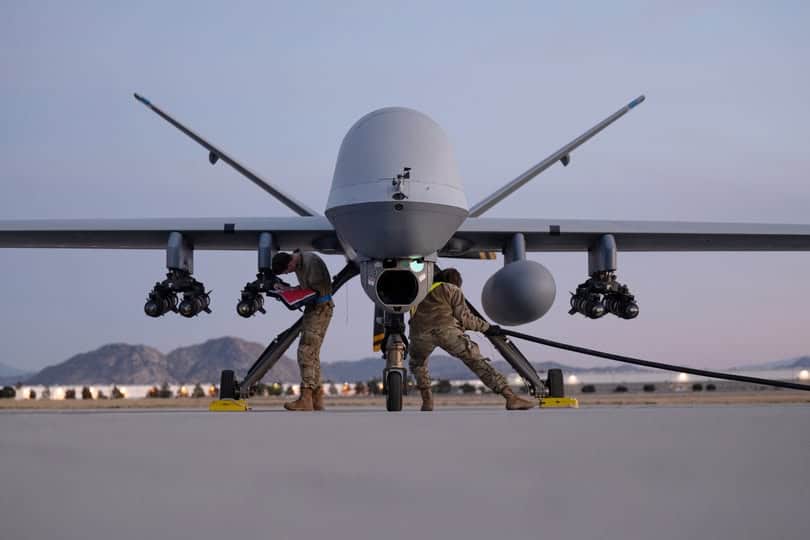
With this morning opening with the usual confusion over the direction of the conflict in the Middle East, reports in Portugal are that “several MQ-9 Reapers” – the largest and most lethal drones in the U.S. armory – are due to arrive at Lajes airbase, in the Azores, within hours.
If this is the case, it is the first time that MQ-Reapers have passed through Lajes (which is not being used by the United States as a launch-pad for attacks on Iranian, or any other, soil, stresses the Portuguese government).
Noticiasaominuto cites its source for the story as SIC Notícias, recalling that “the Trump administration” used MQ-9 Reapers when it launched its attack on Venezuela in January.
The news outlet adds that the Reapers’ objective will be to reach Iran.
This may all change however as President Trump has just announced over social media that he has given instructions to the United States armed forces to delay “all military attacks against Iranian power plants and energy infrastructure” as a result of “very good and productive conversations” that he has apparently just had with Iran.
MQ-Reapers – also known as Predator Bs – were developed by General Atomics Aeronautical Systems, and are known as the “largest and most lethal” drones in operation in the United States Air Force. They have a wing span of approximately 20 metres and can fly at altitudes of more than 15,000 metres/ up to 50,000 metres. Their range is 1,850 kms – and their use, beyond precision/ surgical attacks, is for missions of intelligence, vigilance and reconnaissance.
These drones are said to have autonomy of flight for 27-hours, and are operated remotely by two people.
According to noticiasaominuto’s report, they can “transport a load of 1,700 kg, and each one costs more than 48 million euros”.
Brazilian site G1 adds that Reapers can be equipped with up to eight laser guided missiles each – and were equally used in Iran in 2020.
Source material: noticiasaominuto