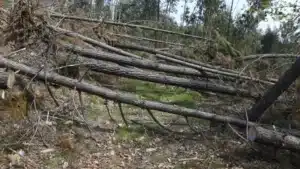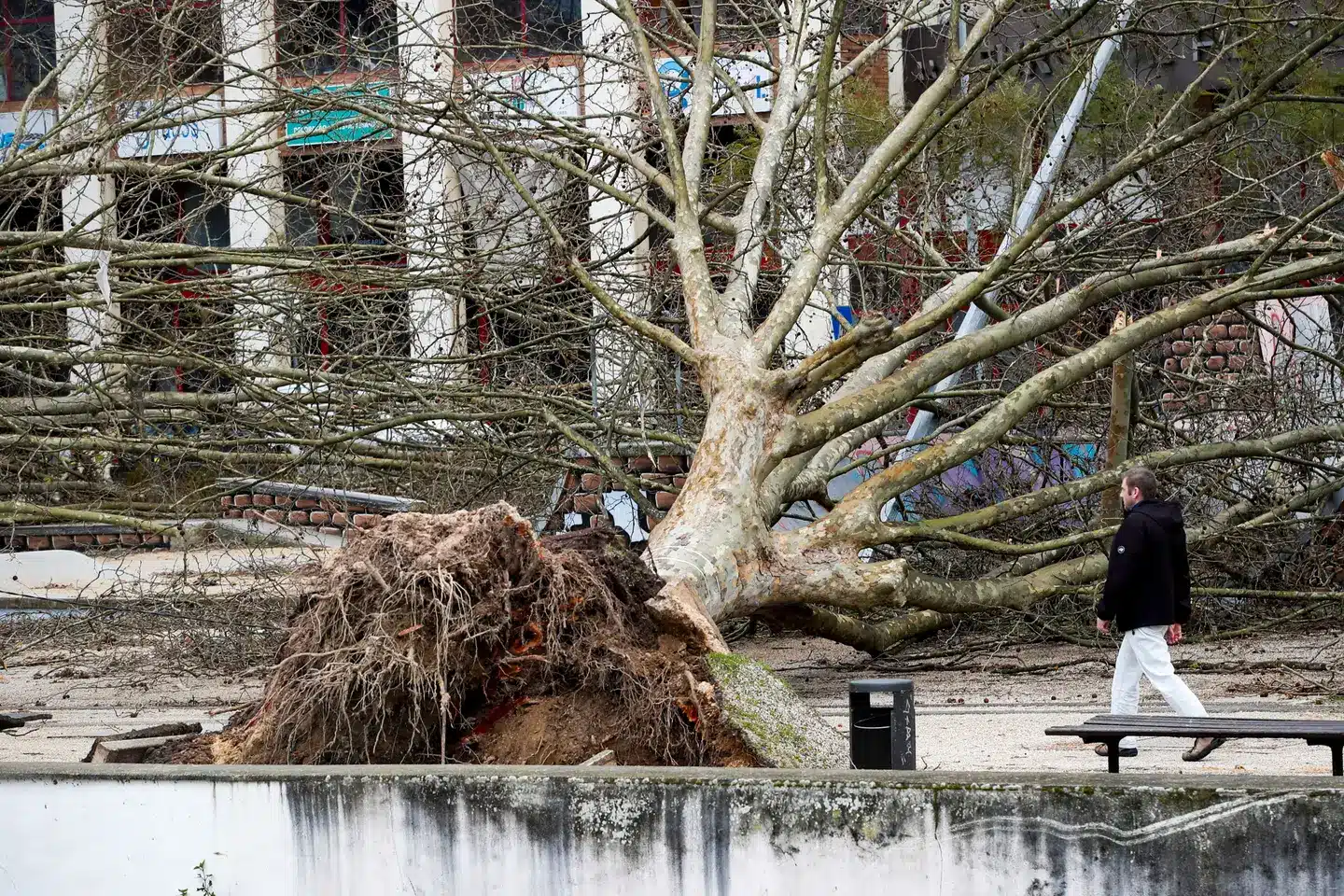
It is only in the last few days that the sheer number of trees lost (just in the district of Leiria) has become clear: between five to eight million.
Experts are warning that the situation implies “extreme risk” for the looming summer wildfire season.
The problem lies in the quantity of combustible material ‘just lying on the ground’: fertile pasture for any wildfire.
Expresso drills down into silent threat today, explaining how trees have been lost from pine forests, scrublands, public gardens, avenues, cemeteries, schools and private homes.
The municipality carried out its survey with the help of drones. “We look at photographs of the ‘before’ and ‘after’, and it looks like there was a war. It is impossible not to feel shocked and sad,” councillor for green spaces, Carlos Palheira, tells the paper.
In Villa Portela, which only opened its doors as a centre for the arts five months ago, over 160 trees that had stood in the gardens since the 19th century crashed to the ground.
In ‘Parque do Avião’, on the banks of the river Lis, 27 of the 110 trees (all of them large) succumbed to Kristin’s monster winds – one actually falling on top of the historic aircraft that gave the park its name. The ‘Beechcraft C-45 Expeditor’ will be painstakingly restored by the Air Force – but the same cannot be done for the trees.
Over the last three weeks (since Kristin bowled through the municipality in the early hours of January 28), the council has contracted 20 companies to clear fallen trees from the city. It is beginning a replanting programme (which will necessarily run until 2029). But this is only for the urban areas. The big problem now is the number of trees that have fallen in rural/ forested areas.
Wildfire specialist António Salgueiro – one of a number of experts involved in AGIF (the agency for the integrated management of rural fires) – explains that it isn’t just a case of trees lying on the ground but the additional material that has fallen from them that adds to fire risks. We’re talking pine needles, leaves, branches etc. which could “easily duplicate what we have on the ground and favour fires of exceptional intensity”, he tells Expresso.
Paulo Fernandes, of the Centre for Applied Ecology at Trás-os-Montes and Alto Douro university, calculates that biomass from tree tops that now lies on the ground will dry and “could add 10 tons per hectare to the 20-30 tons that are already there”.
It is a scenario that “makes the whole situation explosive”.
“Now, everything depends on weather conditions and the number of fires”, says Expresso.
Work is going ahead on trying to clear fallen trees and restore some sort of ‘order’ before the spring. And then there is another ‘downside’ to the situation: “the mass falling of trees creates ideal conditions for the explosion of ‘perforating insects’, which reproduce without resistance in dead wood, and could go on to kill trees that survived the storm”.
All in all, Kristin set the scene for a domino effect of uncertainty and risks.
Expresso concludes that authorities need to be ready and well-organised for this year’s wildfire season – the latter situation perennially being the ‘lament’ when firefighting goes ‘less well’.
Source material: Expresso