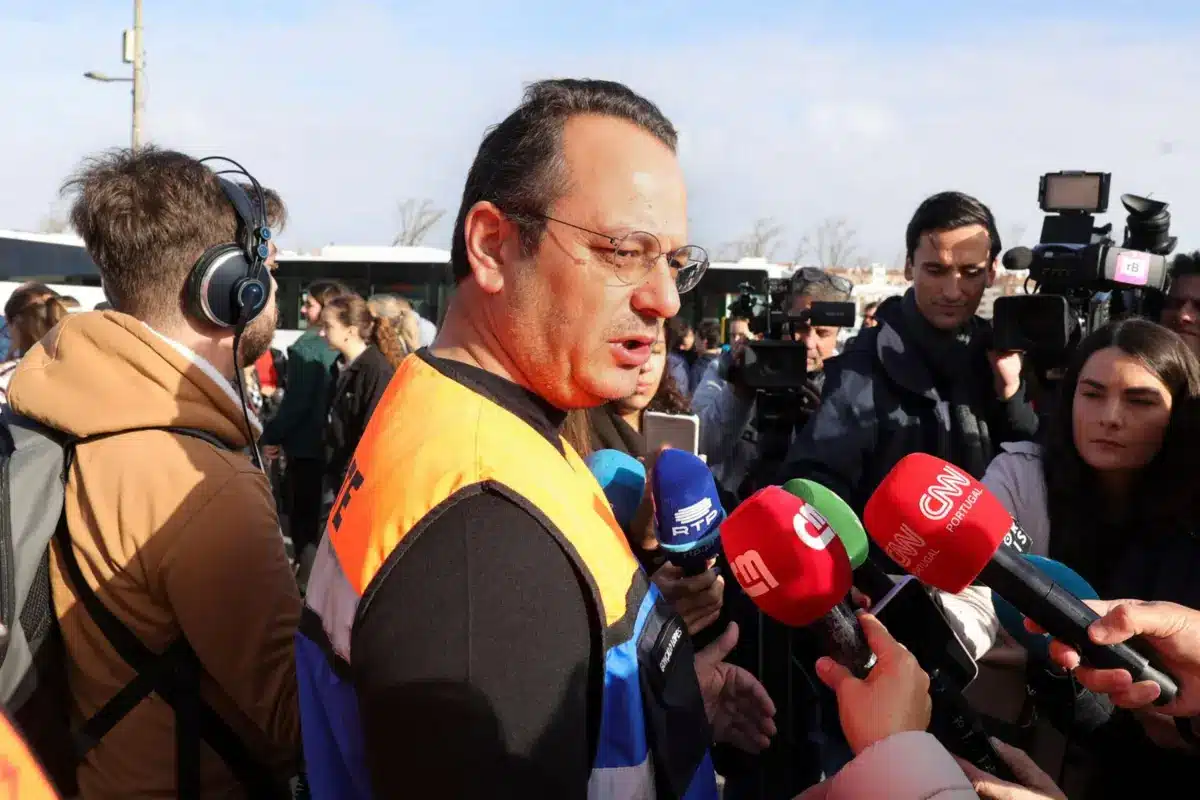
Leiria mayor Gonçalo Lopes has accused the government of leaving municipalities in an impossible position since recent storms.
Lisbon ‘threw’ the inspection of applications for home reconstruction at local authorities without questioning whether they had the capacity to follow-through.
“We were thrown to the front line to solve a problem without being asked if we were in a position to do so – nor was there any negotiation with us about how it should be done. People rushed to submit their applications because they need money, and now I can’t analyse them as quickly as the government said they had to be analysed! If they (the government) wanted to analyse applications that quickly, they should have taken on the responsibility themselves!”.
In an interview with Lusa news agency, one month after the Storm Kristin devastated vast swathes of inland territory, Lopes has explained some of the enormous difficulties still ahead.
For example, financial support to repair damages to homes caused by Kristin is (meant to be) granted within a maximum of three working days for expenses up to €5,000 (with photographs), which do not require inspection – and within 15 working days for the rest.
But “submission forms are being systematically changed, requirements are changed every day”, and council offices have a finite number of employees.
Leiria, for instance, is dealing currently with 6,000 applications for financial support – but it has only 10 people working in urban planning.
Lopes adds that he has contacted experts and expert companies to work for the council, “without success, because they are working for insurance companies”, and he has contacted insurance companies “to ask if they could provide experts. Again, without success”.
The government’s solutions have essentially left councils tied in knots…
Earlier this week, Leiria sent letters to councils that supported the district immediately after the impact of Storm Kristin, stating that it is available to “receive people for a week, two weeks, three weeks, whatever time is necessary so as not to inconvenience” them, offering, in exchange, accommodation and meals to technicians, especially engineers, to participate in the expert assessments”.
The municipality has also reached out to all higher education institutions that offer civil engineering, so that teachers and student “can help in the informal analysis of some of these (rebuilding) processes,” Lopes continued.
The municipality already has “several dozen engineers and architects willing to participate” under an agreement with their respective professional associations and the Intermunicipal Community of the Leiria Region. The aim is to “expand this involvement” to make the process “faster”.
Otherwise, there will be problems.
“We will have people coming to the council asking “how is my case going?”’, he said, recalling the issues of house reconstruction after the 2017 fires in Pedrógão Grande, which triggered legal proceedings and convictions, including of local authorities.
In this regard, he pointed to the risks of incompatibilities between local authorities and technicians in validating support for the reconstruction of houses and admits that applications may come in with “photographs that may not be associated with the storm” or with inflated budgets.
“And if we validate such an expense, such support, what will they say about us? Incompetent? Is it just a scam? They failed,” he asked, ensuring the creation of “maximum conditions” for “fair decisions”.
Challenged to rate the work of the government, led by Social Democrat Luís Montenegro, in the wake of the bad weather, Gonçalo Lopes (PS) considered that “any rating I give will always be unfair to the government”.
“What’s more, if I give a rating, it could harm Leiria,” he said, leaving the assessment of the government’s performance to citizens themselves.
“I want the government to govern the country well, that’s all I need, that’s what we all want. If it governs well, local authorities will have better conditions,” he added.
But for the time being, Leiria is far from being out of the woods. It has only received €5 million in cash since storm Kristin hit “which was an advance from the insurance company we work with. Other than that, I haven’t received any more money,” said Lopes.
Earlier this month, the council estimated damage caused by Kristin amounted to €792.8 million – not including costs to municipal and state infrastructure and forests.
“Based on what we have been able to ascertain, what we have already spent, plus the initial low estimate, we have a figure of €792.8 million. There is still another amount to be added,” said Lopes at the time.
Now, Lopes anticipates that in the case of housing, losses could exceed €100 million and, in the case of businesses, the figure “could reach approximately €700 million”.
Several situations have yet to be accounted for, such as the number of vehicles affected and the damage to forest areas, which, in this case, “represents an immediate economic loss, and then a very serious loss from an environmental point of view.”
Reiterating that the district’s gross domestic product “is around €2 billion per year, a single day of inactivity represents around €5.6 million that is not produced,” the mayor added. recalling that, for a week, Leiria had “practically 100% of its economic activity at a standstill.”
“Therefore, it was a country and a region that became poorer,” he said.
At this stage, “figures are impossible to calculate accurately, they are estimates.”
A survey of the affected municipal heritage is underway, “both in response to insurance claims” and “to submit the information” to the Regional Coordination and Development Commission of the Centre – but all in all, Leiria is not feeling overly confident about the way in which things have been going since that fateful morning of January 28 when it was hit by an ‘explosive cyclogenesis’.
Source material: LUSA