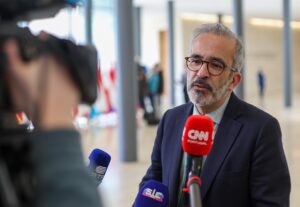
No sooner had the news arrived of the fall of one of the legal challenges lobbed at plans for a desalination plant in the Algarve than minister for the environment, Maria da Graça Carvalho was hailing the news and stressing the time-line for work to begin.
Talking to Lusa in Lisbon, she said: “The public consultation will be open – I think for two or three days. Then there will be a final decision based on the public consultation, and immediately after that, work can begin.”
“Congratulations to the work of the APA Agency and Águas do Algarve, who formulated their response to the interim injunction well.”
This particular injunction had been filed by property company SEACLIFF COMPRA E VENDA DE IMÓVEIS, S.A. arguing that the public consultation period for the RECAPE (Report on Environmental Conformity of the Project for Execution) violated European legislation because it gave only 20 consecutive days (15 working days) for people to give their opinions.
There remain other legal challenges in the pipeline, however – and even APA (the Portuguese environmental association) has conceded it is still too early to say when construction will move forwards as “further legal challenges could come”.
The principal objections to this project – beyond those centred on the enormous amount of energy required and the environmental harm of channeling thousands of cubic metres of brine and desalination waste products back into the sea – are that it is only needed in order to support the region’s increase in agricultural projects, the majority of them water intensive monocultures.
Environmental engineer Cláudia Sil, working out of the University of the Algarve, has explained that there is, in fact, “ample water for domestic/ urban use in the region” – but not enough to supply those requirements (tourism included), and ‘industrialised agriculture’.
Eng. Sil told a public meeting on the desalination project back in the summer of 2024 “this is all about agri-business”, which has already drained 75% of the region’s underground water reserves.
Adding a sting to the tale, she stressed that the desalination plant is not designed to supply water to this agri-business: this will “continue draining underground reserves” which she describes as “good water”, full of natural salts and minerals for ‘healthy consumption’, while it will be the general population consuming desalinated water, which by dint of the process, is water devoid of natural salts and minerals.
Winding up her presentation last year, Eng. Sil said: “This whole exercise is an opportunity to make money. The Algarve is not a desert. It is being treated as if it will be by the agri-multinationals, because this suits them – and it will increase all our water bills. They will become enormous… and this of course will suit Águas de Portugal…”
sources: Lusa/ Public meeting in Quarteira, June 2024