Excessive bureaucracy limiting our capacity to grow – Luís Montenegro
Portugal’s Prime minister Luís Montenegro has declared war on the country’s excessive bureaucracy, which he insists is holding Portugal back.
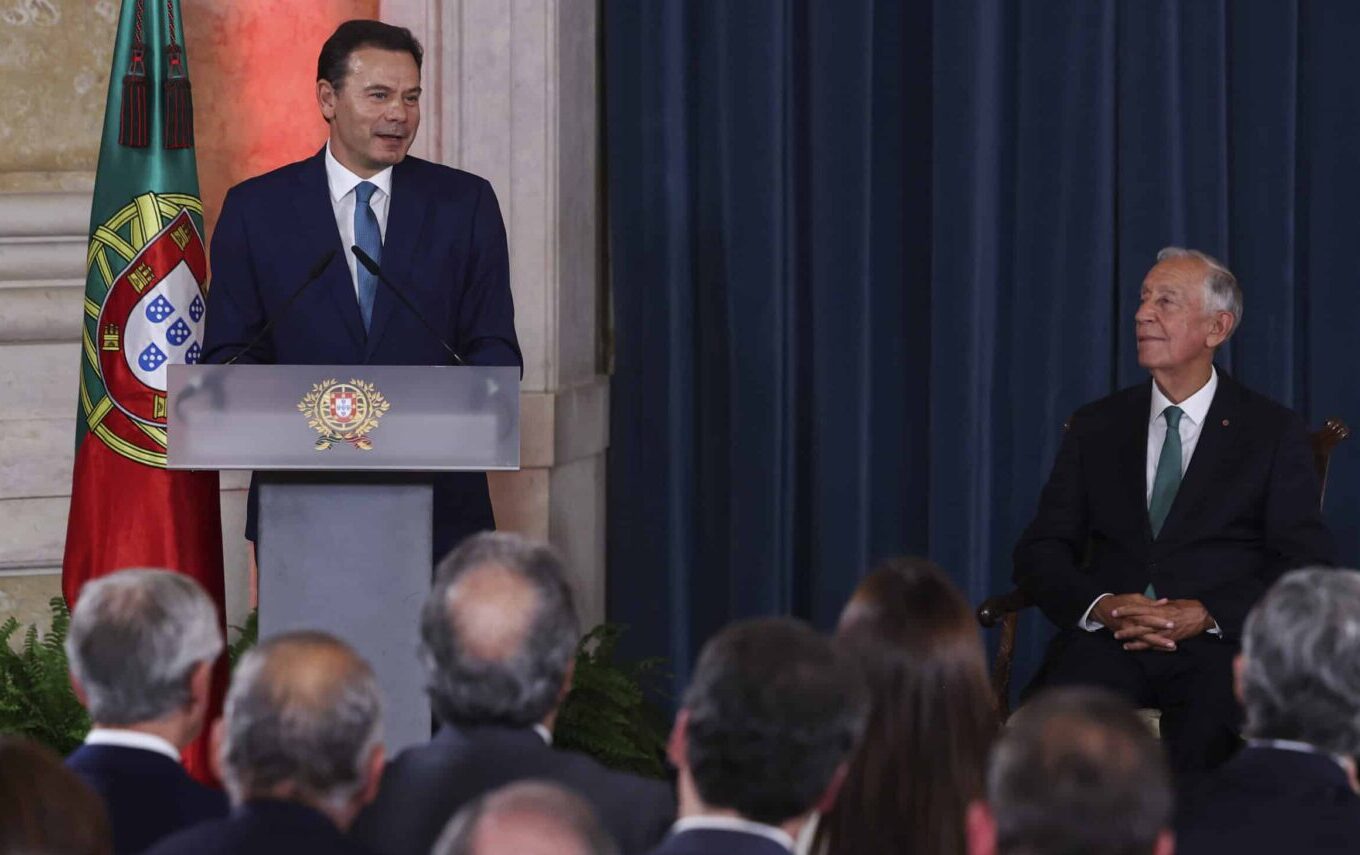
In his first major speech since being sworn in, Montenegro said transforming the country is the only way to tackle poverty and deliver real prosperity – and at the heart of that transformation is cutting red tape.
“I want to declare here today, solemnly, war on bureaucracy,” said the PM, adding that overregulation, slow decision-making, and an unresponsive state are dampeners to growth.
“The growth of the economy and wealth creation are the government’s number one goal to achieve the supreme objective, which is the well-being of the Portuguese people,” Montenegro added.
To lead this change, Montenegro highlighted the creation of a new Ministry for State Reform, which will report directly to him.
“By creating a ministry to promote and oversee this transformation, under my direct responsibility, it is very clear that every department (…) will be called to collaborate on this national goal,” he declared.
President Marcelo Rebelo de Sousa followed shortly with his own strong words, underscoring the urgency of reform and warning that Portugal’s flagship Recovery and Resilience Plan (PRR) is already stumbling because of red tape and fragmented systems.
“The PRR is dragging in many cases, taking far too long, because of so much bureaucracy,” the president said during Portugal Day commemorations in Lagos (see page 12). “Instead of spending €200 million a week on the ground, we’re at €100, €60, €80, €70. Over time, that means a huge amount goes unspent.”
Marcelo also called for an urgent overhaul of digital systems and legal frameworks, insisting that many of the delays stem from the inability of ministries and agencies to work together effectively.
“There are ministries with dozens – if not hundreds – of different digital systems and contracts,” he said. “Each directorate-general, each inspectorate, each department has its own digitalisation contract. This cannot continue, not in terms of cost-efficiency or coordination.”
The president also endorsed Montenegro’s appointment of Bernardo Correia, formerly of Google Portugal, as Secretary of State for Digital Transition in the new Ministry for State Reform, saying the job now is to “coordinate and harmonise how the state handles data”.
Montenegro and Marcelo’s comments echo growing calls from business leaders and European institutions for urgent reform.
A recent 15-page report from the European Commission (EC) underlined how Portugal’s burdensome regulations are stifling growth and investment, with nearly half (48.8%) of Portuguese companies identifying excessive regulation as a key barrier to investment, the report noted.
Brussels also urged Lisbon to simplify licensing procedures, reduce administrative burdens, and remove obstacles to business expansion and innovation. The commission also called for improved efficiency in Portugal’s administrative and tax courts, as well as a more effective tax system.
This same diagnosis has been made by Business Roundtable Portugal (BRP), an influential association comprising 43 of the country’s largest economic groups.
“The simplification of administrative and licensing processes is essential to create the dynamism needed for economic growth,” the organisation stated. “We know that complexity and a lack of speed remove predictability for businesses and are, therefore, barriers to investment.” BRP has created a working group specifically dedicated to the issue, led by its vice-president and BCP bank chairman Nuno Amado.
While the association praised some recent government steps – including environmental licensing reforms under the Simplex Ambiental programme – it warned that Portugal must “go further”.
“Portugal remains a highly bureaucratic country despite administrative simplification efforts,” BRP concluded.
Just last week, hoteliers in the Algarve also sounded the alarm over excessive red tape in Portugal, which they say is scaring away investors.
“We can’t continue with the kind of bureaucracy we have now – it takes an average of seven years to approve a hotel project,” said Hélder Martins, president of the Algarve hotel association (AHETA), calling it a “barrier to development.”
Martins explained that international investors often lose interest in the region once they encounter so many delays and red tape.
“We’re being approached by global brands that want to invest here, but then they say, ‘In the Algarve, there’s too much bureaucracy – I’ll go elsewhere.’ We are receiving world-class brands, but we have to be up to the challenge. Whenever there’s an issue to solve, it must be resolved quickly.”
“Political stability is everyone’s responsibility”
Montenegro’s declaration of war on bureaucracy came shortly after Portugal’s 25th Constitutional Government officially took office last Thursday.
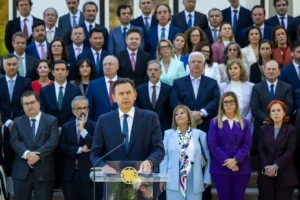
At a formal ceremony held at the Ajuda Palace in Lisbon, Montenegro and his 16-member cabinet were sworn in by President Marcelo Rebelo de Sousa, just 18 days after Aliança Democrática coalition (AD) secured a stronger parliamentary presence in early elections. Although falling short of an outright majority, AD emerged as the largest force in the assembly with 91 MPs — a gain of 11 seats compared to the previous year.
In his inaugural address, Prime Minister Luís Montenegro called for responsibility from everyone to ensure yet another government does not fall before completing its term. “Political stability is everyone’s responsibility,” he said, underlining the need for responsibility and maturity across the political spectrum.
He also thanked President Marcelo for his “impeccable cooperation” and vowed to maintain a “firm and loyal institutional relationship.”
The ‘new’ PM said that the May 18 election’s results show that “the people have decided to reinforce their confidence in the political project” of the AD coalition by giving it a “larger majority, with significant representation compared to the second and third political forces.”
Montenegro said he accepts this confidence with a “sense of responsibility” but also recognised the large numbers of voters who put their faith in the opposition parties, led for the first time by CHEGA, followed by the Socialist Party (PS).
“And it is with humility that we listen to and understand the confidence that has been placed in the opposition, which we will respect and listen to, seeking the convergence that the people demand,” he said.