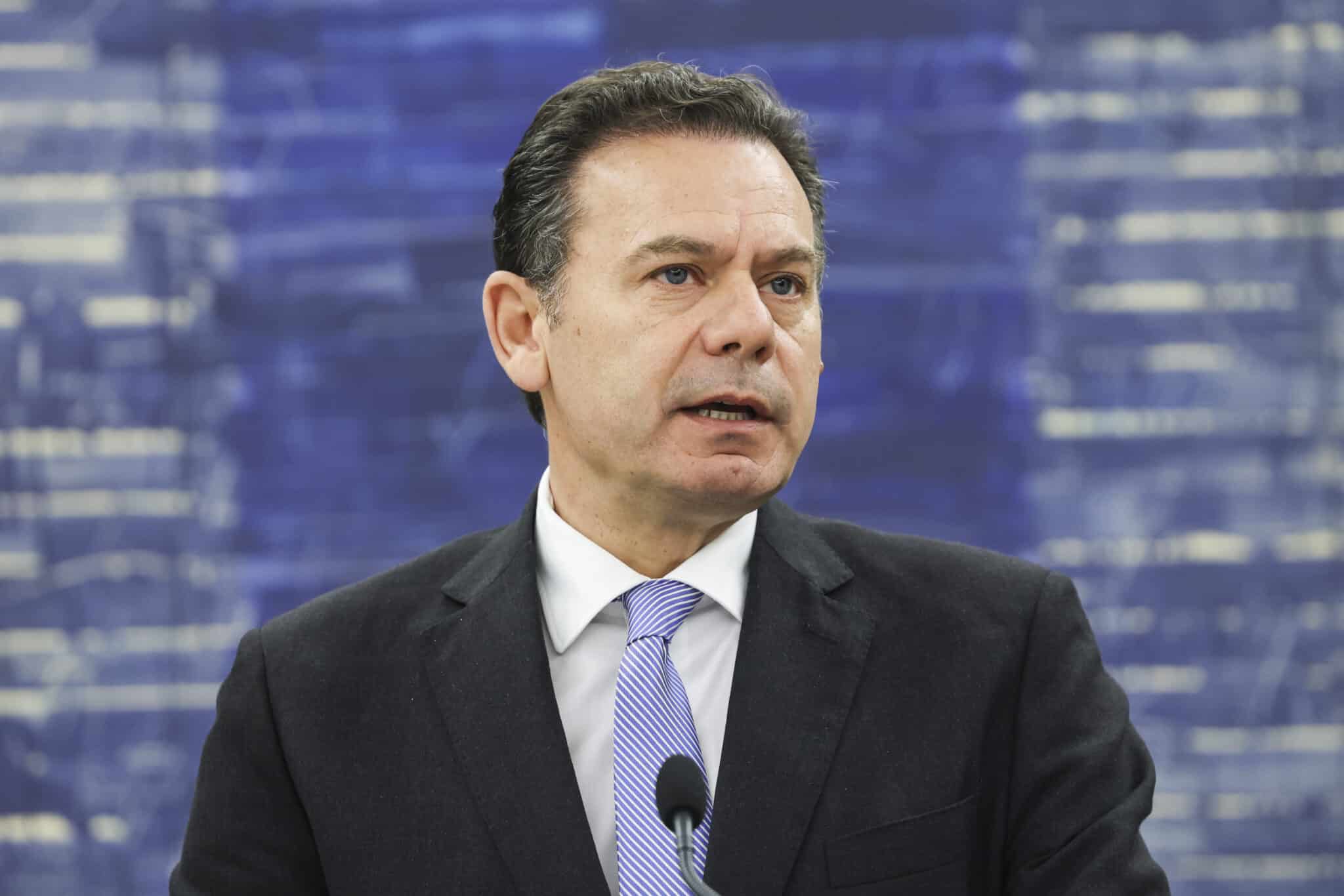
The Portuguese government has approved measures to combat rising fuel prices, driven by the ongoing conflict in the Middle East, at an estimated cost of €150 million per month, Prime Minister Luís Montenegro announced on Friday, March 27, after the weekly Council of Ministers meeting.
Montenegro described Portugal as being in the “Champions League” of European economic and financial stability on the day he unveiled the fuel support measures.
He also emphasised that “no intervention regarding VAT is on the table,” neither for fuel nor for essential food items. The PM reiterated this after Spain announced a VAT cut from 21% to 10% on petrol, diesel, electricity and gas (see below).
Discount on coloured/commercial diesel for farmers
The government will implement a 10-cent-per-litre discount on coloured/commercial diesel, a long-standing demand from farmers struggling with soaring prices. The subsidy, administered by IFAP – the Institute for the Financing of Agriculture and Fisheries – will apply in weeks where the average price is 10 cents higher than the level recorded during March 2-6, before the first price increase.
Extra support for commercial diesel
An additional 10-cent-per-litre subsidy will be provided for diesel used in goods transport and buses between April 1 and June 30. The PM described this as “an extraordinary mechanism for commercial diesel,” applied on top of the standard support, with a limit of 15,000 litres per eligible vehicle. The scheme covers goods vehicles over 35 tonnes and buses with more than 22 seats.
Fuel subsidies for fire brigades
Fire brigade associations will also receive a one-off subsidy to ease fuel costs. Heavy goods vehicles will be granted €360 each, equivalent to 10 cents per litre for 1,200 litres per month, while other vehicles will receive €120, corresponding to 10 cents per litre for 400 litres monthly.
Forecasted fuel price drop and continuation of tax rebates
The Ministry of Finance predicts a slight fall in fuel prices next week, between 1 and 2.5 cents per litre, and confirmed that the current tax rebate will remain in place. “Next week, a reduction in ISP rates of 7.6 cents per litre on road diesel and 4.1 cents per litre on unleaded petrol will continue,” the Ministry said. Including VAT, this corresponds to 9.4 cents on diesel and 5.1 cents per litre on petrol.
The Ministry of Finance is drawing on the tax cuts introduced by the PS in 2022 in response to the Ukraine conflict, which had not been fully reversed, to provide more substantial relief. With these measures, cumulative tax support totals 20.8 cents per litre for diesel and 19.3 cents per litre for petrol. In the case of Spain, impact is up to 40 cents per litre in tax support, something the Portuguese press is keen to highlight.
VAT intervention on food and fuel ruled out
Luís Montenegro confirmed that any additional measures to support households would not involve VAT reductions. He dismissed the reintroduction of “zero VAT” on the food basket, previously in place following inflation pressures from the Ukraine conflict, stating: “We do not see this as an appropriate measure.”
__________________________
How other countries in Europe are responding to energy pressures
Across Europe, governments are introducing measures to manage fuel costs and, in some cases, limit consumption. The closure of the Strait of Hormuz has prompted an urgent push to reduce oil and gas use, with strategies including remote working, replacing air travel with rail, and curbing unnecessary car journeys.
Countries are also deploying fiscal and regulatory tools to mitigate energy price impacts.
Spain has been one of the most active countries in introducing measures to mitigate the impact of the war. The country has released 11.5 million barrels from strategic reserves over 90 days, cut VAT on petrol, diesel, electricity, and gas to around 10%, lowered other energy taxes, and offered subsidies of approximately 20 cents per litre for sectors heavily affected, such as transport, agriculture, and fisheries. Social protections, including a ban on power cuts for vulnerable households, have also been introduced.
Ireland has implemented a €250 million plan to cushion rising energy costs, reducing diesel tax by 20 cents per litre and petrol by 15 cents until the end of May. Measures include a fuel subsidy extension for around half a million households and a tax refund scheme for road hauliers.
In Germany, the government aims to restrict petrol stations to one price adjustment per day, though legal enforcement mechanisms remain under discussion.
Austria plans to allow a maximum of three price increases per week at petrol stations and will redistribute any windfall tax revenue to consumers.
Greece has introduced a cap on profit margins for fuel, food, and essential goods over the next three months. Fuel distributors cannot mark up prices by more than €0.05 per litre above refinery costs, and petrol stations are limited to a €0.12-per-litre margin, a measure that has sparked controversy.
In Italy, Giorgia Meloni’s government, facing a poorly timed energy crisis, has opted to pass on to consumers the rise in revenue from taxes on fossil fuels. It has promised to monitor excessive profits for as long as the crisis lasts.
In France, Prime Minister Sébastien Lecornu announced that the French Fraud Prevention Agency (DGCCRF) would inspect petrol stations nationwide. Critics immediately accused him of trying to downplay the issue, pointing out that the government has no financial leeway in the unapproved State Budget to reduce fuel taxes or freeze prices.
In the UK, the government has cut fuel taxes until at least September, cancelled planned inflation-linked price rises, and introduced a temporary cap on energy bills until June. Additional measures, not yet in effect, include fuel rationing, prioritising essential services, and restrictions on petrol station opening hours.
In Hungary, heavily reliant on Russian oil, Viktor Orbán’s government, facing a challenging parliamentary election in two weeks, is encouraging teleworking, public transport, and car-sharing, and may impose restrictions on car use in cities.