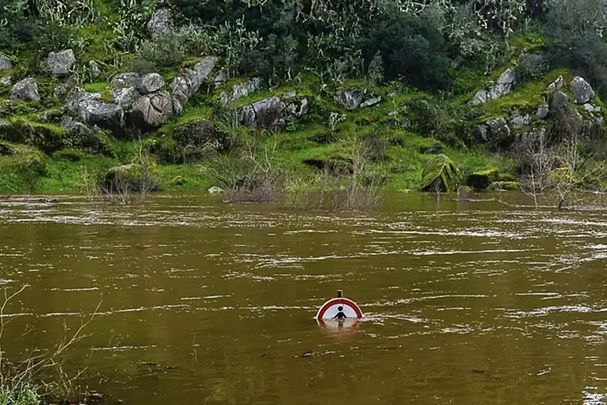
The flow rate of the Tejo River rose again during last night in Almourol, exceeding 6,000 m3/s, and could approach 7,000 on today, with the red alert and requirement for maximum attention remaining in place for the next 48 hours.
Sub-regional commander of Civil Protection for Médio Tejo, David Lobato tells Lusa: “The flow rates increased during the night and at the moment the total being discharged by the three dams upstream of Almourol station is 6,500 cubic metres per second (m3/s) and, at the moment, in Almourol, something like 6,200 cubic metres per second are passing through.
“It is expected to continue to rise a little here, not to the figures we had last week, but figures very close to that,” he added, pointing to persistent rain and the “very full” dams in Portugal and Spain (where the Tejo begins) as contributing factors.
At 7am today, the Almourol hydrometric station recorded a flow of 6,114.45 m3/s, significantly above the 4,836.61 m3/s measured at the same time the previous morning.
According to operational information, discharges from upstream dams amounted to 1,125 m3/s in Castelo de Bode, 496 m3/s in Pracana and 4,786 m3/s in Fratel, for a total of 6,407 m3/s, figures that were not yet fully reflected in the measurement at Almourol due to the time lag in the propagation of water in the river.
The maximum figure recorded for flows reached around 8,600 m3/s on February 5.
Although authorities “do not anticipate” that this level will be matched today, they acknowledge that figures could come close.
Manuel Jorge Valamatos, Mayor of Abrantes and district head of Civil Protection in Santarém, admits “the situation is worrying; river levels are very high and the streams are very full, the land is very flooded”.
“The outlook is that the next 48 hours will be very difficult and require maximum attention – not least because of the rain that is set to continue.”
Water levels are likely to remain very high – with repercussions for Lezíria do Tejo (the intermunicipal community in the ‘centre-oeste’ region) , which is already highly flooded.
The Special Emergency Plan for Floods in the Tejo basin remains on high alert, with several roads cut or restricted due to flooding and landslides, at a time when the soil remains saturated by persistent rainfall.
Conditions everywhere should be improving by Saturday – when the pressure of rainfall will ‘disappear’ and river flows will slowly return to ‘normal’.
The problem with this scenario is that an improvement in the weather will not necessarily bring an end to the dramas: landslides/ road collapses being dangers that will remain for quite some time (which is why the government has instructed the national laboratory of civil engineers to undertake an audit of critical infrastructure).
Coimbra mayor Ana Abrunhosa is only to aware of the dangers ‘lurking in plain sight’. She told RTP this week: “I am truly worried about safety (…) Coimbra and many municipalities have very serious problems on roads, on bridges. They may not be visible, but they are every bit as serious.”
Source: LUSA/ RTP