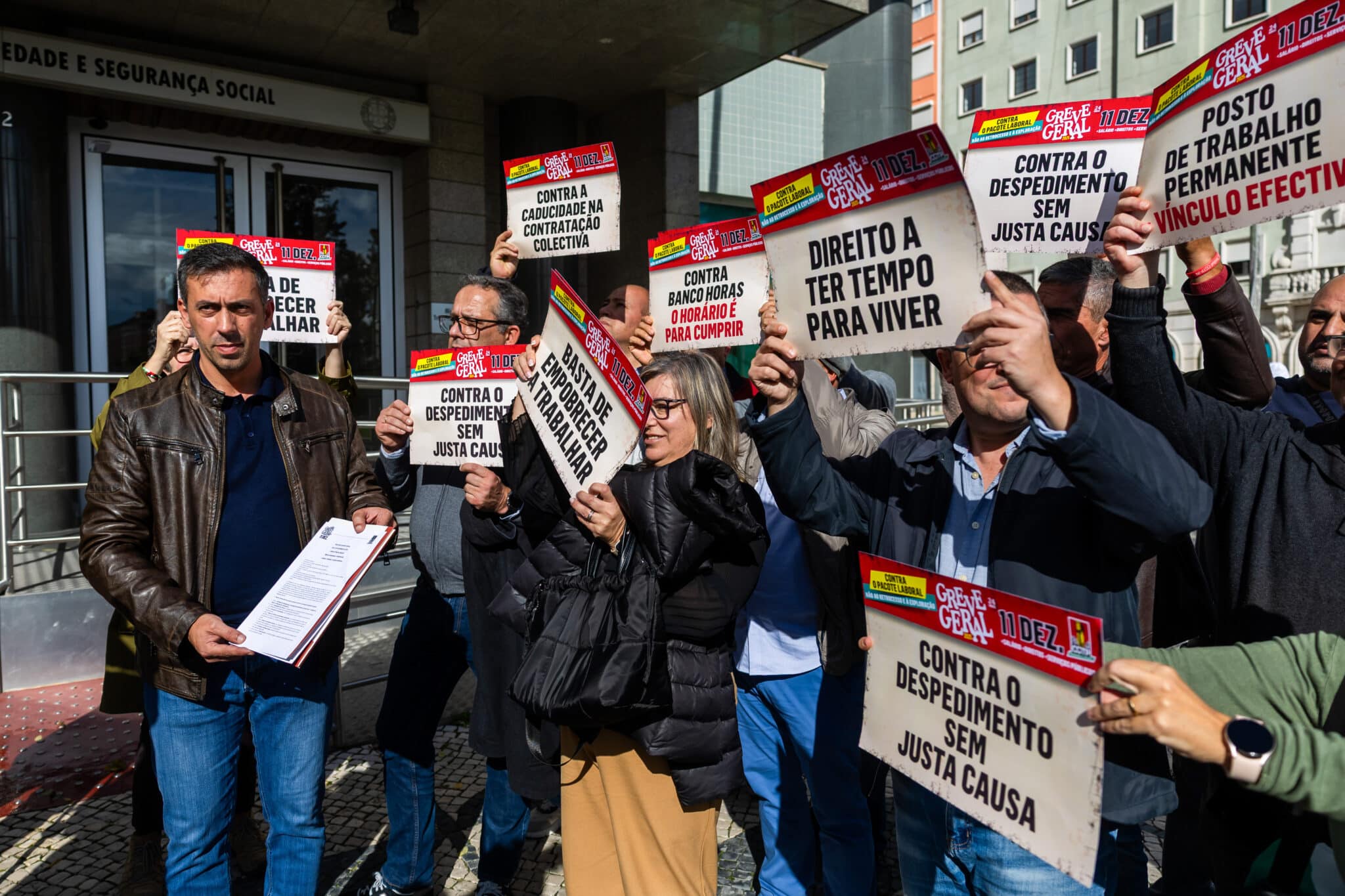
Unless things radically change in the next three weeks, Portugal is on course for the first general strike in 12 years, scheduled for Thursday, December 11 – but very likely to spill over into the Friday as well.
Backed by the two main syndical bodies – the communist-backed CGTP and the more centre-left UGT – the call for a nationwide stoppage has been busily gathering support from various walks of the public sector.
The reason? The government’s ‘profound labour reforms’ presented in the summer: a draft package involving more than 100 measures which the minister of labour promised would be discussed with social partners, but which hasn’t moved in the way unions would like.
As Expresso pointed out earlier this month, “the latest meetings of the Permanent Social Dialogue Committee (CPCS), scheduled to discuss improvements to the government’s proposal, have been repeatedly postponed, with no meeting on the subject scheduled for November. The Executive has been holding bilateral meetings with employers’ confederations and trade union structures” – and these have not been going well.
Thus, the scheduling of December 11 for ‘nationwide paralysis’.
Prime minister Luís Montenegro has already insisted there is no need for any of this. Indeed, he began by trying to suggest that the threat of a general strike was much more a political stand as the CGTP is aligned with PCP communists.
The attempt was soon deflected by support for the strike shown by UGT (the general workers’ union), known for its centre-left-leaning ideologies.
In this way, the government’s house of cards started to fall. Even the PSD choice for the country’s next President of the Republic is sounding warnings.
“This is a very delicate situation,” Luís Marques Mendes explained in an interview with TSF Rádio/Jornal de Notícias. “On the one hand, the government believes that labour legislation needs to be reviewed, and it has every right to do so. On the other hand, there are trade unions that believe in holding a general strike, and they too have every right to do so” (…) But authority cannot be confused with authoritarianism.”
If the government does not want to negotiate, “we run the risk of losing social peace”, warns the seasoned political thinker. And at such a difficult time geopolitically, the last thing a small country – already riven by social difficulties – needs is social unrest.
Memories may be short, but the days of rioting that followed the shooting of a Cape Verdean chef by PSP police last year received worldwide (negative) exposure. Marques Mendes clearly believes, general strike or not, the government needs to get off its high horse and start negotiating.
“We must ensure social peace (…) Modern governance is done in partnership. It is done with authority, but not with authoritarianism. It is done with a desire for reform, but not with imbalance. We must combat social imbalances, which are very large and very serious,” he said. “And this is done by mobilising everyone, not by pitting some against others.”
Marques Mendes’ comments came just as the wider media was running stories on the combined wealth of members of the AD government: this is an executive of very substantially well-off millionaires – and this too may be fuelling the perceived disconnect with the country’s wider population – the majority earning lacklustre wages.
As doctors and nurses announced their adherence to the general strike earlier this week, health minister Ana Paula Martins immediately said ‘minimum services’ would be demanded of them.
Again, it was a response that will have rankled: doctors and nurses know all about minimum services, and they have always provided them. The nub of their resentment of this minister/of this government is that their own suggestions for improving the parlous situation of SNS state health care are rarely even acknowledged – and they feel (rightly or wrongly) that this government is dismantling the SNS ‘from within’, “diluting the public sector and absolving the state of responsibility” (these last words from president of FNAM, the doctors’ federation, Joana Bordalo e Sá).
The more than 100 reforms
The changes set out in the government’s draft proposal — dubbed ‘Work XXI’ and presented in July as a ‘profound’ review of labour legislation — range from parenting (with changes proposed to parental leave/pregnancy bereavement) to flexible working, in-company training and trial periods for employment contracts.
The measures also provide for an extension of the sectors covered by minimum services in the event of a strike. This last point is particularly irking unions (CGTP especially, which suggests that some minimum services require its members to work a longer day than normal).
The problem with this strike is that the nitty-gritty of the government’s measures is not sufficiently well-known, or written about, to understand whether or not unions are sounding off in indignation over ‘worst case scenarios’ without cause. That is what happens when governments lose control of the narrative.
Tabloid Correio da Manhã is thus focused on bringing “a series of special articles on the proposed alterations” over the coming days.
In the meantime, it is clear that the call for a general strike is spilling over to the private sector. The ‘Mais Sindicato’ of banking employees has said that it sees the government’s plan as one that will “seriously prejudice banking staff” as it opens the door, says the union, to “cheaper, easier work”.
CM’s deputy editorial director and columnist Armando Esteves Pereira writes that, in his opinion, the government is planning “a revolution in labour legislation”, in which the Work Code, “traditionally defending the rights of workers, changes its philosophy and becomes a kind of commercial code governing the relationship between the employer and the employee.
“No government should be hostage of the CGTP, but the union structure needs to be heard, as UGT needs to be respected – and any changes to the labour laws should, at the very least, have the agreement of one central union.”
Far from this being a political fight orchestrated by the far left, it seems much more to be yet another case in which the centre-right AD government has sought to ‘run’ before it has mastered the art of walking.
The next few days will be pivotal. If the government can show it means to negotiate/cede ground and meet unions halfway, the country may be spared one, if not two days, of complete chaos.
December is already pitted with ‘days off’: December 1 (this year falling on a Monday); December 8 (ditto), December 24 (Christmas Eve, Wednesday, although officially not a bank holiday), December 25 (Christmas Day, Thursday) and December 31 (New Year’s Eve, Wednesday, followed by another day off, January 1, on the Thursday). To add December 11 (a Thursday) and 12 (the following Friday, being UGT’s suggestion) would well and truly hobble next month from the point of view of industry/production.