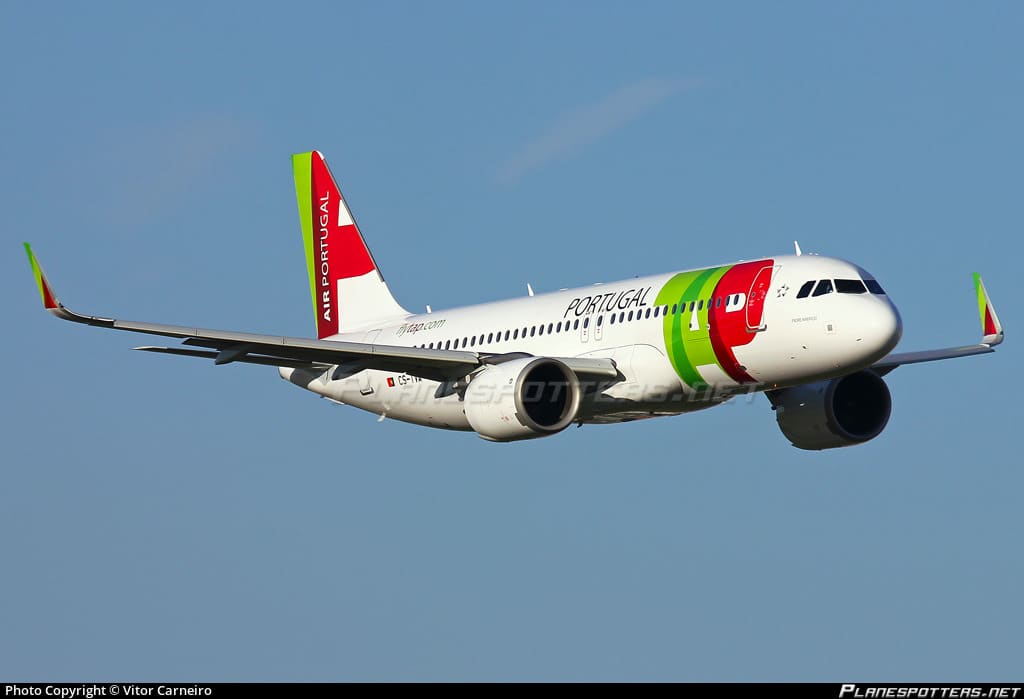
TAP Portugal has mounted an ‘internal investigation’ into an incident in which one of its Airbus 320neos allegedly came “30 seconds from crashing” at Prague’s Vaclav Havel Airport, in the Czech Republic.
The incident took place almost exactly a month ago – and local press reports at the time considered it “one of the most serious at Prague Airport in the last decade.”
According to Rádio Prague, the TAP Airbus had descended at high speed “to an altitude below that of minimum safety” as it approached the runway in extremely adverse weather conditions.
Indeed, Flight TP1240, from Lisbon, reached a point where it was only 300 metres from the ground, claims the local radio station.
Tragedy was only averted “thanks to a last minute climb manoeuvre executed by the pilot”.
Reports in the Portuguese press today explain that the ‘minimum safety altitude’ on approach is considered to be around 1,300 metres.
Thus, if the details forwarded by Czech authorities are correct, TAP’s plane was 1,000 metres closer to the ground than it should have been.
The moment of greatest danger apparently came over the ancient Křivoklát Castle (30 km west of Prague).
Today, an official source for TAP has said the airline – in the process of reprivatisation – is “investigating the situation internally, and collaborating entirely with the investigation of competent authorities in the Czech Republic”.
Rádio Renascença explains that air traffic controllers “sent alerts to the crew after radars detected the descent below 1,300 metres”. At the same time “the warning system of proximity to the ground sounded in the cockpit. As a result the pilots initiated an immediate climb to recover safe altitude”.
Once re-established, the plane effected another approach and landed without incidents. There were no injuries suffered on the plane, nor any damages.
According to Czech experts however, even in the situation of adverse weather conditions, this is something that should not have happened.
“It is unclear why the situation occurred”, pilot and university lecturer Jiří Hořínka in a statement to Zdopravy.cz. “The aircraft was traveling at high speed and had been descending for some time. Had the crew leveled off at 4,000 feet (1,290 meters) above ground level, they would have been able to stabilize the aircraft and land without any problems. Descending below the minimum sector altitude of 3,600 feet (1,097 meters) is a serious violation of regulations – and of common sense.”
Hořínka adds that the problem could have resulted from “an incorrectly selected autopilot mode or interference from a false signal from the Instrument Landing System (ILS)”.
Indeed, suspicions are that this may well have been another incidence of ‘foreign interference’ – along the same lines as the GPS blocking that affected a plane in which European Commission president Ursula Von der Leyen was travelling to Bulgaria last year.
Source: Rádio Renascença/ Rádio Prague