In January, the meeting in Davos of the World Economic Forum ended in gloom at the prospect of Trumpian policies resulting in world affairs being set under the control of a new global order composed of super-powers and immensely wealthy business corporations which could buy and sell weaker entities at will. Thus, the role of the UN as a regulator, negotiator and peacekeeper would end leaving such functions to the whims of an influential elite.
Mark Carney, one of the few statesmen among many politicians, pithily said: “Nostalgia is not a strategy.” However, we can learn from history by tracing the origins of rules-based order to ‘The Freedom of the Seas’, written in year 1609 by the Dutch jurist Hugo Grotius in response to a request from the Dutch East India Company (DEIC)
This Company had been created seven years earlier using similar procedures to that of a modern corporation and was granted privileged sovereign rights which enabled it to pursue its trading intentions by creating military forces and entering into treaties with foreign governments. It was very covetous of the Portuguese near monopoly which had been established in India, Malaysia and China and its formation had been provoked by the Macau incident.
This occurred in September 1601 when a Dutch flotilla arrived on the coast of China with a patent from the Prince of Orange which was intended to establish a trading post with the consent of the Ming Chinese authorities.
Two pinnaces sent on a peaceful reconnaissance were intercepted by the garrison of Portuguese Macau and the crews were imprisoned. After various interventions by Chinese diplomats were frustrated, the 20 Dutch men were taken to a dungeon where they were interrogated, tortured and then summarily executed.
Six were hung and 11 thrown into the sea with heavy stones attached to their bodies. Only the factor Martinus Apius and two 17-year-old cadets were spared and transported to Portuguese Malacca where sympathetic officials initiated an investigation and ordered their release.
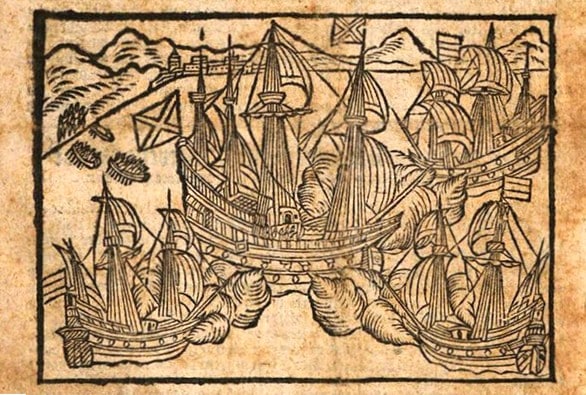
Upon being informed of the circumstances of the massacre, an incensed Admiral Jacob van Heemskerck led three warships of the DEIC’s fleet in search of revenge. On February 25, 1603, they encountered a heavily laden Portuguese merchant vessel, the Santa Catarina, riding at anchor off the coast of Singapore and swiftly forced capitulation.
To their joy, they found that the cargo consisted of treasures such as Ming porcelain, fine textiles including many bales of silk, spices and perfumes. Under escort, the ship was taken to Amsterdam where a week-long auction raised three million Guilders. As this was equivalent to one half of the paid-up share capital of the DEIC, the value of the booty had an immediate effect on the economy and caused the Company to ponder the legality of its action which had bordered upon piracy.
Consequently, Hugo Grotius was commissioned to give an opinion which would justify the capture of the Santa Catarina as an action of privateering at a time when the Kingdom of Portugal was in Union with Spain and thus an ally in the ongoing conflict between the latter and Holland.
The result was his monumental treatise ‘The Freedom of the Seas’, which consolidated the prevailing and often conflicting ideas about what constituted the laws of maritime warfare.
Grudgingly, the document was accepted by most European seafaring nations and set standards such as the extent of territorial waters, the protection and exchange of prisoners and how compensation for violations should be paid.
The Grotian tradition became the cornerstone of maritime law. It is for this reason that we should examine with urgency the nostalgia of which Mark Carney spoke and oppose the forthcoming New Order.
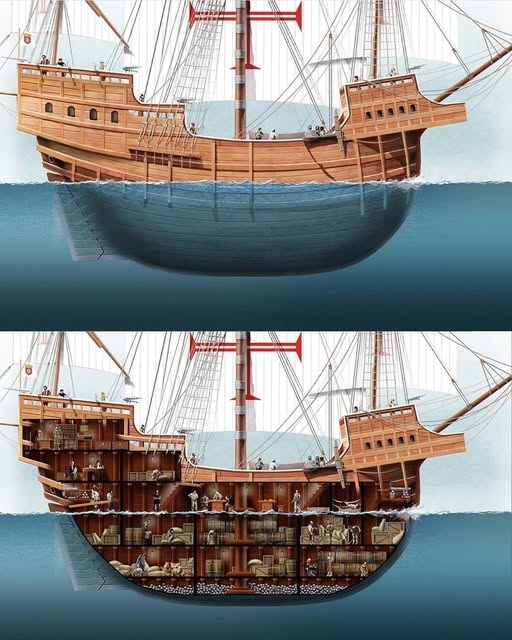
Note: The Portuguese carrack was probably the largest ship of the early 17th century. The Santa Catarina had a length of nearly 50m. With a full displacement of 1,500 tons, she drew about 7m. Atop of four continuous decks and large cargo hold were very high stern and fore castles which, being bulky, caused difficulty when maneuvering into the wind. At the time of the incident of 1603, she was thought to be carrying 900 souls: a crew of 300 sailors, about the same number of soldiers while women, children and native slaves made up the rest. Additionally, livestock were penned to supply the communal kitchens. Sanitation was primitive and potable water limited.