This, on the one hand, could be the opening sequence of a dystopian zombie movie. On the other, a true story where the man’s life-long obsession does indeed transform society, in the way he has dreamed of, for much of his life.
I’d be entertained by either scenario but am delighted to tell you that it’s the latter that is in fact real, and a story, years in gestation, that I want to share with you today, happening here in Portugal.
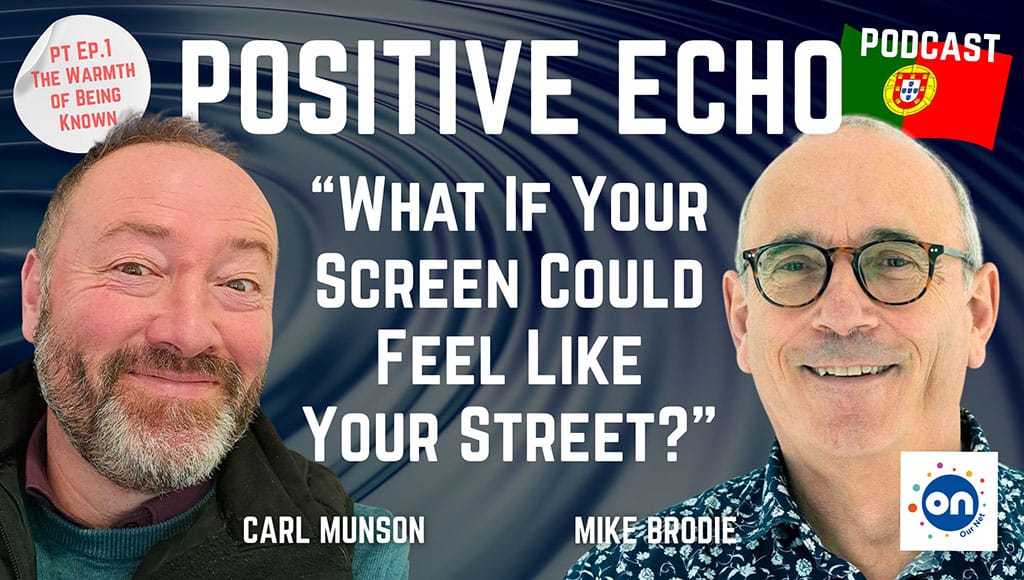
The man mentioned is Michael Brodie, a Brit now living here on the Silver Coast, who started his career in community architecture, was a positive change magazine publisher, and nearly 20 years ago became obsessed with creating an online platform that could facilitate “a world that works” (those words of Buckminster Fuller, who I’ve showcased previously).
In those early days, when the original internet was morphing into something described as ‘Web 2.0’, AKA social media with user-generated content and web-based communities, Mike saw how the technology might assist humanity, as well as having suspicions about its actual impact, which appears to have gone the way of all world-changing invention – financialisation, exploitation and polarisation.
His project, named early on as ‘OurNet’ (a pretty good clue as to its intentions), had me hooked a few years ago as soon as I first heard of its, and Mike’s, noble intentions, as did other descriptions like “virtual village”, “a place for conversations” and, more recently, “what if your screen could feel like your street?”, that all characterise this labour of love endeavour.
So, as a longtime fan, and well-wishing cheerleader, it was a delight to catch up with the man behind the mission and see what the AI turbo-charge had brought to the idea, after many years of relatively slow (and expensive) human, techie-dependent development.
Mike began, in last week’s Portugal-flavoured Positive Echo podcast, by reminding me of how the idea first came to him in 2008, when he chanced upon a thriving community forum in West London.
“We used this amazing website to find out what we’re going to do in the evening,” he recalled. “It looked horrible, very 1980s (like a bulletin board), yet it delivered exactly what people needed, before loneliness became epidemic, and before Facebook turned every opinion into a battlefield.
“This is my seventh go at launching OurNet,” Mike revealed, laughing, adding: “It’s always been the time for it, except for one thing; it’s taken me this long to grow into being the person that can actually make it happen.”
“So why now, and why here on the Silver Coast in Portugal?” I asked him, to which he responded: “This area is going to be involved in helping create a real, vibrant local community. A few little gremlins remain (in the software), so for now, it is restricted to the Silver Coast so that the team can learn in real time.”
On the surface, OurNet looks to the uninitiated like Facebook or other social media platforms that we are familiar with, with its groups, events, chats and posts, so I asked the elder entrepreneur what makes OurNet different.
“The whole basis of OurNet is that we completely switch to the user actually being in control. The user decides what they see, where they see it, and where they get their information from,” Mike responded, shifting attention to functionality over form, emphasising the idea of “contribution rather than confrontation”.
“Social media was built to sell attention to advertisers,” he continued. “OurNet flips the model. Success will be measured not in clicks or rage, but in a lively space that people can use to develop ideas, develop organisations, develop anything.” A noble pivot for sure, but how can Mike stop or undermine the toxicity we see everywhere else?
Throwing me, he said: “No user moderation, unless it’s illegal. We use a ‘reputation system’, thumbs up or down, and an article spreads (or not). Reputation is private (visible only to the user) but diminishes abusive spread, like real life.”
This is perhaps counter-intuitive, but brilliant when you dwell on it. When the “system is deliberately light”, Mike thinks the platform will reflect real villages or communities, and not highlight or promote algorithmic outrage. On that note, he reassuringly told me: “Our overlap of understanding is far far greater than our differences. Fights are sideshows rather than the central matter” for us humans.
Another phrase that characterises OurNet’s person-centredness and humanity is “the warmth of being known”, based, Mike says, on our psychological need to have other people around, our human need to communicate and exchange in a variety of ways. People do want to help.”
Pushing him for an angle on legacy and long-standing impact, I asked Mike what he hoped he and OurNet might be remembered for, and how – if all goes according to plan – this endeavour might transform humankind for the better.
“This is my hobby,” he shared, rather unexpectedly and modestly. “Creating a system that works for the people around me,” he went on, which is certainly a little different to collecting stamps, going for long walks or building a model railway. It seems this near-octogenarian, who struck up a deep and compelling conversation with AI, has a hobby capable of creating a huge impact.
He’s what we could call a ‘radical retiree’. And I hope for Mike, and for all of us, this will be seventh time lucky, touched positively by the oft-dreaded AI, which helped this OAP create computer code and build a social network by himself, in the home of healthy community, Portugal.
See for yourself and sign up (if you’re on the Silver Coast in the first wave of development) at ournet.news
Read Carl Munson’s previous article: Why would they do that?