Taboo is a funny word, isn’t it? Applied to all the areas of life that are arguably the most important and impactful for us, like sex, religion, money and, of course, death; all inevitable and intrinsic components, yet none quite so final as the last in that little list.
It can be hard when we hear of a death back home. The distant and remote loss, in its own right, is hard enough, and the intensity of feeling and sadness directly related to our level of familiarity or attachment. Then the funeral announcement and arrangements adding to the poignancy, having to make a judgement call about attending, which would, of course, be easier if we had not chosen to be miles away, when making life decisions less focused on such certainties.
The ‘Zoom’ ceremony, as pioneered in the Covid era, strangely helped with this awkwardness, allowing the far-flung at least a remote and truly socially-distanced connection. And it can still help, should the dearly departed’s loved ones consider it a useful and comforting option, which isn’t always the case, and completely understandable.
I found myself in this difficult position recently on the passing of my ex-Mother-in-Law, a wonderful woman, who I ultimately chose to pay my respects to in my own way, here – another way the expat might approach grief and the honouring of those who pass away, far away.
Truly, it is one of the most challenging parts of being ‘away’, and that’s just the aspect of death that is funerals as a foreigner. Worse still, for I suspect most of us, is the death of a loved one who is with us abroad, in what is, or was, our ‘new life’. Should it be you or I that is the one who passes, that burden will be borne by our nearest and dearest, an unenviable task in your native culture, let alone one where near-everything might be different, at the most desperate and difficult of times.
By way of some consolation, and dreading the worst of scenarios at this worst of times, great work has been done by Joy Goldman in Setúbal, and Amelie Sangmo in Caldas da Rainha. The former visionary and nettle-grasper of the two co-created a community of brave souls prepared to look at ‘Aging and Dying’, which the latter picked up and ran with, building on the practical and preparatory work, expanding it to ‘Living, Aging & Dying Well’.
Both groups are pleasantly popular and hugely helpful to anyone who wants to do the taboo talk, and ultimately minimise stress and suffering for those literally left in our wake.
Meanwhile, the gentle and supportive work of Rev. Em Mcgowan has, for some years, been developing in the background and online in the form of the Share and Care Portugal group, which was prompted by, and now honours mine and Em’s mutual friend ‘Debs’, who experienced the sudden death of her partner in Portugal, and died herself here, alerting and informing others to the need for greater knowledge and preparedness.
Em has remained a stalwart in the support of those grieving and struggling around death and dying in Portugal. More than just figuring out and decoding the ‘logistics’, which she certainly has, Em, AKA ‘Mamabear’, has also counselled the grief-stricken and supported some through the dying process, with great love, respect and dignity.
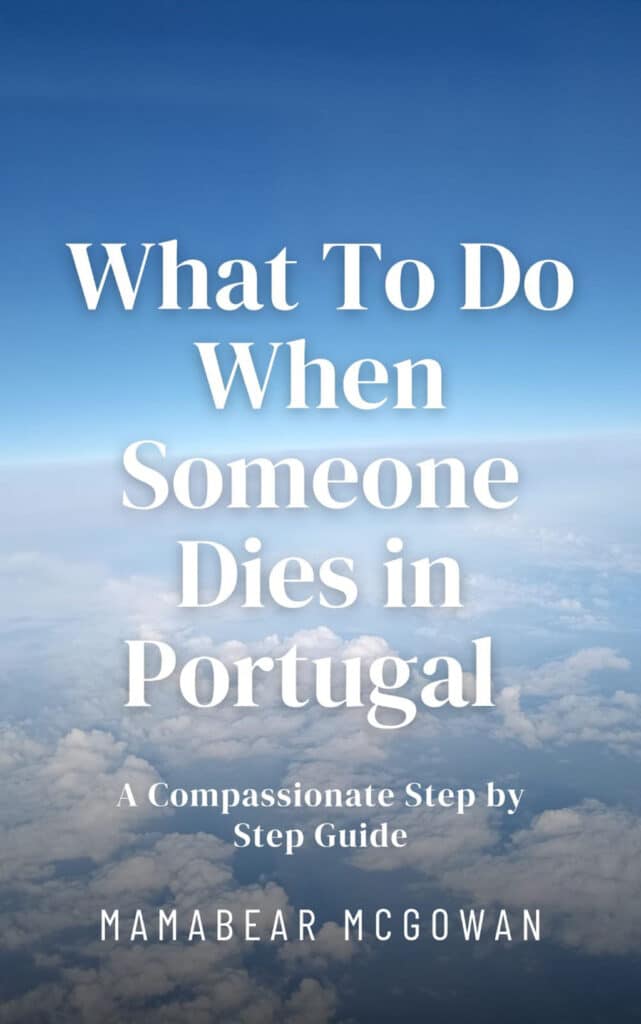
Her contribution to this part of life – death, and everything around it – is inspiring and important, and has recently culminated in the creation and publication of a book, What to Do When Someone Dies in Portugal.
She spoke to me recently about the book on my Good Morning Portugal! show and began by talking about her work as a ‘death doula’. “There’s the birth doula who births people into the world,” she explained, “and death doulas birth people out,” as well as caring for those around the human who is close to passing.
Inspired by working with a client, “Linda”, a few years ago and appalled by the way that a funeral director was trying to sell relatives an urn outside the crematorium, which she found “incredibly disrespectful”, Em set about explaining what can and might happen, such that foreigners and their families can have their last wishes and requests honoured.
“I’ve known many things like that, and this was the shove I needed,” she told me. “I have helped design and write funerals, helped design the order of service, and put all that together for an incredible send off.” From her experience working with the dying and their families in Portugal, Em wanted to crystallise it all into a book that can support the family in a way that she does in real life, but may not be able to do so, in some circumstances.
“This book holds you and talks you through (the process) and gives you the Portuguese words for what’s going to come up,” she added, urging us to be pro-active and clear about our wishes. “It helps you realise you’ve got a choice. It helps you find your own way, and you can create anything that honours a person in the best way possible.”
Em’s guide goes through every step from the moment of death to the viewing (velório); how you can donate your body to medical science; it explains all about funerals and cremations; care for the body; what to expect on the day of the funeral, and up to the wake.
“It takes you through all of that,” Em revealed, adding that people may think that the funeral is the end of the process, which it usually isn’t. “So, I take people through what they have to do: paperwork, different places they have to visit, all the different things they have to do, and the people they’ve got to see, and the (Portuguese) words that they might need to use.”
It’s also worth noting that whilst honouring the fact that this is predominantly Catholic country, Em also details how we can create a non-conventional ceremony in a respectful and least-stressful way. All in all, Em has created a masterwork on the subject, the final taboo, which is difficult to talk about, but usually worse to avoid, in the ‘end’.
It is available on Amazon and Em can be contacted via the ‘Creative Rootz’ Ministry (creativerootz.com) or Facebook (sharecarept)
Read Carl Munson’s previous article: Rebuilding hope (and maybe homes) through music