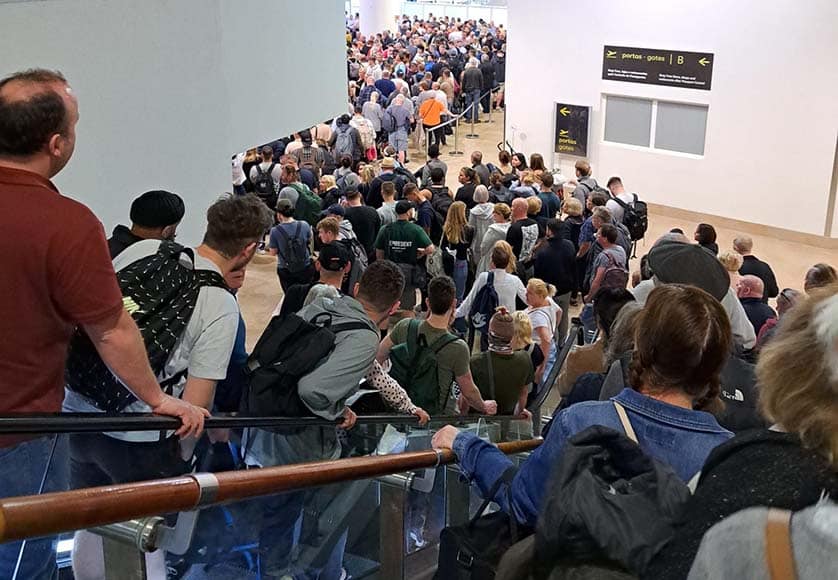
Portugal’s Internal Security System (SSI) “acknowledges that European border controls for non-EU citizens may be suspended during Christmas to avoid queues at airports”, trumpet reports today – following weeks and months of stories on the interminable bottlenecks caused by these newly-adopted controls.
SSI indicates that “there is a possibility of suspending the Entry/Exit System (EES) during the Christmas period”, writes Lusa – stressing that it is a decision that “will be taken according to the information received from Portuguese airports”.
This change to current policy was recently “authorised at European level by the European Commission due to constraints that have been observed in some European airports, given the need for more procedures in the EES registration process,” says the agency – ‘assuring’ that the decision to suspend (or not) EES will be taken “on a case-by-case basis and, if necessary, based on an assessment of the situation at each airport and without compromising border security.
“If there is no need to suspend EES, it means that there are no excessive waiting times to cross the border,” SSI adds helpfully.
The new European border control system for non-EU citizens was adopted in Portugal (and other Schengen Area countries) on October 12 – at which point snarl-ups for passengers, particularly those travelling through Lisbon, took on hideously unprecedented proportions.
The EU’s narrative was that this was all for our own good: Portugal (and the wider EU) would be eminently more secure from threats of terrorism; cross-border crime would be dealt a major blow – and as for ‘over-stayers’ (people who had been in the country longer than their visas allowed), these would be unceremonious exposed, and then dealt with (presumably harshly). The EES’ electronic recording – indicating date, time and border crossing – and the harvesting of biometric data were all crucial to the EU’s integrity ‘while at the same time fully respecting fundamental rights and data protection’.
The system’s mplementation however soon flagged the dreadful downsides: “worsened waiting times, particularly at Lisbon airport, with passengers sometimes having to wait several hours,” admits Lusa.
Even the creation of an emergency task force “to manage this crisis situation” failed to bring the necessary results. Indeed, secretary of state for infrastructures Hugo Espírito Santo recently admitted that “the situation at the borders is an embarrassment for the government. There is no other name for it.”
So, with luck now thanks to Brussels’ authorisation things may get a little better, if only for the festive season.
Or will they?
“SITUATION COULD BECOME EVEN MORE COMPLICATED FROM WEDNESDAY“
This is where the ‘possibility’ for suspending EES starts to make even more sense.
“The situation could become even more complicated with the implementation of the second phase of the EES, scheduled for next Wednesday,” explains Lusa today.
The dates of December 10, 2025 to January 10 2026 have been ‘determined by the European Commission’ as moments where biometric data “will have to be collected from 10% of passengers” crossing Portugal’s borders, explains the agency.
“The EES also requires each passenger to complete a travel questionnaire, and for areas outside the Schengen Area, the mobile application ‘Travel to Europe’ is planned, where pre-registration can be downloaded 36 hours before the trip so that the data can be stored centrally and used for border control”.
Lusa ends its report stressing that an assessment (by SSI) of the approximately two months since EES was adopted, shows that “globally” the system is “stable, reliable and robust, and has proven to meet the technical requirements for which it was developed (…) Since October 12 almost one million passengers have been registered on EES, making Portugal the EU country with the most registrations on this new system” (even if also the longest queues).
Source: LUSA