An international team of archaeologists led by a researcher from the Portuguese University of the Algarve have used techniques inspired by forensic science to reconstruct a story of adaptation and survival in the Arabian desert 100,000 years ago.
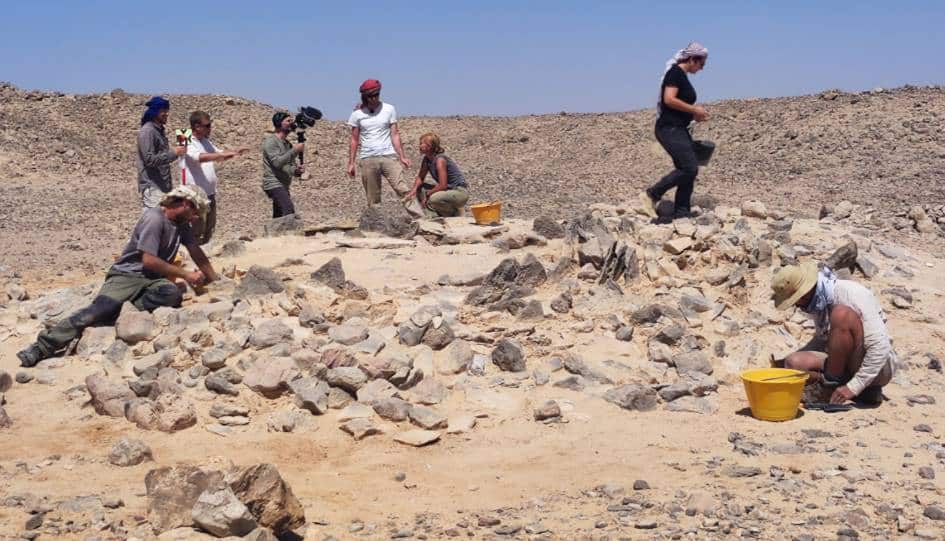
The team, led by Jeffrey Rose of the Interdisciplinary Centre for Archaeology and Evolution of Human Behaviour (ICArEHB) at the University of the Algarve, has identified hundreds of stone tool manufacturing sites in southern Oman over the past 15 years, a region that served as a crucial corridor for the early migrations of Homo sapiens.
Analysis of the environmental corrosion changes suffered by the tools over time has identified two distinct waves of migration, separated by thousands of years, the second of which stands out for a remarkable innovation: the creation of significantly smaller and more efficient stone tools during a period of severe drought in Arabia.
“We discovered a history that was literally scattered across the desert floor,” says Jeffrey Rose, lead author of the study, adding that the miniaturised tools “suggest a major leap in creativity and problem solving – and may represent one of the first examples of our species finding a way out of an environmental crisis.”
The team applied methods similar to those used in forensic investigation to study how desert conditions affect stone tools over millennia, a note published today reads.
“By observing the development of a mineral alteration on the surface of the artefacts called patination, it was possible to distinguish older artefacts from more recent ones, revealing two groups with radically different tool styles.”
Although both groups used African technology called “Nubian Levallois”, the first manufactured large, robust tools, while the second switched to smaller, more standardised implements.
According to the researchers, the set of miniaturised tools emerged during a period when climate records show that Arabia was becoming more arid, suggesting that these smaller stone points “could make weapons more effective in difficult times, requiring less raw material and offering greater accuracy and penetration capacity when hunting.”
However, this innovation does not appear in isolation, with similar trends towards miniaturisation emerging around the world during the same period, suggesting a broader shift in human problem-solving capabilities.
“Oman’s position along the Southern Dispersal Route, which many scientists believe was the route taken by early humans to leave Africa, makes this discovery a key piece in that global transformation,” says Rose.
The research, published this month in the Journal of Palaeolithic Archaeology, provides new insights into how our ancestors developed the behavioural flexibility that would later allow them to colonise diverse environments around the world.
The study involved researchers from institutions in Oman, Portugal, the Czech Republic, Ukraine, the United States and France, highlighting the international collaboration needed to unravel humanity’s prehistoric past.
LUSA