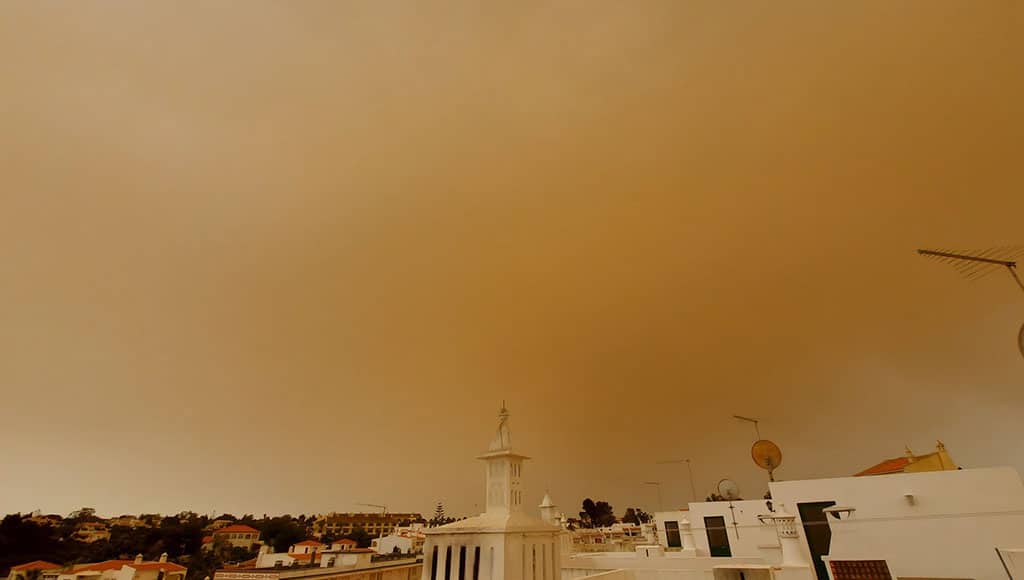
“Suspended dust”, as it is often referred to, is more common in spring and summer when high temperatures in North Africa favour winds capable of lifting large quantities of soil particles and transporting them over long distances.
A global perspective
It is a fact that around 3.8 billion people are affected by sand and dust storms around the world and that 25% of global dust emissions originate from human-related activities. More than 80% of the global dust is produced by North African and the Middle East deserts. That’s around 2,000 million tons of yearly emission of sand and dust, amounting to 307 Great Pyramids of Giza (source: World Meteorological Organisation).
The most significant dust sources globally are concentrated in arid and semi-arid regions, particularly major deserts such as the Sahara in Africa, the Gobi in Asia, and the Arabian Desert in the Middle East.
Sand and dust storm activity varies widely depending on geographical location, climate conditions, and local environmental factors. They originate from natural sources like deserts, dry lake beds, and coastal regions with loose sediment. Human activities exacerbate the problem through construction, agriculture, and poor land management practices that strip vegetation and expose soil to wind erosion. Climate change amplifies the occurrence of sand and dust storms by altering weather patterns and reducing vegetation cover.
Sand and dust storms are environmental and weather-related phenomena that affect nearly all countries across the world. Powerful winds can lift tiny dust particles high into the atmosphere and carry them thousands of kilometres across continents and oceans.
In countries within or near desert dust sources, sand and dust storms can seriously harm livestock, agriculture, and human health. Strong storms may also close roads and airports due to poor visibility and damaged infrastructure. They can also disrupt solar energy production.
Transportation of dust
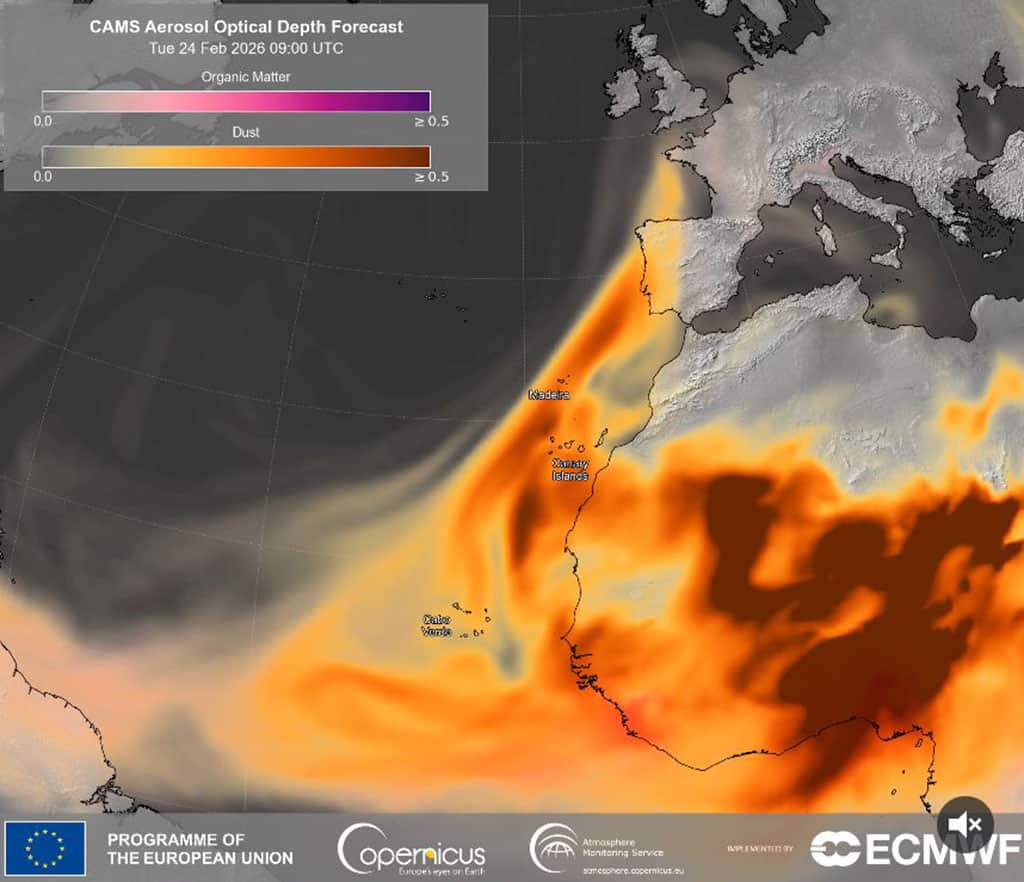
Dust plumes occur when strong winds whip up sand and other organic sediment from the deserts and send it into the troposphere – the lowest portion of the Earth’s atmosphere. This is transported towards the Caribbean following trade winds in the spring, summer and early autumn, when the Saharan air layer forms, crossing the Atlantic with very dry, dusty air masses.
Early spring is the most active period for Saharan dust transport into Europe. Whilst entering the Atlantic from North Africa, it can turn northwards and north-eastwards affecting Madeira, Canaries and mainland Portugal.
Around 180 million tons of Saharan dust are transported across the Atlantic each year.
Air quality – Particulate Matter (PM)
From the point of view of air quality, it has been demonstrated that African dust is the main particle source, contributing 35 to 50% of PM10 levels, with maximum contributions up to 80% of the total PM10 mass.
These sporadic but huge natural contributions of PM have been responsible for a high number of occasions the PM10 daily limit value (50 µg/m3) has been exceeded, according to the 2008/50/EC European Directive as registered in different rural and urban monitoring sites across the Mediterranean Basin, particularly in Portugal and in Spain.
This pollutant (inhalable particles — PM10) generally has some effects on human health, mainly on the most sensitive population, children and the elderly, whose healthcare should be redoubled during these situations.
According to the current European legislation, Directive 2008/50/EC of May 21, 2008, the limits for PM10 are 50 µg/m3 (daily average), which must not be exceeded more than 35 times a year. The WHO daily guideline values for PM10 are 45 µg/m3, respectively, not to be exceeded more than 3-4 days per year.
Dust – March 2022
An extreme event resulting in dust transport from the Saharan region to Portugal took place from the early morning of March 15 to the end of March 17, 2022, and was described as causing a considerable decrease in visibility and the appearance of an “orange sky”.
The dust was brought to Europe by Storm Celia, which caused a warm air mass from North Africa to reach Europe. Spain was especially affected by the dust cloud: the storm, which reached its peak between March 15 and March 16, 2022, with a PM10 reading of over 250 µg/m3 (five times over the European limit), was described by the Spanish State Meteorological Agency (AEMET) as “extraordinary” for its intensity and extent.
The suspended dust heavily impacted air quality in several areas, to the point that the residents in affected communities both in Portugal and Spain were advised by the local authorities to avoid staying outside for long periods of time. It has also impacted visibility in most of the country, affecting air travel.
The most recent – March 2026
Due to Storm Regina, an air mass originating from the deserts of North Africa, carrying suspended dust, is crossing mainland Portugal between March 3 and 5, 2026. Poor air quality is being experienced across parts of the mainland.
Mark Parrington, senior scientist at the Copernicus Atmosphere Monitoring Service (CAMS), stated that “a large-scale aerosol outflow into the North Atlantic is not uncommon at this time of year, with seasonal biomass burning in Equatorial Africa typically peaking between January and March, and Calima winds carrying dust from the Sahara across the ocean. The high intensity of this particular episode is significant, as our forecasts show a plume reaching northwestern Europe”.
Although most dust cloud transport occurs at higher altitudes, there was an increase in PM10 concentrations during Tuesday and Wednesday, with some deposition on cars, windows and solar panels during those days.
Health advice
The DGS (Directorate-General of Health) states that the particles, called PM10, are very small and can cause irritation to the eyes, nose and throat, coughing and worsening of respiratory diseases.
Although the predicted concentrations are not considered dangerous for the general population, children, the elderly, and people with respiratory or cardiovascular diseases may experience discomfort.
DGS recommendation is to avoid prolonged outdoor physical activity, reduce exposure to cigarette smoke, and, whenever possible, remain indoors during periods of higher dust levels. People with chronic illnesses should maintain their usual treatments and seek medical attention if their symptoms worsen.
Previous article by David Thomas: How well are we prepared for winter storms?