As Depression Leonardo begins to make itself felt across the country, a number of rivers and watercourses have ‘burst their banks’ – most notably in Oeiras (Ribeira da Laje) overnight, in conjunction with the high tide, where a number of parked cars were affected by the rising waters, but damage was otherwise limited as there are no homes in the immediate area.
As daylight broke, the situation in Oeiras was much calmer, while reports were coming in of weather-related incidents (including localised landslides) in various locations.
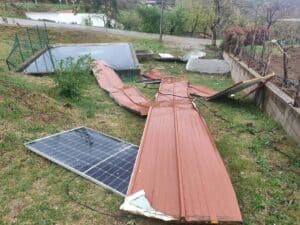
In Almada, a wall gave way from the pressure created by wet soil, burying parked vehicles under rubble.
Climate expert Duarte Costa told SIC last night that the levels of rain up till early morning are not the ones we should be worrying about. It is what is coming after: roughly ‘three days of rain’ in a period of 24-hours. “I would even dare to say that it hasn’t even started to rain yet,” he said.
Civil Protection is thus on ‘maximum alert’ for the next few days, warning that Leonardo’s arrival simply complicates an already “very complex meteorological situation”.
The Armed Forces report that they too have already positioned 42 boats and the boats respective teams in areas of Coimbra, Tancos and Águeda (all braced for possible flooding).
Support being laid on by the military includes teams for helping populations secure their homes, teams for clearing and cutting fallen trees, installations offering food and shelter to displaced families, as well as technical resources (generators/ waterpumps/ Starlink systems).
A press release adds that the Armed Forces also have six helicopters, one C-130 transport carrier and a fixed wing P3C plane available if necessary, stressing that “the Armed Forces reaffirm their permanent mission for the protection and well-being of citizens”.
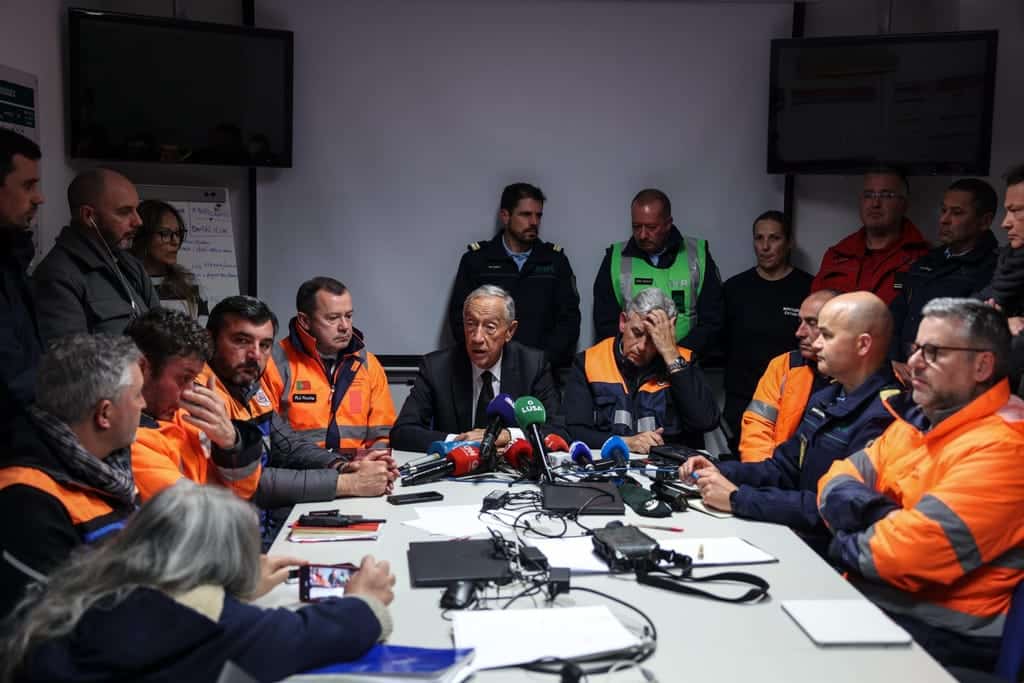
President Marcelo meantime has been at Civil Protection headquarters in Ourém (one of the areas badly affected during Storm Kristin), showing that he has some questions over the government’s action up till now. Indeed, he said a number of times that the government’s ‘explanations to populations did not go well’. “It is not that I’m saying the government was better or worse. There were things it did better, and things it did worse. In many cases, the explanation given to people did not go well, did not go well, did not go well,” he admitted, declining to say much further when questioned over the performance of the Minister of Interior Administration, who has been seen (again) to appear slightly on the wrong foot.
What is most needed, and much more quickly, is financial support for populations, said the president – meaning support coming ‘in days, not weeks’ – and he is clearly curious over decisions (albeit he accepts that it is the government that is in charge).
Marcelo explained, for example, that he queried why the government had chosen not to action the European Civil Protection Mechanism (the government’s response being that it could not have helped resolve the problems of telecommunications operators, nor of restoring electricity to the 69-plus municipalities in the centre). He told reporters that there is a lot to be said about an electrical grid that is supported by pylons that in many cases are over 50 years old. Improvements were made after the catastrophe of the 2017 fires, he said. “But even so, we cannot have such a long time to reposition normality”. (At the time of the President speaking, there were still over 100,000 households without electricity.)
Marcelo took the opportunity to stress that he believes an independent technical commission is needed to “evaluate response to depression Kristin”. It may conclude that Civil Protection needs more resources (human and other) placed in different areas of the country “to face situations of calamity” such as the current one, he added.
The president’s decision to travel to Ourém shows that even at this final stage of his mandate he sees it as very important to accompany what the government is doing, and how its decisions are working out ‘on the ground’.
As for the doubts over deadlines for PRR (recovery and resilience) money, Marcelo showed he too will be pushing for Brussels to revise deadlines in the context of Portugal’s current ‘calamity’.
Source material: LUSA/ SIC Notícias