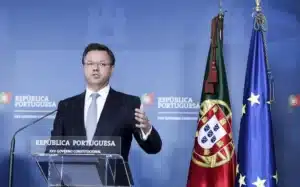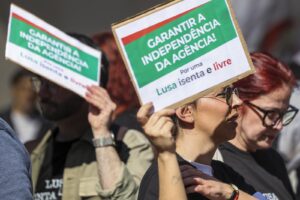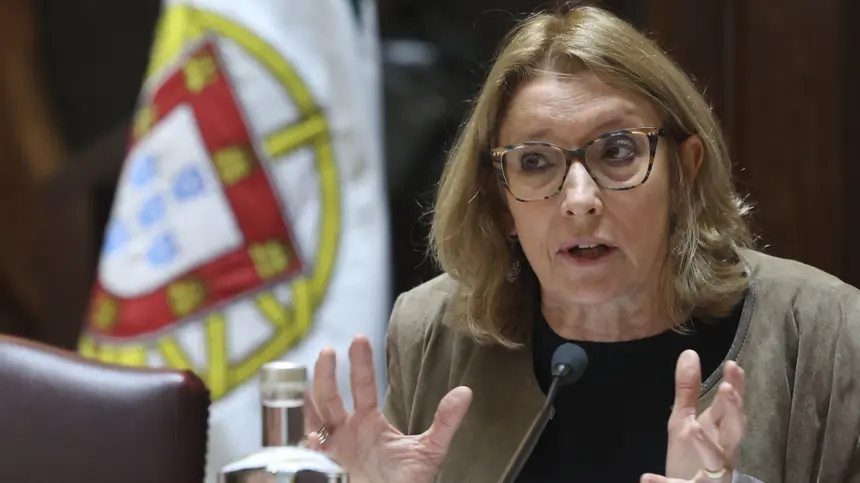
Portugal’s Minister of Labour, Solidarity and Social Security stated yesterday that the government rejects returning to “square one” in the reform of labour laws – and perpetuated the official narrative that adherence to the general strike had been completely overblown.
Showing ‘openness to contributions from the UGT’ (the general workers union with which she has agreed to meet on Tuesday) Rosário Ramalho told RTP Madeira that “official figures” for worker participation in the strike “do not correspond in any way to the figures put forward by the trade unions”.
“The government is obviously not willing to go back to square one because it presented this draft bill legitimised by the electoral programme, the government programme and even the tripartite agreement it signed last year with social partners – including with the UGT, which provided for us to review labour legislation,” she said.
The minister responsible argued that a series of very significant changes are at stake and that, therefore, it is technically impossible to start from scratch.
“Someone has to take the initiative. In this case, it was the government which presented it as a draft bill, and that is what is being debated, but with complete openness,” she added.
According to Rosário Ramalho, the draft bill is “a working basis and not a finished product”. It is a document for “building solutions, and the solutions are halfway there.
“We will have to bring parties closer together, but it has to be on both sides. The government has presented several proposals on the first ones – this draft bill. The UGT, so far, has not yet presented any proposals, but has agreed to study ours,” she said.
Rosário Ramalho stated that the government “never” interrupted negotiations; it was the UGT, “by deciding to call a (general) strike,” that “naturally” caused the suspension of the meetings.
The minister returned to the government mantra that the strike had “very little impact on the private sector (…) at company level”, and was essentially (yet another) strike by the public sector.
“But regardless of the figures, a general strike obviously always has a major impact. Not only because the sectors where it actually had the most participation are sectors that cause damage and have a greater impact on the economy – for example, if schools close, there is not only the problem of the school, but also the problem of parents who have to look after their children,” she acknowledged.
Rosário Ramalho added that the government always considered the (general) strike “inappropriate because negotiations are ongoing”, but it nonetheless ‘respected it’.
Her position is ‘all very well’ but the reality is that both PS Socialists and now CHEGA have spoken out against the government’s draft bill on labour reform, and thus if it isn’t radically altered before being presented for debate in parliament, the likelihood is that it will not pass (the AD government is still a minority executive that needs the support of at least one of the other two ‘main parties’).
Source: LUSA