
Portugal’s housing crisis is no longer a distant policy issue — it has become one of the country’s most urgent social challenges. Nowhere is this more visible than in the Algarve, a region long celebrated for its beauty, climate, and quality of life, but increasingly unaffordable for those who actually live and work there.
Demonstrations last Saturday, across 16 cities, including in Faro, reflect a growing frustration. On the square near the Doca, protesters gathered with signs and chants, calling attention to a simple but powerful reality: in one of Europe’s most desirable destinations, having a home is becoming a privilege rather than a right.
A region caught between lifestyle dream and living reality
For decades, Portugal — and especially the Algarve — was considered an affordable place to live. That reputation has fundamentally changed.
Today, the Algarve stands alongside Lisbon and Porto as one of the regions most affected by soaring housing costs. But unlike the major cities, the Algarve’s housing pressure is shaped not only by local demand, but also by international buyers, second-home owners, retirees, and short-term visitors.
This dual demand has created a distorted market: homes are no longer priced according to local incomes, but according to global purchasing power.
For many residents, especially those in essential professions such as healthcare, tourism, or education, this creates an impossible situation. Recent data from the international network of journalists Correctiv Europe show that, in the regions under the greatest pressure, workers in essential sectors have to spend between 50% and 90% of their income on housing costs. This figure far exceeds the 30% threshold considered affordable. Put simply: working, even in less precarious professions, no longer guarantees access to a decent standard of living.
The problem is not unique to Portugal. A European analysis based on the ESPON House4All project confirms that this crisis is widespread. However, in Portugal it is particularly acute: between 2012 and 2021, house prices rose by 78%, more than double the European average. By 2025, the country had the most overvalued property market in the European Union.
In practical terms, this means that working full-time no longer guarantees access to decent housing.
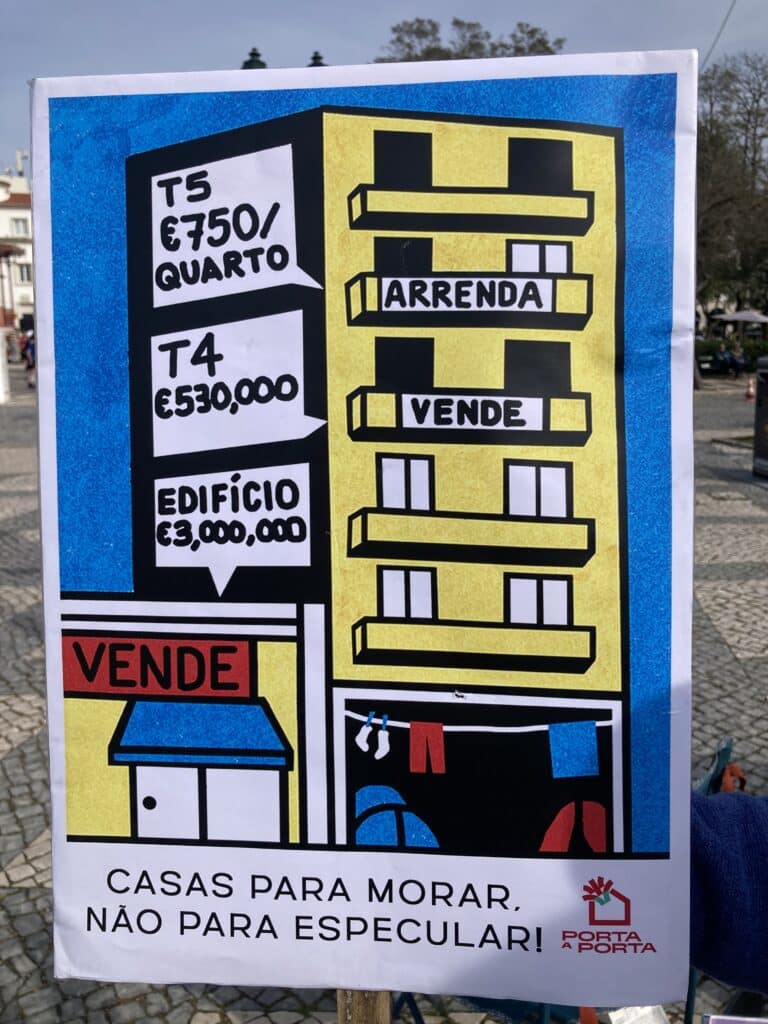
How the Algarve became a hotspot for housing pressure
The current situation did not emerge overnight. It is the result of overlapping economic and political developments.
Following the financial crisis, Portugal actively encouraged foreign investment. Programs such as the “Golden Visa” and tax incentives for foreign residents attracted significant international capital into the real estate market. The Algarve, with its climate and lifestyle appeal, became one of the primary destinations.
At the same time, tourism boomed. Short-term rentals expanded rapidly, turning many residential properties into holiday accommodation. In popular coastal areas, entire neighbourhoods shifted from long-term communities to seasonal, tourism-driven zones.
This transformation brought economic benefits — but also reduced the supply of long-term housing for local residents.
Compounding the issue is the lack of sufficient public housing and slow construction processes. While demand surged, supply failed to keep pace — particularly in the segment of affordable housing.
The hidden cost: a region that struggles to function
The consequences of this imbalance are becoming increasingly visible.
Young people are unable to leave their family homes. Workers in essential sectors are pushed further inland, commuting long distances to coastal workplaces. Businesses — including hotels and restaurants that depend on tourism — report growing difficulties in finding staff, not because there are no workers, but because there is nowhere affordable for them to live.
In a region that relies heavily on tourism, this creates a paradox: the very success of the Algarve as a destination is undermining its ability to function as a place to live.
Foreign demand: part of the problem, but not the whole story
It would be easy to blame foreign buyers and visitors alone, but the reality is more complex. International demand has undeniably driven prices upward, particularly in prime locations. However, it is not the sole cause. Structural issues — including limited housing supply, weak regulation, and insufficient public investment — have amplified the impact.
At the same time, foreign residents contribute significantly to the regional economy. Many invest, create businesses, and generate employment. The challenge, therefore, is not to reject international demand, but to regulate it and balance it with the needs of the local population.

Policy responses that miss the reality
Recent government measures have focused heavily on incentivizing private investment and increasing supply through market mechanisms. However, the definition of “affordable” used in these policies often fails to reflect local incomes.
Rents of up to €2,300 per month or construction thresholds of €660,000 are presented as “moderate,” yet remain far out of reach for the majority of residents in the Algarve (Editor’s note: these ceilings have been presented in key government bills aimed at tackling the housing crisis).
Even if such policies succeed in increasing the number of available homes, they are unlikely to address the core issue: affordability for ordinary people.
More concerning is the simultaneous push to accelerate evictions in cases of non-payment. In a context where housing costs are already overwhelming many households, this risks deepening social vulnerability rather than resolving it.
A right in theory, a privilege in practice
The Portuguese Constitution guarantees the right to adequate housing. Yet in regions like the Algarve, this right is increasingly theoretical.
For a growing number of people, the right to housing exists only on paper.
This raises a fundamental question: to what extent can a society still be considered fair when access to housing increasingly depends on high income — or simply luck?
Conclusion: continuing down this path will deepen the crisis
The warning signs are already clear. If nothing changes, the crisis will not only persist — it will deepen.
Continuing to rely almost exclusively on market-driven solutions, in a context of strong international demand and speculation, means ignoring the structural nature of the problem. Without more ambitious public intervention — including regulation, investment, and long-term policies — the gap between those who can afford housing and those who cannot, will continue to widen.
And this gap is not only economic. It is social, territorial — and ultimately, democratic.
Because a society in which a growing share of the population cannot access decent housing is a society that begins to fail at its very foundations.
By Michael Hagedorn
Retired consultant in international cooperation