Personally, I never tire of finding out more about Portugal’s rich and fascinating culture, a habit that came to the attention of a local bar and restaurant in my home town on the Silver Coast – Baía Cultural, who specialise in freshly-cooked, local specialities. They spotted me hosting a Portuguese wine-related quiz in another of the town’s bars and invited me to launch a weekly culture quiz aimed at local expats, which is now underway and hugely enjoyed.
Imagine yourself then, in the cosy embrace of a local Portuguese hostelry, grilled sardines in front of you and a lovely local glass of wine on hand, and let’s see how you get on with 10 questions from my repertoire that I hope will inform andentertain you. And by the way, here’s a quiz where you are allowed to use your phone, as it’s all about the fun of learning, more than beating your mates at the pub!
Question 1: Portugal has a new President, António José Seguro, who is 63, and hails from Penamacor, a small town in the Castelo Branco district near Spain. He is a long-time member of the Socialist Party, will be in the job for five years, and his net take-home monthly pay is thought to be around €6,000.
- What does ‘Seguro’ mean?

Question 2: The presidential palace, known as the ‘pink place’, overlooks the Tagus River, which is the longest river on the Iberian Peninsula, flowing through Spain and Portugal before finding its outlet into the Atlantic Ocean in Lisbon.
- What is the Tagus River better known as, especially by locals?
Question 3: The Ponte 25 de Abril bridge spans the river in question 2, an iconic Lisbon landmark whose construction began in 1962, finished in just 45 months. At inauguration, it was the fifth-longest suspension bridge in the world and the longest outside the United States. It is often compared to San Francisco’s Golden Gate due to similar design, colour, and the American engineering company involved. It also appeared in the James Bond film On Her Majesty’s Secret Service (1969).
- What was the bridge called before it was called ‘Ponte 25 de Abril’?
Question 4: The Bond movie On Her Majesty’s Secret Service was the sixth James Bond film, and starred George Lazenby as 007. The film has a strong connection to Portugal, with location filming taking place on Guincho beach near Cascais, in the Arrábida national park (where Diana Rigg is killed), and at the capital’s tourist hotspot, Praça do Rossio.
- But what is Portugal’s most outstanding connection to the Bond franchise and why?
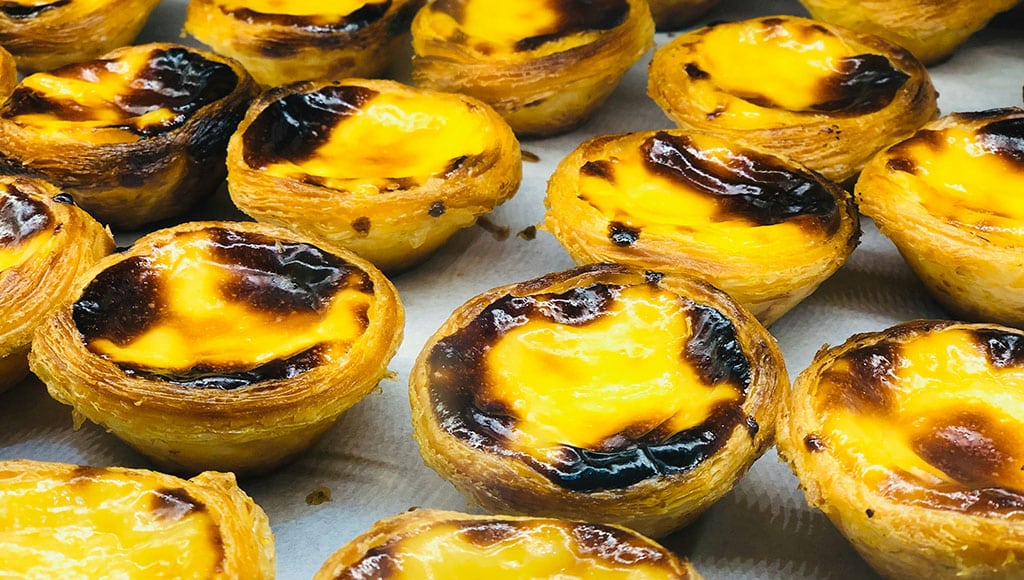
Question 5: The pastel de nata, Portugal’s world-famous egg custard tart, has a recipe that can be traced back to the Catholic monks at the Jerónimos Monastery in Belém, Lisbon, before the 18th century. In 1834, the Jerónimos Monastery closed, and the secret recipe was sold to a nearby sugar refinery who opened the famous Fábrica de Pastéis de Belém. Only a handful of people know the full recipe, which is kept in a secret room, and the shop produces over 20,000 tarts daily, served fresh with cinnamon. The tarts are baked at extremely high temperatures for a short time to create the iconic blistered, golden-brown spots on the custard’s surface, and the crisp, flaky puff pastry layers.
- But at what temperature?
- 400°F/200°C
- 800°F/425°C
- 1200°F/650°C
Question 6: Eggs are found throughout Portuguese cuisine. They’re poached in soups and açordas; fried on top of steaks, alheiras and francesinhas; boiled with fish and mixed into many beloved bacalhau (cod) dishes; as well as beaten with sugar and cinnamon in numerous desserts and sweets, which you have no doubt enjoyed.
- In which Portuguese dish might you find an unlaid egg?
Question 7: Portugal boasts an incredible diversity of grape varieties, with over 250 native castas, the highest density of indigenous grapes per square mile of any wine-producing country. Most wines are blends, but grape planting reflects tradition, regional styles and some international influences. Top 5 grape varietals in Portugal are typically ranked by planted vineyard area (hectares under vine), based on official statistics from official sources.
- Which of these is NOT a Portuguese grape variety?
- Tinta Roriz (also known as Aragonez or Tempranillo)
- Fernão Pires
- Cuecas (AKA Calção)
- Touriga Nacional
- Touriga Franca (AKA Touriga Francesa)
Question 8: You will be asked in Portuguese shops and supermarkets foryour ‘NIF number’, which for tax residents is a unique nine-digit Portuguese tax identification code, issued by the country’s finance department. Also known as the ‘Número de Contribuinte’, it serves like a Social Security number in other countries. Essential for nearly everything financial in Portugal, including opening a bank account, signing a rental contract, buying property, paying utilities, working legally, filing taxes, or handling any official financial and legal activity, it is a fiscal fact of life.
- What does ‘NIF’ stand for:
- Número de Identificação Finanças
- Número Inevitável para Faturas (Inevitable number for invoices)
- Nunca Ignoro Finanças (Never ignore finanças)
- Número de Identificação Fiscal
Question 9: Portuguese culture, like any other, is not without its superstitions, which include never placing bread upside down on the table, nor sweeping over someone’s feet with a broom or brush, and throwing salt over your shoulder when some is accidentally spilled.
- But why should you never leave your handbag on the floor in Portugal?
Question 10: Portugal is one of the oldest nations in Europe, coming into existence in 1139, with borders that have barely changed since 1297. It joined the European Union on January 1, 1986, and became a member of the Schengen Area on March 26, 1995. Its Escudo currency, meaning ‘shield’, was introduced after the Republican Revolution in 1910 and was subdivided into 100 ‘centavos’.
- When did Portugal replace the ‘Escudo’ with the Euro?
** See answers further down
Read Carl Munson’s previous article: Taking time in the age of AI

Answers:
Q1: Safe, secure (or even ‘insurance’)
Q2: The Tejo
Q3: The Salazar Bridge
Q4: Bond author Ian Fleming conceived the 007 idea whilst in Estoril, Portugal, during World War 2
Q5: b) 800°F/425°C
Q6: Portuguese chicken soup, known as ‘canja’
Q7: c) ‘Cuecas’ (which means underpants, in Portuguese)
Q8: Leaving your purse or handbag on the floor leads to poverty
Q9: d) Número de Identificação Fiscal
Q10: January 1, 1999