… while country has over half a million requests for nationality ‘pending’
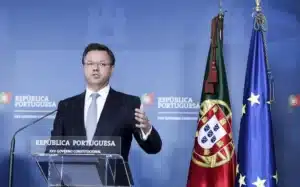
With parliament already in debate on the government’s legal changes to immigration/ nationality laws today, minister for the presidency António Leitão Amaro has described a backlog of over half a million requests for nationality pending – only 15% of which refer to Portuguese nationals born abroad.
Opening the debate this morning, he explained that “last year, requests for naturalisation of foreigners based on residence increased five times compared to 2015”. In comparison for numbers in 2021, requests tripled.
Today, authorities “have 512,000 pending applications for nationality”, he said – which Expresso adds are fairly evenly split between ‘descendants of Sephardic Jews’, descendants of Portuguese nationals and people from the Indian subcontinent.
As to foreigners who have already succeeded in getting nationality, Expresso reports that 40% of them are in fact Israelis – while 60% of new nationals “live outside the country”.
This supplies an explanation as to why seven Portuguese nationals’ killed in last month’s plane crash in India had apparently never even set foot in this country: the immigration system as it stands is open to manipulation, and has “given the impression externally that Portuguese nationality is something that is easy to obtain”.
As Expresso summarises the 60-pages of the government’s proposal to alter the Nationality Law, the current situation has “made Portugal a point of passage” to Europe. People get Portuguese nationality, and are then able to settle anywhere within the European Union.
Today’s debate will centre on the consequences for the country of this new wave of immigration that has “had a completely destructuring effect” on the services constructed to deal with them (see below).
Expresso refers to statistics from INE (national statistics institute), which show that “in reality, 60% (of foreign citizens who acquire Portuguese nationality) live outside the country.
“In 2023 – the latest data available – 41,393 foreigners received a Portuguese passport, and of these 24,408 reside abroad. One can get an idea of the weight of Sephardic Jews among the new Portuguese when Israelis were the nationality with most acquisitions: 16,377, which corresponds to 40% of the total.
In the last five years, 73,449, Israelis received Portuguese nationality under the special ‘amnesty’ that has since been terminated (due to perceptions that even this was being ‘manipulated’).
If the government gets its way, and is able to tighten controls as it has outlined, Portugal will join a small group of European countries that have acted similarly: Italy, Spain Austria, Slovenia, Latvia and Lithuania have all increased the number of years foreign residents need to actually live in the country before qualifying for applying for nationality.
“Even so the debate about restricting access to nationality is the order of the day throughout Europe”, says Expresso. “Recently, Finland increased the minimum time (foreign residents must live in the country before requesting nationality) from five to eight years, and the same discussion is ongoing in Switzerland.
And even if the government’s proposals ‘pass through parliament’, there is still the question of the enormous backlog of requests and applications in registry offices up and down the country.
Right now, it can take up to four years to complete the nationality process, and these delays are growing, president of the syndicate of notary employees Arménio Maximino tells Expresso, as there has been a veritable ‘stampede’ by foreigners to put in applications before rules are tightened.
Constitutionalists slam government’s proposals
Constitutionalists are digging in their heels over a number of clauses in the government’s proposals.
A reasoned opinion signed by Jorge Miranda – considered the ‘father of the Portuguese Constitution’ – is being sent to President Marcelo and the various political parties represented in parliament.
One of the main sticking points is the fact that the government wants legal changes to be backdated to June 19 – the date on which the government’s programme was approved in parliament. This would mean that any application for nationality received after that date would have to comply with ‘the new rules’. The government has justified this decision on the fact that as soon as it revealed its strategy there was a ‘massive submission of nationality requests’ by people hoping to “benefit at the 11th hour from the highly permissive requirements of the outgoing legal regime”. But Miranda stresses the equivalent of ‘you cannot have your cake and eat it”. The government’s plan “frontally violates the prohibition of retroactive application”, he argues.
Other experts equally stress that just because the Nationality Law “has flawed measures”, this does not mean that they can be revoked.
There are a number of other moot points: the form in which the counting of years is to be applied (only after foreigners have received residency, which “can take years”, say constitutionalists) and the fact that nationals could lose their nationality if they commit serious crimes (murder/ high level corruption/ rape) – the experts argue that this could violate the principles of equality, proportionality and universality, by introducing a difference between Portugese by birth, who can never lose their nationality, and Portuguese by naturalisation.
Update: Debate set to move straight to ‘speciality phase’, without any voting today. Government stresses that it seeks ‘consensus and dialogue’ with parties of the opposition.
sources: Lusa/ Expresso