Vida Justa “has been prejudicing” people of shanty neighbourhood, “forbidding them talking to council“
The controversy over the demolition of ‘shanty homes’ constructed in the Bairro do Talude Militar, in Loures, has taken a number of sinister twists.
Mayor Ricardo Leão has gone on air (in a debate organised for Lisbon municipalities by SIC Notícias) to insist that not only is there a criminal network selling these homes to impoverished people (almost all of them originally from São Tomé e Príncipe or Cape Verde), but that ‘Vida Justa’, the self-described platform to give a voice to neighbourhoods, has actually been instrumentalising them, and so making their situations even worse.
Vida Justa has come out to refute Leão’s assertions – but like so much that goes on under a media spotlight these days, there is a lot more to this story than originally explained. And, according to the mayor (who has the support of the government when it comes to dismantling illegal shanty developments), families still living among the detritus of the most recent demolitions are only doing so “because they want to”.
Loures council has “presented solutions to families who want a roof over their heads”, Leão told SIC – but influences like Vida Justa have seen to it that they are not taken up.
Yesterday, minister for infrastructure and housing Miguel Pinto Luz admitted that the government knows all about the ‘criminal network’ selling shacks in Loures.
“We have this knowledge because we are constantly in contact with the mayor”, he said.
This means the government is aware of the identity of the person believed to be selling the shacks for between €2,000 and €3,000, with guaranteed water and electricity (see below), but Miguel Pinto Luz stressed that the last thing the government wants is a return to the days of the 1980s when ‘shack developments’ (bairros de lata) proliferated through the capital.
The minister stressed this is a “multi-faceted issue”, with the Socialist mayor of Loures defending the municipality’s “legitimate interests” and “guaranteeing legality” as he cannot allow the “proliferation of these illegal constructions”.
All that said, “these people must be guaranteed a roof over their heads”, Pinto Luz stressed.
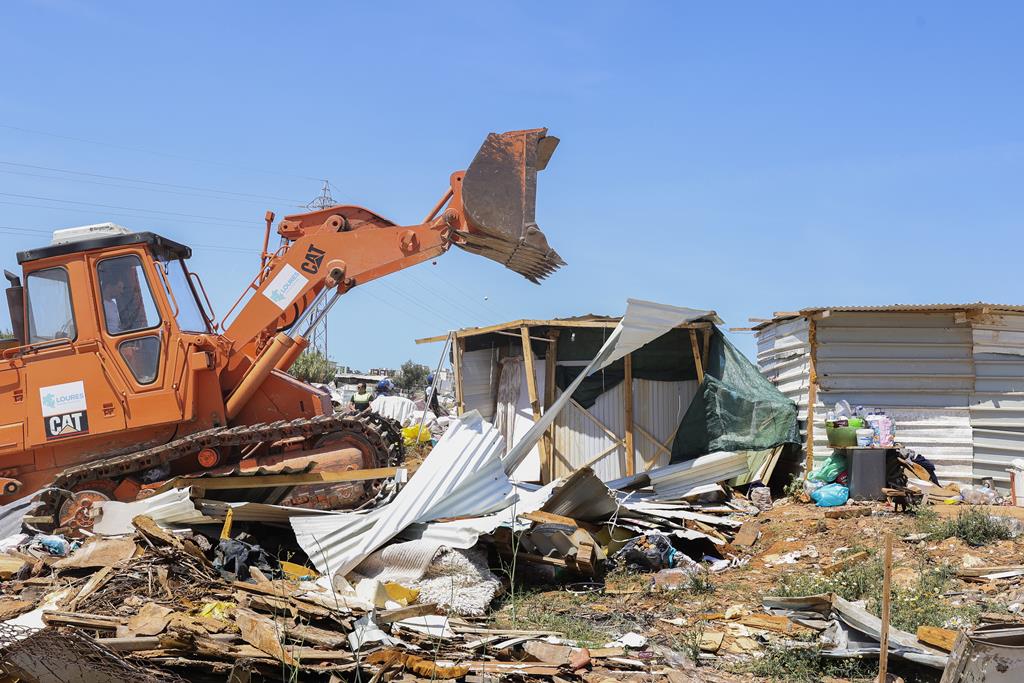
The demolitions in Bairro do Talude took place over a week ago, with roughly 55 constructions that had served as homes to 161 people demolished in the space of a day.
An embargo lodged by families through Vida Justa halted the destruction 24-hours later, meaning a handful of shacks still remain standing.
What appears to have happened since is that families rendered homeless have pitched tents on the site, or tried putting their shacks back together again.
As SIC Notícias has explained, Loures is not the only municipality grappling with this kind of crisis. With the costs of putting a roof over one’s head increasing all the time, families ‘living on the margins’ are resorting “more and more” to shanty developments. Just in the Greater Lisbon area, “there are almost 30”, says the news outlet “with thousands of people living in them. Councils organise demolitions, but as the base-line problem is left unsolved, many families end up returning and building new shacks”.
Homeowners near ‘bairro’ have had repeated electrical failings
The official complaint lodged by Loures mayor over ‘a criminal network’ selling shacks with guaranteed water and electricity sheds some light on the problems suffered by homeowners in the area around the Bairro do Talude. They have been telling SIC Notícias that since the neighbourhood started ‘spreading’, electrical failings have dogged their lives: lightbulbs flickering, failing internet, freezers not working. An investigation by SIC discovered a network of wiring in the undergrowth, leading to the Bairro, from a nearby electrical pylon. Ergo, the ‘guarantee of water and electricity’ appears to have involved appropriating these utilities, and taking so much in the way of power that it affected local supplies.
Source material: SIC Notícias/ Lusa