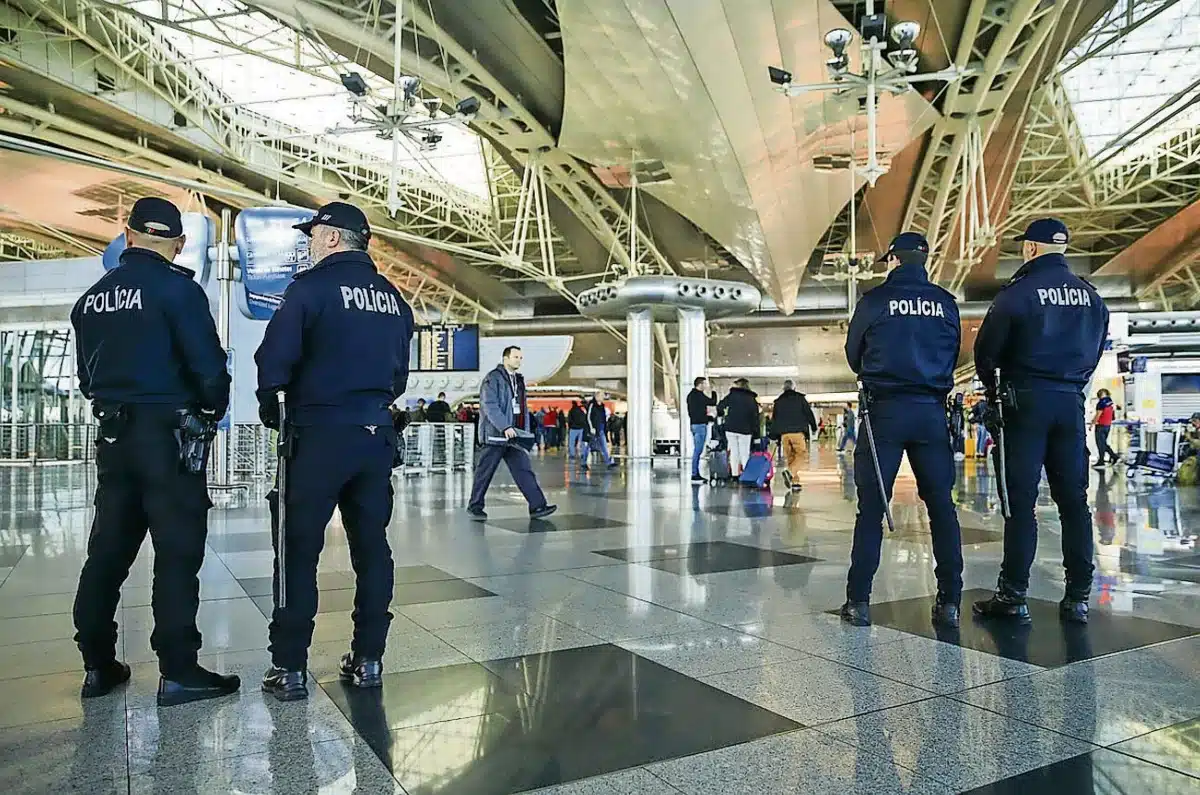
PJ inspectors from the former SEF (Foreigners and Borders Service) who are working for the PSP in air border control say they “refuse to remain at airports after October 29”.
The warning has been issued today by the inspectors’ union, SPIC-PJ.
“PJ inspectors from the former SEF do not accept being forced to remain at airport borders six months after the initially planned date of October 29,”’ says the union (initials of which stand for Union of Criminal Investigation Staff of the Judicial Police.)
In a statement sent to Lusa, the union says that the inspectors, who were supposed to return to the PJ and had already been notified to report to their respective units, “were surprised 11 days before (October 29) of the government’s new intention’ to extend their duties at airports for another six months”.
Many of the inspectors had already begun their moves to their new workplaces, says the union, adding that “if the government is not sensitive to the inspectors’ situation and insists on keeping them indiscriminately at the borders, it will be creating more tension in an area that is already troubled and jeopardise the social peace that PJ inspectors, in the name of national security, have always made a point of maintaining”.
When SEF was abolished on October 29, 2023, inspectors were transferred to the PJ, with 324 former SEF members remaining in the PSP on a ‘temporary functional assignment’ to control air borders.
This arrangement stipulated that inspectors would be gradually transferred to the PJ by October 29, 2025, but according to the PSP, 129 are still working at airports ‘due to certain constraints related to training, which requires Frontex-certified trainers, and the resources available for training and facilities’.
SPIC-PJ suspects that the ‘lack of human resources’ used to justify the government’s request for an extension to the inspectors’ orders is “a fallacy that reality completely belies” (again, for the 3rd time just today, we are hearing complaints that the government is distorting reality…)
Says Rui Paiva, president of SPIC-PJ, quoted in the statement: “There is no shortage of PSP resources for the borders. Many more officers have already been trained in border control than the number of inspectors with whom the now defunct SEF performed much broader functions.”
Paiva maintains that it is “totally incomprehensible that the three entities responsible for the borders – PSP, GNR and Internal Security System (SSI) – cannot find a way to ensure, among themselves, what the law requires of them and, two years later, continue to depend on almost 130 PJ inspectors to perform these functions”.
SPIC-PJ points out that “the real reason for this dependence on PJ elements is the fact that the PSP insists on committing vast human resources to criminal investigations that are legally the responsibility of the Judicial Police.”
“With this option, we have fallen into the paradox of having Judicial Police inspectors controlling borders at airports, which is the function of the PSP, while PSP agents continue to deal with situations of drug trafficking, human trafficking and document forgery, which are the responsibility of the PJ,” says Paiva, stressing that “the time has come for the government to realise that this is an organisational problem within the system, and not one of training or lack of resources on the part of the PSP”.
SPIC_PJ also points out that it has informed the government that there are “a reasonable number of inspectors willing to remain at the borders, an asset that can be put to good use”, but that it does not accept that “now, on the spur of the moment, under a false pretext of necessity, those who legitimately wish to perform duties in their own police force are being forced to continue to do what is the responsibility of the PSP”.
Source: LUSA