CARE, the group of environmentally conscious residents (foreign and nationals) in the Sotavento Algarve has a new appeal to people who value the region’s landscapes: a project known as Terra Ruiva, seeking to plaster the Serra do Caldeirão with 85,000 photovoltaic panels over 73 hectares of land rich in biodiversity, is ‘under public consultation’ until September 4, and needs addressing.
“Portugal’s wild spaces hold the key to the food, water and air we all depend on”, says the group. “Make your opposition known and insist that the Serra do Caldeirão remains a living landscape, not another sacrifice zone paved over by 100 football fields of solar glass”.
The issue with this so-called ‘scoping proposal’ is that authorities like the ICNF (Institute for the Conservation of Nature and Forests) / SPEA (the Portuguese society for the study of birds) have already attested to the “significant negative ecological impact” of a project that includes a 50 MWh battery storage unit and a new 60 kV power line.
“This project was deemed so ecologically sensitive that DGEG (Directorate-General for Energy and Geology) was forced to require a full Environmental Impact Assessment. Yet the scale remains staggering, converting what should be a protected ecological corridor into an industrial platform of solar glass and cabling spread across more than a hundred playing fields,” says the group.
“These local red flags echo concerns at the European level. A May 2024 report from the Öko-Institut, one of Europe’s most respected independent environmental research bodies, warns that Portugal’s Renewable Acceleration Areas (RAAs) – zones designated for fast-tracked renewable projects, are being advanced on a shaky foundation. Limited research capacity, outdated and incomplete data, poor public transparency and patchy policy enforcement all cast doubt on the credibility of the country’s energy transition strategy.
“A closer look at the data reveals just how deep these problems run. Land-use maps date from 2018, and there is no national inventory of previously used or degraded land such as old factories, petrol stations, or warehouses that could be cleaned and reused for renewables instead of consuming pristine landscapes.
“Without such a “brownfield” inventory, how can planners choose the least damaging sites?
“Ecological reserve data is missing for 77 municipalities. Public consultations are a sham, late, impossibly brief, poorly structured, and fall short of RED III’s early participation requirements.
“Despite legal obligations, no Strategic Environmental Assessment has been conducted for RAAs. How can good policy be made without reliable, up-to-date information? The Terra Ruiva lays bare this failure”, says today’s press release. “In the absence of robust screening tools, projects end up on biodiversity hotspots instead of degraded land, with consequences measured not just in hectares but in hundreds of football fields of destroyed habitat. Is this just a smokescreen to give a fundamentally underhanded approach some level of credibility?
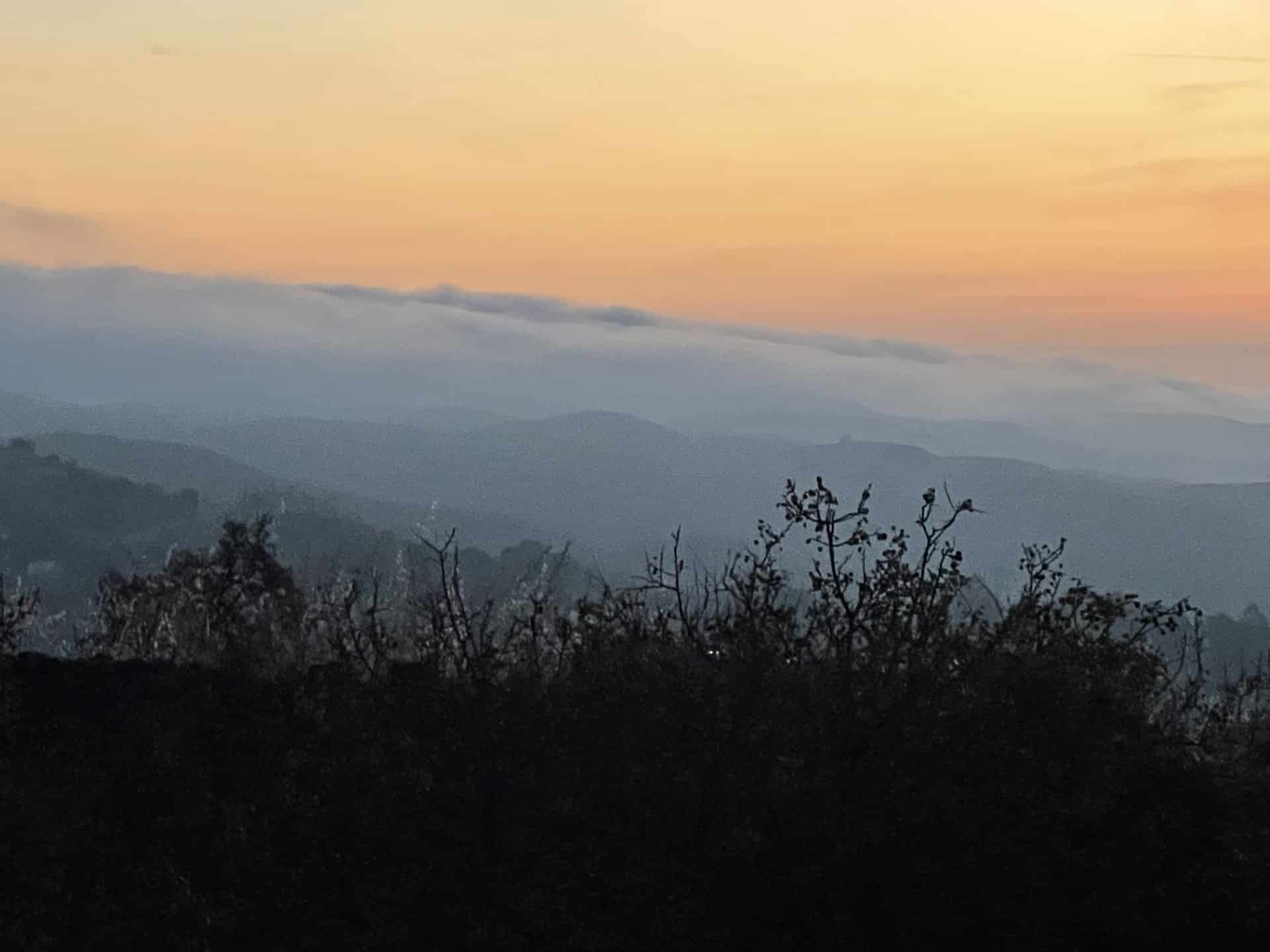
“These shortcomings are glaring in the case of the Serra do Caldeirão, a living cultural and ecological landscape alive with biodiversity, feeding key aquifers that sustain farming, wildlife, and communities far beyond the mountain range, and supposedly protected under the government’s Green Map but still targeted for large scale private wind and solar farm developments.
“When the Laboratory Nacional de Energia e Geologia (LNEG) published the Green Map on January 26, 2023, it designated 10,350 km² (12% of mainland Portugal) as “less environmentally and culturally sensitive” for renewable energy. In bureaucratic terms, this means land judged to have fewer legal, ecological, or heritage constraints, and therefore more likely to be approved for wind or solar projects with minimal extra studies or delays. But “less sensitive” does not mean without value. Outdated maps, incomplete data, and overlooked local knowledge can leave ecologically rich or culturally significant areas, like Terra Ruiva’s eagle habitats, exposed.
“In this context, a hundred football fields of solar panels in the Serra do Caldeirão illustrate a profound failure of planning and of a government neglecting its duty as custodian of the nation’s natural heritage.
The pressures on the Serra do Caldeirão are part of a much bigger picture, says the group.
“The dispute is not just about where wind turbines or solar panels go. It reflects deeper weaknesses in Portugal’s energy transition. Among them, a troubling reliance on assessments led or heavily influenced by consultants hired by the energy companies themselves.
“This lack of independent oversight compounds what the May 2024 Öko-Institut report identified as a systemic shortage of qualified, impartial experts guiding the process”, leaving rural communities to bear the brunt of large private industrial projects.
“Companies reap the profits while shifting the downsides, like drained or polluted water supplies, damaged land, and other social and environmental costs, onto local people.
“The result is a pattern where rural areas carry the harm, while the economic gains and energy flows benefit private investors. An issue highlighted in research such as Green, innovative, and unfair, which examines how the renewable energy transition can unintentionally deepen social and geographic inequalities. The study documents cases where rural and economically disadvantaged regions in Portugal shoulder the environmental and social costs of large-scale energy projects, from land degradation to water stress.
“Other studies of lithium mining in Portugal go further, documenting how such regions become “green sacrifice zones”, left with displacement, pollution and disruption while the electricity and money leave the community.
“The Serra do Caldeirão is one such sacrifice zone in the making (…) Officially marked for protection under the government’s Green Map, it is still being lined up for large-scale energy developments like Terra Ruiva.
“Terra Ruiva should be the line in the sand”, warns the group: the Serra do Caldeirão “is more than a backdrop for megawatts. It stores water, supports pollinators and stabilises climate risks”. Remove these natural values and “emissions rise, water falters, yields drop and fires spread faster…”
“This is why every voice matters now. The Terra Ruiva project is under public consultation while CARE’s campaign can be followed via Aware Algarve on Facebook, which promises “updates and guidance on how to take action”.
For those ‘new’ to environmental campaigns in the Algarve, a group of concerned residents, banded together under another association, was responsible for a major coup two years ago in halting another massive solar farm that would have spelled “catastrophe” for water catchment areas of the Sotavento Algarve.
Collectively people can make a difference.
Source material: CARE press release, to be found in full on Aware Algarve Facebook page