So, imagine my shock when I walked into a super swanky upmarket, seven-star hotel bar, and found the floor intentionally littered in debris! I mean, I had to physically stop myself from reporting it immediately to the law-and-order authorities.
It happened thus that my discovery of the Long Bar, at the Raffles Hotel Singapore, happened quite by chance. After dinner had been partaken of at the elegant Tiffin Room, I was pleasantly full and in no particular hurry. Therefore, I began wandering around the hotel, admiring the colonial corridors that seemed to belong to another century.
Presently, I spotted a wide wooden staircase, lining the walls of which were framed black-and-white photographs of old Singapore scenes – gentlemen in tropical suits and stylish ladies with parasols. I slowed down and, without quite planning to, found myself climbing the staircase.
Reaching the top, I was abruptly at the entrance of the Long Bar, the birthplace of the famous Singapore Sling. What greeted me was polished wood, high ceiling and bartenders who moved with the calm efficiency of people that know they are about to improve your evening considerably.
Suddenly, I glanced at the floor, and almost passed out, because it was completely covered in layer upon layer of peanut shells! The sight was so horrifying that I froze mid-step, fearing arrest, or at least an instant municipal fine.
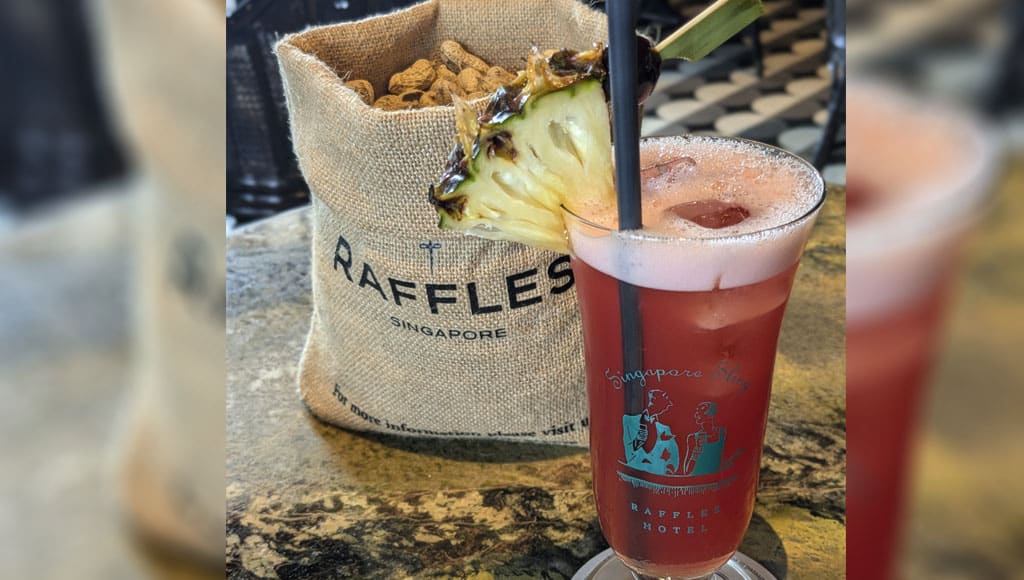
But surprisingly, chucking peanut shells all around seemed to be practically a civic duty here. On every table sat little gunny-bag-style sacks filled with peanuts, and the ritual was simple: crack open the shell, eat the peanut, and toss the remains on the floor.
Soon, I was participating enthusiastically because breaking the law in Singapore made me feel criminally brave somehow. In a most delightful way, I must add.
But the star of the show was the Singapore Sling, created in the early 20th century (1915) by bartender Ngiam Tong Boon. A pink, fruity cocktail that looked harmless (in order to allow women to consume alcohol discreetly), but was actually a mixture of gin, pineapple juice, cherry liqueur, and other mysterious ingredients, combined to produce something that tasted like tropical sunshine.
I took one sip and understood intuitively why everyone kept coming back, for this was a rite of passage for people arriving from every corner of the world. To photograph their Sling, savour it, and become a part of its legend.
Shortly, I struck up a conversation with the quietly watchful manager, Sivam, who had been holding fort for the past 18 years. In hospitality terms, it was roughly the equivalent of a medieval dynasty.
Sivam surveyed his peanut-strewn kingdom with the calm patience of someone who had seen every variety of tourist enthusiasm imaginable. Over nearly two decades, he had watched newlyweds, jet-lagged executives, nostalgic regulars and wide-eyed first-timers, all converge around the same pink drink.
“Why do so many people come here?” I asked Sivam.
“For its history, of course,” he answered charmingly.
“And?” I probed as he paused.
“You can tell me,” I prodded.
“And also to follow the ridiculous tradition,” he admitted.
“Of littering like this?” I giggled dropping one peanut-shell intentionally.
“Yup, and not getting arrested for it,” he laughed.
Read Nickunj Malik’s last month’s article: Past forward