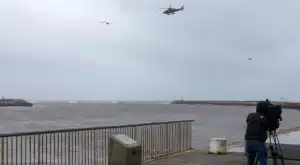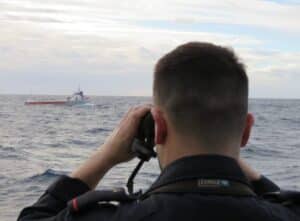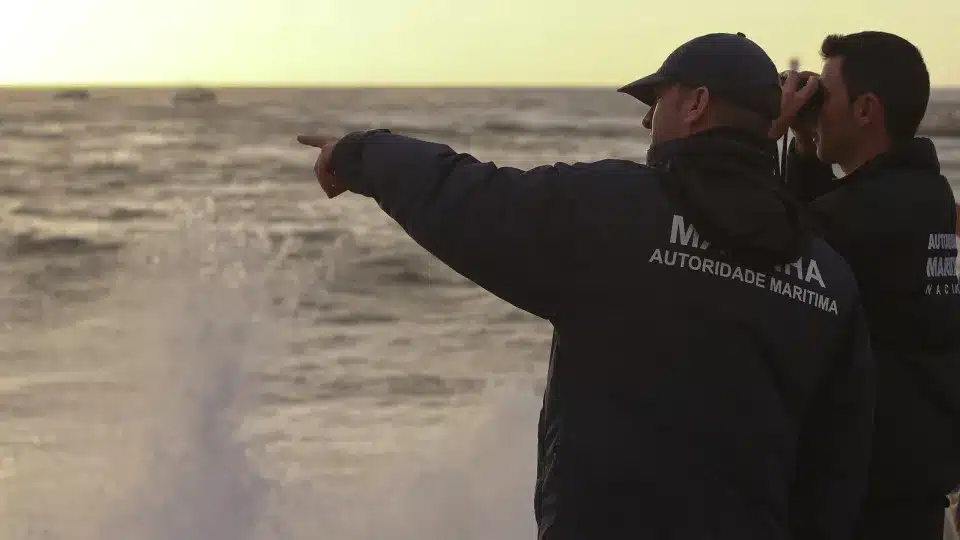
With a nail-biting rescue operation still underway off the coast of Figueira da Foz – where a cargo ship transporting 3,300 tonnes of cellulose pulp has been floundering for days – controversy has opened over Portugal’s abject failings when it comes to a network of rescue and emergency tug boats.
As the vice president of Figueira da Foz’s ports community, Paulo Mariano, said yesterday: “There are thousands of merchant ships that come to Portugal (…) around 4,000 every year, which is a huge number”. But if any of them run into trouble (similar to the issues suffered by the Eikborg this week), this country offers very little.
In Mariano’s opinion, a country that “was once a power at sea” and calls itself “Atlanticist” should have state owned rescue tugs that can be dispatched in emergencies.
“It should be the state, as in Spain” that acts – not, as is the case this week, a company from a different country entirely.
“The Spanish state has a company that has four deep-sea tugs, solely for salvage operations. Portugal, if it had one or two, would be very well served and could provide a good service to shipping passing through here,” Mariano tells Lusa – suggesting that without this resource “Portugal conveys an image of insecurity to the largest European shipowners”, such as Royal Wagenborg – owner of the damaged ship, which has 160 cargo ships and 3,000 employees…
The issue of the nation’s lack of rescue tugs was addressed on Monday by Luís Távora, operational director of the transport and maritime towage company Tinita, based in Viana do Castelo, who also lamented the lack of a state body with this function.
“Many years ago, more than 20 years ago, there was talk of this, of having a tugboat in the north and another in the south, dividing the country in half. But as always, here in our country, this never gets off the drawing board,” Távora told Lusa.
After exhausting all contacts with potential private tugboats in Portugal, the Dutch shipowner and Altri – the owner of the cargo that the ship is transporting – ended up contracting a Norwegian ocean-going tugboat at the rate of €350,000 per day.
The tugboat in question is the Skandi Lifter – a powerful ocean-going vessel 90 metres long (one metre longer than the cargo ship it will assist) and 23 metres wide, which can accommodate up to 70 people. Built in 2009, the ship is owned by Norwegian group DOF and is mainly used to tow mobile oil drilling platforms and wind turbines.
Paulo Mariano has explained that the Norwegian tugboat’s service “will be extremely complicated” and that the operation will “take several days” – given the sea conditions, with waves between six and seven metres, and also the situation of the Eikborg itself, which has limited manoeuvrability because it has no rudder, moving in reverse at about two kilometres per hour.
The final destination of the Eikborg is likely to be a Spanish port, presumably in the bay of Vigo, in Galicia, a decision that will depend on the rough seas forecast for the coming days, he said – and forced by Portugal’s refusal to accept the ship in any of its ports.
Meantime, the suggestion that the Eikborg suffered its damage because of the build-up of sand outside Figueira da Foz is another issue.
Multiple sources have ‘blamed’ the build-up on sand dredging works carried out under the auspices of state environment agency APA. As a result, the government is ordering a study to “analyse the impact of the sand movements, to help detect the origin of the accident and prevent future accidents”, environment minister Maria da Graça Carvalho has told a parliamentary commission.
She added the the type of accident in question involves four ministries – Defence, Agriculture and Sea, Environment and Infrastructures – and all have been ‘coordinating’ since the Eikborg ran into its difficulties.
Yesterday, it became clear that this accident is costing the ship’s owners and Altri (the company that owns the cargo) €350,000 per day. It is not so clear whether the two will subsequently be making an insurance claim against the Portuguese state for having precipitated the accident with the allegedly ‘high’ build-up of sand.
Sources: LUSA/ nowcanal.pt/Diário de Coimbra