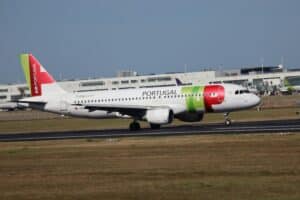
2020 prediction comes further into focus as government intent on ‘re-privatising’ flagship airline
The prediction five years ago by the then infrastructures minister Pedro Nuno Santos that flagship airline TAP could need €3.7 billion by 2024 has come much further into focus, thanks to information supplied by ECO online.
According to ECO, Mr Santos was pretty much spot on. The online explains the rising costs of Socialists’ decision, in 2015, to bail the airline out, as due to a ‘bill’ that the state may have to pick up as a result of a multi million loan organised in 2016 by TAP’s then ‘owner shareholder’ David Neeleman.
The loan, almost a decade ago, was a great deal less than the current total awaiting repayment (due to interest that has piled up on it). ECO suggests the €177 million the state faces paying is ‘double’ the money that Neeleman invested in 2016.
The initial sale by PS Socialists to the Atlantic Gateway consortium (led by transport baron Humberto Pedroso in partnership with Neeleman) brought in €10 million.
Since then, the state has spent well over €3 billion, first in recovering control of TAP and then in ‘restructuring it’.
The result today is that TAP’s holding company is in technical bankruptcy, carrying an excess of €1.34 billion in negative equity, and “the state has not yet given indications of how it wishes to proceed with payment”, says ECO.
David Neeleman, through his airline company Azul, could end up demanding payment of the loan debt in court – and if he ‘wins’, ECO explains, the state will have no option but to fork out another €177 million, bringing the grand total of taxpayers’ money spent on the country’s flag carrier to €3.6 billion.
According to ECO, the state has already ploughed €3.431 billion into TAP since wrestling it back from Atlantic Gateway – and it is now (still) trying to sell it.
Former prime minister António Costa admitted in parliament years ago that the state could not hope to recoup the money it has put into TAP – and when PS Socialists were negotiating the sale that has still not taken place, media reports suggested the country was unlikely to walk away with more than a billion euros. Infact, a billion would be ‘a good deal’.
In other words, the handling of TAP looks set to have cost taxpayers dearly, and be the ‘scandal’ that so many detractors have always called it.
UPDATE: since uploading this story online, the Constitutional Court has delivered another hammer blow to TAP accounts, by rejecting the company’s appeal against cabin crew indemnities, which could come to €300 million.
In the meantime, we are always told that the airline is being prepared for sale – and that a number of airline consortiums are interested.
These groups may also be interested in the experience of customers, one of which wrote to us last week to describe his utter dismay at the way he and his wife were treated.
The following text puts the dismal experience in the words of the 86-year-old flyer:
Dates:
7 May 2025 TP 257 Lisbon – Toronto
18 May 2025 TP 258 Toronto – Lisbon
Passengers : husband and wife, aged 86 and 83 respectively
1. Both travelling Business Class with Wheelchair Assistance for a price of €4,890.
The aircraft was an Airbus A 321. The cabin was divided with 16 Business Class seats at the front and Economy in the rear. Seats 5A and 5C were allocated for both journeys.
2. Although Wheelchair assistance had been booked beforehand, the allocated seats were on the back row farthest from the entrance and toilet. Usually such seating is arranged nearer the front for ease of access. The cabin crew seemed unaware of passengers requiring assistance.
3. On the outgoing flight TP 257, several seats at the front were occupied by off duty TAP personnel and children as evidenced with frequent interchange with flight crew and access to restricted areas.
4. Airbus describes the A 321 aircraft as suitable for short and medium haul flights. TAP states that its long haul flights to North and South America uses wide bodied A 300 aircraft with separate access for Business Class and Economy passengers.
5. On both TP 257 and TP 258 Business Class was given priority boarding. However any benefit was negated by Economy Class following through the only access available on a A 321 aircraft. Any semblance of exclusivity for Business Class was nullified.
6. On TP 258 several faults in the seating equipment were experienced. The seat belt of 5C was faulty and required help from cabin crew to relocate it from under the seat. The table on 5A was unstable with drinks sliding on to the floor. The hand held control situated adjacent to the head rest on 5C failed to work and efforts to rectify by cabin crew proved unsuccessful.
7. During the flight on TP 258 transmission of a film was interrupted on several occasions due to loss of power. The purser had to reboot the computer system situated at the front of the aircraft which took 7 minutes. The film could then be watched for approximately 20 minutes before the procedure had to be repeated. A film of normal length of 111 minutes took almost 3 hours to view in total.
8. No information was provided on the meaning of the push buttons on the seats and entertainment channels.
9. A fancy brochure advertised catering options. Exclusions of certain items on A 321 flights were shown. On enquiry the purser stated that the lack of space on the A 321 aircraft meant that several items offered on A 300 aircraft long haul to North America and Brazil could not be carried on the A 321. She stated that the fare charged to Business class passengers on this route by TAP was less than those levied by its competitors offering superior service and facilities.
10. Three courses were advertised on the dinner menu – salmon, beef and vegetarian. By the time the trolley reached row 5, the salmon course was no longer available. The purser stated that only seven salmon dishes had been provided. It was possible for Business class to order meal choices in advance by internet. She admitted that probably no notice of this was given beforehand.
11. The fancy brochure advertised two white wines, one of which was Chardonnay. Unfortunately only one bottle had been available which had been fully used by row 5 Using her initiative the crew member went into the Economy class kitchen and obtained another bottle although unchilled. She offered to put some ice in the drink which would take 10 minutes to prepare. This offer was declined.
12. The whole catering experience was underwhelming. The presentation and quality were equivalent to basic Economy fare and in no way comparable to Business class offered by other airlines operating long haul.
13. Attempts to sleep on TP 258 were impaired by constant interruptions from the Economy class toilet. This was situated immediately behind seats 5A and 5C and divided by a thin partition lacking sound proofing. Thus the click of locking and the bang from closing the toilet door by users was clearly audible. The whoosh from flushing further added to the unpleasant experience throughout the flight.
Conclusion
Full price Business Class tickets were purchased in the belief that TAP promotional literature stating that its long haul flights to North America would be using A 300 wide bodied aircraft with separate entry from Economy passengers as previously experienced. Instead TAP provided an A 321 aircraft designed only for short and medium haul and inadequate for an 8 hour flight in the several areas described above.
TAP evidently coconsiders Canada to be excluded from its definition of North America as described in its promotional literature. It made no attempt to inform passengers travelling to Toronto that A 300 aircraft and its usual Business Class facilities would not be available.
TAP boasts having 19 wide bodied A 300 aircraft for use on long haul routes such as Lisbon – New York. Why the Lisbon – Toronto flight of equivalent mileage is not accorded an A 300 for this long haul flight is difficult to comprehend. Without prior information to the contrary, potential Business Class passengers are duped by TAP into expecting a quality of service that cannot be delivered on an A 321 aircraft. It is tantamount to false pretences.
Instead the offering by TAP alleging a Business Class service was a travesty with its unsuitable aircraft, poor equipment maintenance, Economy Class catering and lack of appropriate seating location for wheelchair assistance passengers.
Whilst TAP staff apologised for the various indignities suffered, indifference was palpable suggesting that dissatisfaction was nothing new in this regard. If it is shown that off duty TAP staff was occupying Business Class facilities on a no charge basis to the disadvantage of full paying passengers, then this further compounds the situation.
Senior management are ultimately responsible for this state of affairs. If they are unaware of the serious matters revealed in these observations or, even worse, permit them to continue, then they should be called to account. ND