To read from the start click here.
Although there are upwards of 20 churches in the town, only the two parish churches have fonts, and every Tavira resident belongs to one or the other parish. The two churches stand only a few metres from each other within the Vila Adentro.
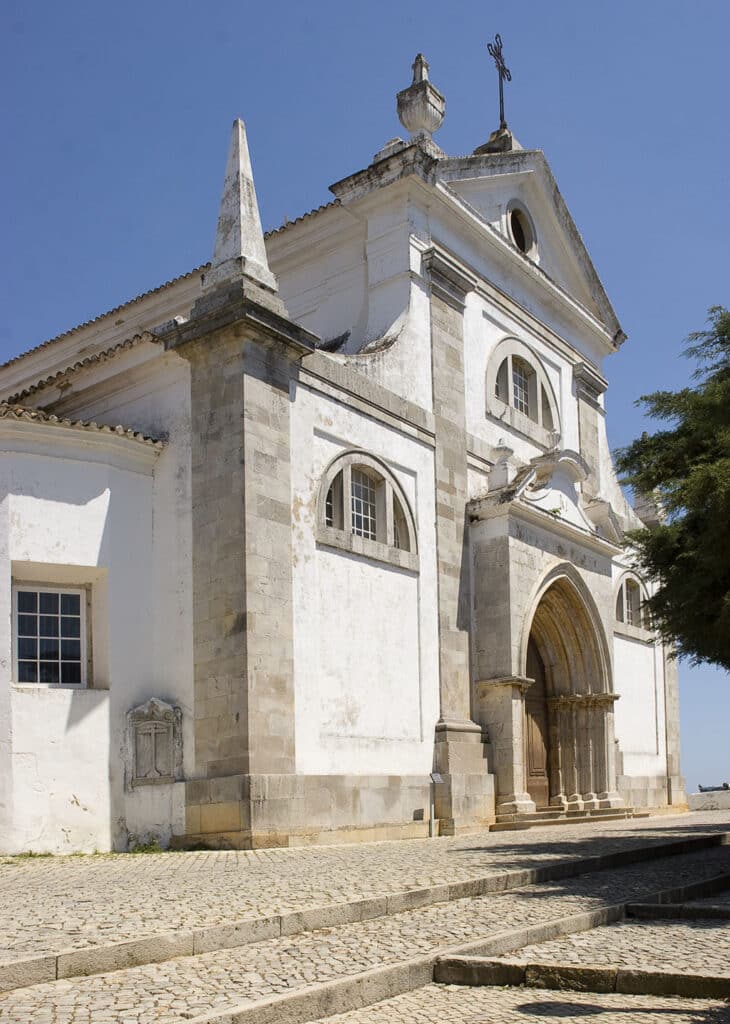
Igreja Matriz de Santa Maria do Castelo
The parish church of Santa Maria is the oldest Christian building in the town, and dates from immediately after the conquest in 1242. It was almost certainly converted from the former main mosque, although there is no proof of this conversion.
Mosques were usually oriented so that the mihrab faced towards Mecca, which in the Algarve is easterly. I suspect that the Christians oriented the newly converted church north-south to distinguish it from the previous Moslem building.
Santa Maria suffered enormous damage in the Great Earthquake of 1755, and as soon as he had been consecrated, the new Bishop of the Algarve, D Francisco Gomes de Avelar, made a visit to the town in 1789 to view the ruin.
He selected an Italian architect, Francisco Xavier Fabri (1761-1817), for the work of rebuilding part of Faro and also engaged him to rebuild Santa Maria. Fabri retained those parts of the church which were still standing, and he rebuilt the nave and outer walls on the existing footings. The side chapels, the east end including the bell tower and the great gothic southern doorway are all survivors from the original building.
The church of Santa Maria that we now see is, therefore, an unusual and pleasing amalgam of the original surviving gothic and the late 18th century neoclassical, and its image now serves as the ex-libris of the town.
The main altar is painted, and either side shows columns which are trompe l’oeil. The side chapel of Senhor dos Passos is a good local example of the Manueline style and the ceiling bosses show the arms of the Orders of Santiago and Christ, as well as those of Lançarote de Melo, who paid for the construction of the chapel.
The figure of Nosso Senhor dos Passos was brought from the chapel of São João Baptista after the suppression of 1834.
The neighbouring chapel of Santíssimo Sacramento was built by D Teresa de Aragão in 1748. Its beautiful blue and yellow azulejos (which are from the early 1700s) withstood the destructive 1755 earthquake.
On the opposite side of the nave is a retable devoted to São Bartolomeu. This retable has been converted from one belonging to the Brotherhood of St Crispin and St Crispinian. This brotherhood was originally supported by the leather workers and cobblers, most of whom had been converted Moslems and became extinct in 1893.
This church contains the memorial graves (on the east wall of the chancel) of the seven Santiago knights whose deaths led directly to the conquest of the town and on the opposite wall of the chancel, that of their commander, D Paio Pires Correia himself. This grave was first marked in the church in 1721 and so may not actually contain his remains.
D Paio is lucky in that he has two graves – the other is in the Church/Monastery of Santa Maria at Tentudía in Spain. D Paio is also famous for the Miracle of the Sun. While fighting against a Moslem army during the siege of Seville in 1248, he saw that as night was falling, his forces would not have enough daylight to defeat their opponents. Legend suggests that he successfully appealed to the Virgin to halt the course of the sun to prolong the day, allowing the Knights of Santiago to seal their victory.
We know from the records of the visitations made to this church that a smaller bell tower with a wooden stair existed before 1518; and the present structure must have been built after 1565, when the stone staircase was added. The clock tower on the north-western corner may date from Moslem times, and we know that its clock was in place in 1611. The date on the northern face of the tower shows 1809, when it was rebuilt. Strangely, this tower belongs not to the church, but to the Câmara, and I have no idea why it should be so.
To the uninitiated, it appears that this church is rarely open, since its main doors are usually closed. But for those who wish to visit, the entrance to both the church and a small museum is in the north-west corner of the building, under the clock tower.
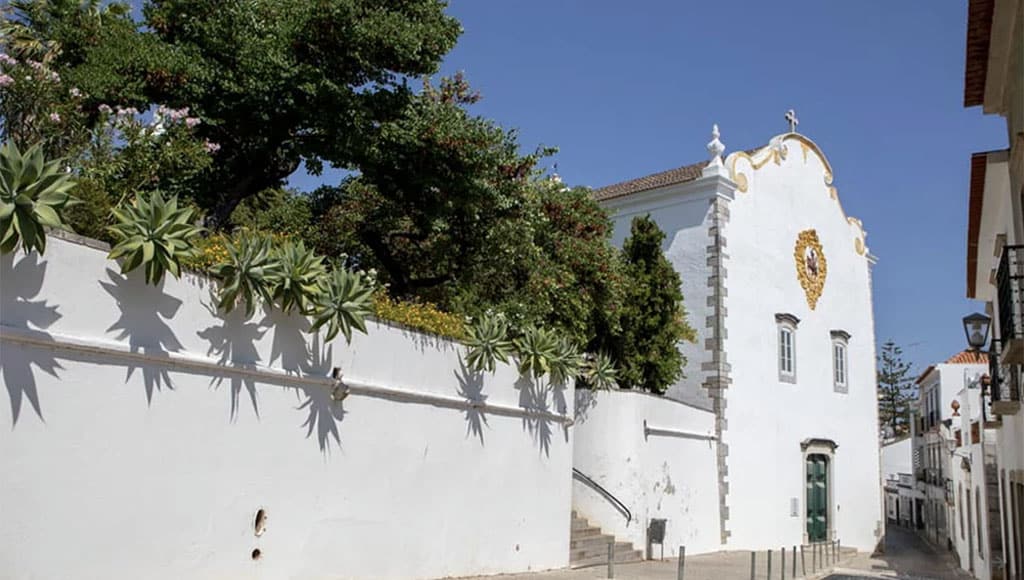
Igreja Matriz de Santiago
The origin of the parish church of Santiago (St James) is shrouded in mystery, but we know that it existed in 1270, when D Afonso III donated its advowson to the Bishop of Silves. There is an idea that this church is also on the footprint of an original mosque, since it is also oriented north-south, instead of the more usual east-west. Near the door on the eastern side, the wall shows a circular outline which may have been the mihrab of an earlier mosque.
This church also suffered major damage in the Great Earthquake, and its reconstruction took some time. In 1763, King D José ordered that the brotherhoods which used the church of Santiago should each contribute towards its reconstruction. There was attached to this church for many years the Confraria do Santíssimo Sacramento de Santiago(The Brotherhood of the Holiest Sacrament of Santiago), which became extinct only in the 1940s.
On the eastern side of the nave stand the baptistery with its font, the altars of the Calvary, the Santíssimo Sacramento and Nossa Senhora de Lourdes (Our Lady of Lourdes). Painted wooden panels of the 15th and 16th century represent Our Lady, St John the Baptist, St Vincent, St Blaise and St Peter.
On the western side of the nave, the side altars are Capela das Almas (All Souls), Nossa Senhora do Leite(Our Lady of the Milk), Santa Rita de Cássia and Nossa Senhora da Graça (the image came from the Convento da Graça after the suppression of 1834) together with the Sagrada Família (Holy Family).
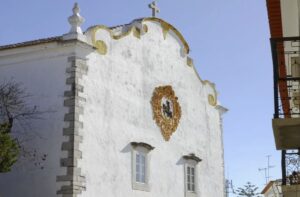
The most notable feature of the church is the exterior yellow medallion over the great south door. The medallion portrays Santiago in the thoroughly Christian practice of raising his sword to kill someone, probably a Moslem. High over the altar there is a Hebrew inscription, which shows the Hebrew name for God. There is a similar inscription on the front façade of Igreja do Espírito Santo.
To read part 7 click here.
Read more from Peter Booker about Tavira – a dog’s eye view or Three women, Tavira and the Carnation Revolution.