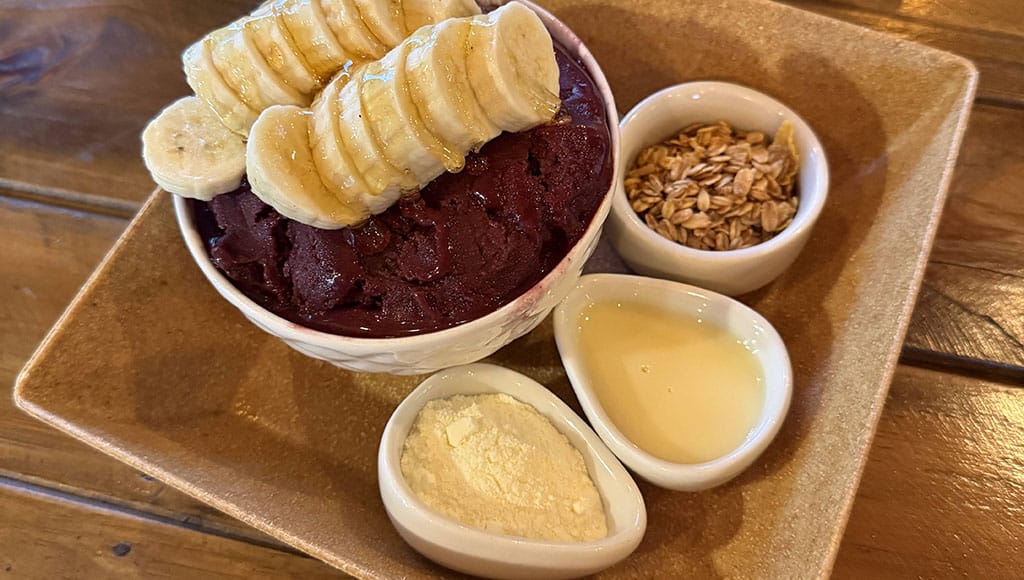
I’ve spent a lot of time in Brazil over the past few months, and one thing I never miss while I’m there is açaí – in a bowl with banana, granola, and a drizzle of doce de leite, the sweet milk paste you find everywhere in Brazil. Like many people, though, I first came across açaí not in the Amazon, where it originates, but at a beach quiosque in Portugal.
Only after spending time in Brazil did I realise how much more there is to this small, dark-purple fruit – and how different it tastes in its original form. Today, most of us know it as a sweet, cold dessert. But traditionally, açaí is eaten savoury, salty, and warm.
In the Amazon – especially in the state of Pará – it’s not a treat but a staple food, served at lunch or dinner with manioc flour and fried fish. Together, these ingredients form the backbone of the region’s daily nutrition, providing carbohydrates, protein, fat, and essential vitamins.
In this region, açaí is more than food. Like maize to the Aztecs or wheat to ancient Egyptians, it carries cultural and even spiritual weight. According to legend, long ago in a village near Belém do Pará, a terrible famine forced the tribal chief to make a cruel decree: all newborns were to be sacrificed to reduce the strain on dwindling resources.
One day, his own daughter Iaçã gave birth – and lost her child to the same rule. Heartbroken, she locked herself away and wept for days. One night, she heard a baby crying and ran outside, thinking it was her child. Instead, she found a palm tree full of dark berries growing where none had stood before. She died beneath it, smiling. When the chief found her body and saw the fruit, he realised it could feed the people. He ended the decree, and the fruit was named açaí – Iaçã spelled backwards – in her honour.
Despite its importance in the North, açaí remained largely unknown outside the Amazon for decades. That’s partly because fresh açaí has a notoriously short shelf life. Once harvested, the berries must be processed within 24 hours or they begin to spoil. The pulp is extracted by soaking the berries in water and then straining them, producing a thick, slightly gritty substance with an earthy, bitter taste. This version is hard to transport – even within Brazil.
What most of us eat today is far from that original paste. In the South and Southeast of Brazil, and certainly abroad, açaí is usually blended with guaraná syrup, sweetened, stabilised, and frozen to a sorbet-like consistency. It’s convenient, tasty, and a world apart from its Amazonian roots. By blending in guaraná – for both its energising effect and natural sweetness – the mixture became the standard version of açaí served around the world.
In Brazil, the sweetened açaí gained popularity beyond the Amazon through the jiu-jitsu community, where athletes embraced it for its energy-boosting properties. It quickly became a staple in training circles and along beachfronts, particularly in Rio and São Paulo.
Meanwhile, two American surfers who had discovered the fruit in Brazil started bringing frozen pulp back to Los Angeles. Selling it on the beach, they tapped into the health-conscious California market, which quickly embraced the exotic fruit.
Around the same time, açaí was rebranded as a “superfood”, rich in antioxidants linked to reduced inflammation and improved heart health. It also contains good levels of fibre, iron, and potassium.
With antioxidant-rich diets on trend, and its exotic Amazonian origin adding mystique, açaí exploded in popularity – showing up in everything from smoothie bowls to skincare.
Although açaí has become a global sensation, roughly 95% of Brazil’s açaí still comes from the state of Pará. Most is still harvested by peconheiros – skilled men who climb the slender, 20-to-25-metre açaí palms using a rope called a peconha looped around their ankles.
These palms grow in wild groves in floodplains known as várzeas, where farmers manage the forest rather than plant it. Açaí is also environmentally resilient: it requires no pesticides, little fertiliser, and thrives with minimal intervention.
From sacred food of the Amazon to viral super-fruit, açaí has travelled far. But its roots remain deep in the flooded forests of northern Brazil. I hope to visit the region soon and taste the original version at its source – earthy, salty, and served up with manioc flour and fried fish.