So, when our visitors visited us, there was a lot of time on their hands, especially if they did not like to go shopping in the air-conditioned malls.
In such a scenario, I used to suggest visiting the “Tree of Life” very tentatively. In all honesty, I should have made it a top priority because if you did not want to drive half distance on the causeway before you were stopped (as you did not have a visa to visit the neighbouring country), and had already been to the museum, this unique location was the place to go.
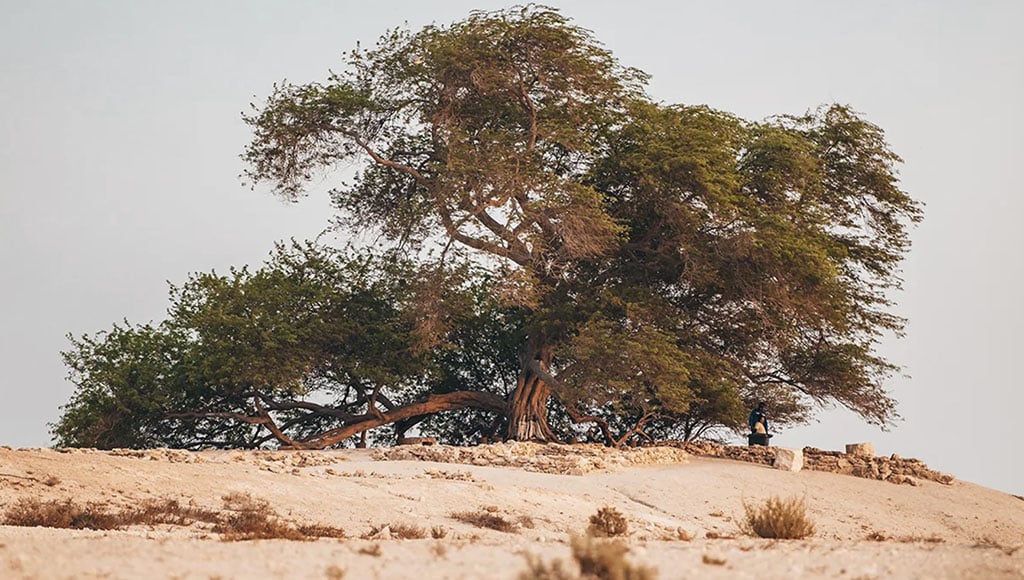
Also called Shajarat Al Hayat, this remarkable tree was almost 10 metres tall and had survived in impossible living conditions for approximately 400 years. There was no apparent source of water and other vegetation for miles around, and the mystery of the survival of the tree had made it into a legend of sorts.
It stood alone, majestically, on top of a seven-and-a-half-metre high sandy hill, at the highest point in Bahrain, with no other natural tree nearby.
It had come to be known as the “Tree of Life” due to the fact that it existed in a hot and dry desert, which truly represented the magic of life and the power of nature.
The local inhabitants believed that Enki, the mythical god of water in Babylonian and Sumerian mythology, granted the tree its longevity. Others say that it marked the location of the biblical Garden of Eden.
With this remarkable saga of mysterious and unusual vegetation in the desert, why was it not the first port of call for all my visitors to Manama? The answer was that going to visit Bahrain’s loneliest tree was like entering a puzzling maze, and to reach the spot took a good part of the day. Every time I went there, I got lost. Every single time!
The GPS did not have it on its list of tourist attractions and, after traveling some distance, would show brown sand in its pictorial view. The signage was missing for most of the journey and, wherever it was visible, was completely misleading. Following it, one could land up onto a dirt track which actually went nowhere.
So, one had to drive by sheer instinct. The first landmark was a scrap metal yard, which suddenly appeared on the right-hand side of the road, and after continuing straight for a bit, one finally reached the luscious tree, by turning left at Gas Well No. 371. One had to be careful about staying on the slow path, or the car would get stuck in the soft sand.
The way back was the same, with several right or wrong turns. A distance of roughly 40 kilometres could take one from two to six hours depending on whether lady luck assisted you on that particular day, or not.
I was back in the island nation recently. On day two, I ventured out to find the “Tree of Life” once more.
“Oh mom! You got lost again?” our daughter was on the phone.
“Missed the Gas-Well-something-number turn,” I complained.
“But why did you even go there?” she asked.
“Fools rush in where angels fear to tread,” I chuckled.
Read Nickunj Malik’s last article: Hope floats