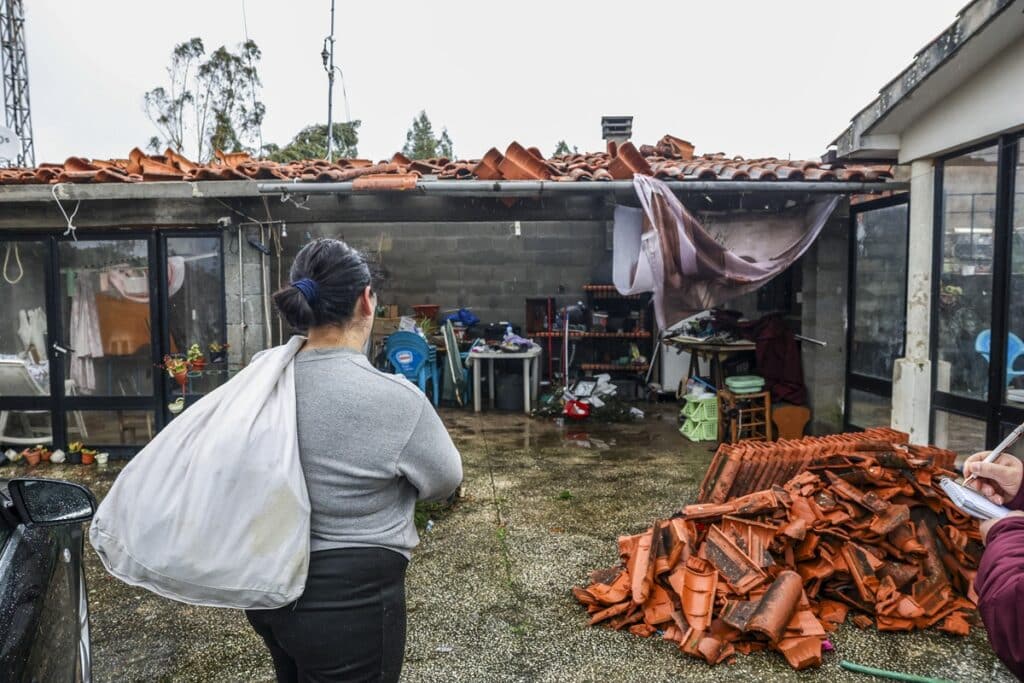
With a lot of comments now on social networks over a perceived lack of empathy by members of the AD executve to the real agony suffered on the ground, the Association of Victims of the Pedrógão Grande Fire (AVIPG) has accused the government of a “slow, insufficient and distant” response to storm devastation in the centre of the country – distant being one of the truly pertinent adjectives in this drama.
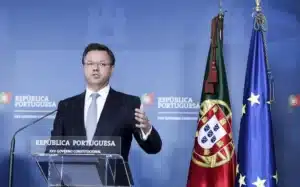
Videos have been widely circulating showing the prime minister’s announcement yesterday of measures to ‘help populations’ affected by the worst weather phenomenon in living memory – all highlighting his complete lack of empathy.
But what resonated most for the association was the feeling of a ‘repeat performance’ by the country’s political leaders to a drama that left families, once again, frightened, “feeling uncertainty in body and soul”.
“Once again, we saw the interior alone facing the storm”, they write in a text sent to Lusa news agency.
Supports that “never failed” were “the local authorities, municipal employees, local firefighters, volunteers, and all Civil Protection agents who work, live, and breathe this territory.”
But the government? It came up short. “What hurts even more is realizing that, despite warnings, the government’s response was slow, insufficient (…) the state was slow to respond and, especially, to arrive when it was most needed,” says the association created to represent victims after the 2017 fires in Pedrógão Grande, Leiria district.
Like the fires, Storm Kristin has “left deep marks”, and underscored to communities how little central governments seem to be ‘aware’ of what they are actually going through.
“As always, it was the people of the interior who rose up” to help themselves. (…) It was the resilience of our communities that shone, but this strength cannot serve as an excuse for the inaction of those who govern us at the central level,” says the text.
Recalling that they know “all too well the pain of abandonment, the burden of waiting for answers that never come, the struggle for justice and recognition,” the victims’ association vows not to remain silent, demanding “respect for the populations of the interior,” but also “serious prevention, clear communication, and quick and coordinated support.”
“We demand that municipalities not be left alone to bear problems that affect everyone. We demand that people be a priority, not statistics,” says AVIPG, and that “living in the interior does not mean always being at the end of the line (…) Because people’s dignity cannot be postponed. And the interior is also part of Portugal.”
To some, this poignant text may seem ‘overblown’ – but one has to go back to 2017 to understand how desperately communities torn apart from the fires that killed over 100 people in that year felt after the initial ‘national response’ had died down, and central government returned to ‘other matters’.
Add to that the extremely ‘distant’ performance to date of a prime minister – who has never managed to convey much in the way of empathy – and the stage is set for criticism which is now coming from a number of quarters.
Presidential candidate André Ventura has never been one to hold back. He has been venting his opinions as the days count down to the second round of voting on Sunday (in which he is expected to lose the bid to become the country’s next president to PS candidate António José Seguro).
With this focus on his every comment starting to wane, Ventura has wasted no time in trashing both the government’s response and its support programme, announced after the Council of Ministers yesterday, calling it a “complete failure”, and accusing the executive of “making fun of people”.
“When you set limits of €500 or €530 to help people, this can only be mocking the population,” he said ahead of a campaign event in Vila Verde (Braga district).
“It would have been better for the government to have remained silent today”, he went on, adding: “When I have the opportunity (to speak to the prime minister), I will say that I think this is one of the darkest and most disastrous days in the history of this government.”
source material: LUSA