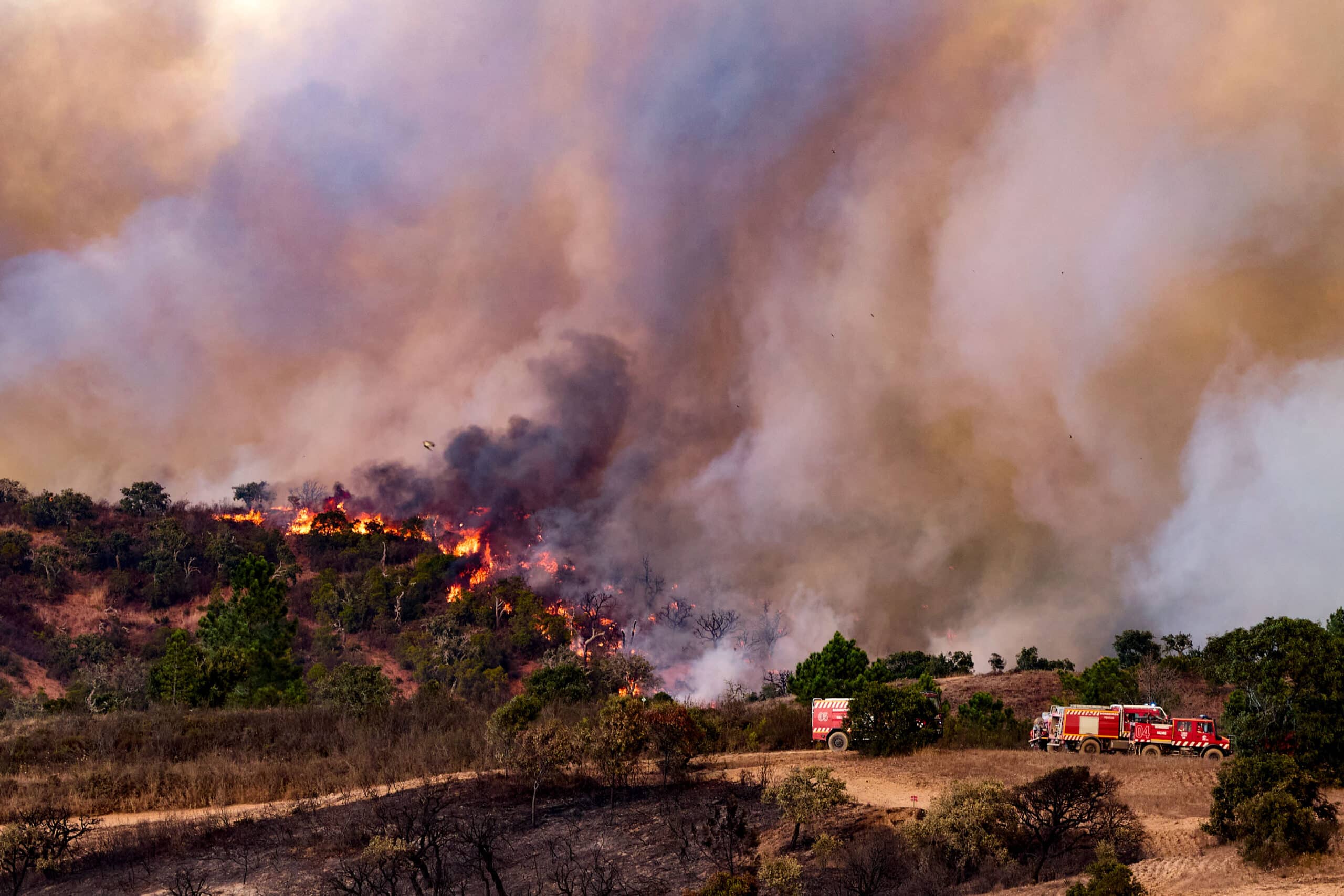
With Portugal still reeling from a summer of massive wildfires, environmentalists from WWF Portugal warn that the country could face another ‘summer of fire’ next year if nothing changes.
By the end of August, 254,000 hectares had already been scorched, making 2025 one of the three worst wildfire years on record – and still excluding the major wildfire that blighted the western Algarve since Sunday.
As WWF Portugal points out, most damage occurred in the North and Centre, regions made up mostly of “large areas of homogeneous, poorly managed forest”. Forest plantations (118,127 hectares) were hardest hit, followed by scrubland (107,881 hectares) and agricultural land (28,288 hectares). Protected areas such as Peneda-Gerês, Serra da Estrela, Alvão, and more recently the Southwest Alentejo and Costa Vicentina were also affected, causing “sometimes irreversible losses to natural heritage.”
WWF Portugal is thus calling for urgent government action, proposing three priority measures to be implemented by May 2026:
- Restore forests through ecological restoration, natural regeneration, and extensive grazing to reduce fire risk and protect habitats.
- Develop agroforestry and agrosilvopastoral (land-use model that combines crops, trees, and livestock in the same area) systems, which help keep rural populations in place and combat land abandonment.
- Cut bureaucracy and increase staff at the Environmental Fund so landowners can access funding effectively and implement fire-prevention measures.
“While we deeply regret all the losses caused by fires – particularly human lives – we also lament the ongoing inaction of successive governments,” says Ângela Morgado, Executive Director of WWF Portugal. “Year after year, the government fails to take the steps necessary to prevent the next summer’s fires. An example of this are the measures launched by the government this year after the fires to recover the burnt area, but which focus little on prevention. This is not a responsible of individual government, it is a structural problem,” she adds, calling for solutions that will have long-lasting effects despite which government is in power at the time.
While the number of fires has dropped in the last two decades, Portugal continues to face increasingly intense and destructive wildfires. WWF highlights factors that worsen fire risk, including low forest profitability, rural abandonment, fragmented land ownership, and lack of coordinated public policies.
“To break the cycle of mega fires, WWF defends the need to change the composition and structure of the landscape to make it more resilient. One of the ways to do this is by reducing unmanaged production forests and converting them into agroforestry or agrosilvopastoral systems, reintroducing grazing, and investing in derived products,” says the Portuguese branch of the world’s largest conservation organisation.
“The WWF, in Portugal and globally, advocates a proactive, integrated approach to fire prevention, rather than focusing exclusively on firefighting,” Morgado adds. “Mosaic landscapes with forests, wetlands, and pastures act as natural barriers against large fires.”
She also explains that healthy ecosystems are far more resilient to fire when protected and restored.
In May 2025, WWF gathered specialists from multiple sectors to produce the “Common Agenda for Wildfire Prevention”, outlining concrete measures for government, private sector, civil society, and the scientific community. The agenda aims to transform the landscape and implement integrated forest management. The full agenda can be found online, as well as a summary.
WWF Portugal has been active in the country since the 1990s and currently manages around 30 projects. Globally, WWF has over five million supporters and a presence in more than 100 countries, working to conserve biodiversity, promote sustainable use of renewable resources, and reduce pollution and waste.