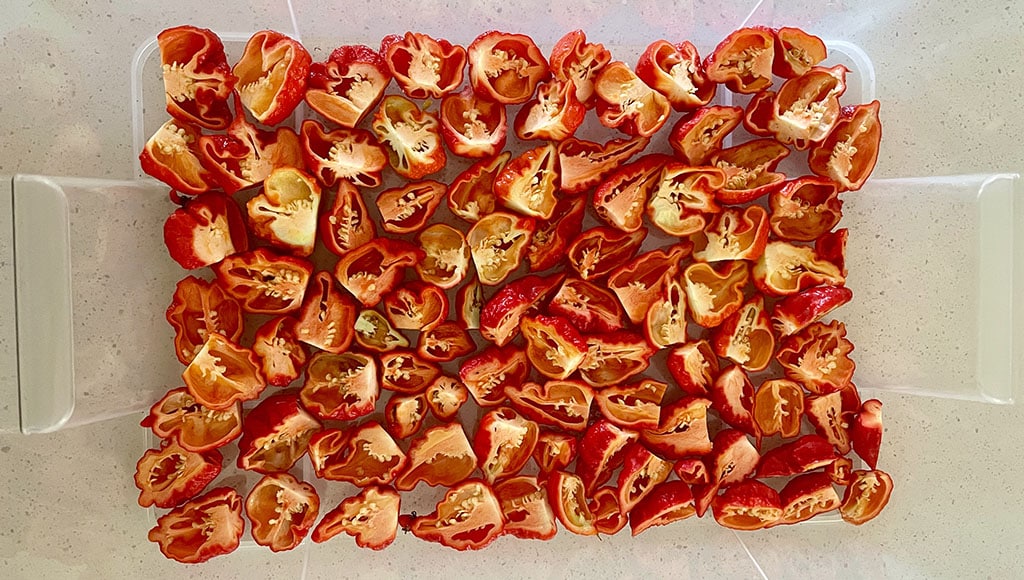
They are red, green, orange and yellow. They can be fresh, dried, ground, powdered, pickled or sauced. They can tickle you gently or turn the heat so high and so fast that the launch of the Apollo rocket would appear like slow exercise.
Known to the culinary world as a spice or condiment, chillies are actually fruits of the plants from the Capsicum genus and its five domesticated species, namely chinense, frutescens, baccatum, annuum and pubescens.
In the kitchen, chillies are used for their heat and flavour. Although Indian, Thai and Chinese cuisines have grown fond of them, chillies originate from Central and South America, in places like Brazil, Peru, Bolivia and Mexico.
It was the Columbian Exchange that brought them over the pond, as well as give them part of their name. Etymologically, the word chilli comes from the Nahuatl language and means the fruit of the capsicum plant. However, when Christopher Columbus first tried it, the fruit reminded him of the pungency of peppers, hence he called it a chilli pepper.
There has been some additional confusion with regards to how exactly one should spell the first part, – chilli, chile or chili are all equally plausible. But let’s not dwell on that and, for the purpose of this conversation, follow the former way of writing it.

Interestingly, the chillies’ wide dissemination across the Americas has come about as part of the plant’s premeditated strategy. To propagate themselves across the vast territories, its species have formed a bond with birds.
Having consumed the fruits, birds travel across distances dispersing seeds that, in turn, grow into new plants. Their mouths and stomachs are insensitive to capsaicin, the naturally occurring compound found in chillies that is responsible for the burning sensation. In fact, the “heat” itself has come about as the method to deter mammals who were deemed less efficient for disseminating.
The measure of capsaicin heat is done with the help of the Scoville* scale and its SHU units (Scoville Heat Unit). The Scoville values are obtained by determining how much sugar it takes to dilute the chilli extract until it no longer can be detected by the group of tasters. The more sugar it takes, the hotter the chilli is. However, since it is the people’s perception that determines these numbers and all people are different, the SHU is expressed as a range and the scale itself is often regarded as subjective and imprecise.
The scale runs from zero to millions, and the many representatives of the chilli kingdom find themselves distributed between 500 SHU of a pimento, and the astronomically hot Caroline Reaper, at 1.4-2.2 million SHU or the current hottest chilli, Pepper X, at 2.69-3.18 million SHU. No wonder that India has studied some of the Capsicum species for weaponization!

These high levels of heat are not found in nature, and have been cultivated artificially, probably in search of a ‘feel good’ kick. The postprandial euphoric effects of consuming hot foods are associated with the release of a party of happiness hormones, such as endorphins and dopamine, that arrive as part of the response to the heat alert.
This reaction comes as a result of the process known as chemesthesis, the body’s reaction to irritation, and is not associated with the work of the tastebuds (these soldiers of flavour are only suited to identify sweet, salty, acidic, bitter and umami).
Let’s consider it in detail. Our bodies are constantly on the lookout for any trouble that might come their way and, for that, they deploy all kinds of receptors, including those in our mouth and nose.
When we bite into a hot pepper, its capsaicin attaches to the receptors, which get irritated and falsely alarm the brain that the mouth is on fire. The body then responds by producing sweat and usually craves water to help wash it away. This, as we know, is an erroneous strategy as it causes just quite the opposite effect.

It appears that capsaicin is not water but fat-soluble; hence, hot foods are often greasy and are served with dairy. For having survived the ordeal, the body rewards us with a hormonal boost, which, in turn, can make us crave to repeat the sensation. This might be the reason why hot foods are sometimes considered to be addictive, and why, despite all, people are drawn to consuming them and often invest time in training up their heat tolerance.
To be continued.
*Wilbur Scoville, an American pharmacologist invented the Scoville scale in 1912.