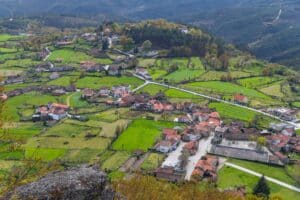
The latest news of Savannah Resources – the company with 27% of its share capital in Portuguese hands, which seeks to mine lithium in Boticas – is interesting not just because of its content, but because of the comments that have appeared under the story, published yesterday by SIC Notícias.
The roughly 500 comments show how acutely citizens have become aware of the dangers flagged up till now simply by ‘environmentalists’ and communities threatened, as in this case, with an operation that has raised hackles since the get-go.
“They are selling us, in pieces”, says one.
“I hope the press can help us fight these economic interests”, says another.
The truth is that Savannah has already got a number of heavy-hitters on board, and is backed by the European Commission. Taken with everything else that is happening at the moment, readers would be forgiven for wondering what will be left when all these ‘mega projects’ in the pipeline, promising to whisk Portugal into a digital and energetic transition, have mined the lithium, copper, feldspar, tungsten, etc. and plastered the countryside with photovoltaic panels and wind turbines.
One commentator under SIC’s story – part of the pressure group to stop the massive Sophia Solar Park – says: “It is time to say enough. If we don’t, there won’t be a natural, healthy Portugal. We have to stop this calamity”.
But, for now, Savannah is super positive: it is still aiming to start operations in Boticas by the end of 2026, and has a new concession (Aldeia) where it hopes not only to mine more lithium, but also quartz and feldspar.
Savannah is often criticised for ‘making announcements’, which have been seen as a form of self-promotion. The company’s studies suggest the lithium in the Boticas concession is ‘far greater’ than originally expected – and now adding likely returns from the Aldeia concession, Savannah CEO Emanuel Proença is predicting spin-offs for the local economy “because the lithium could undergo its first transformation at the factory to be constructed (on site) and generate more jobs (…) for one or even potentially several generations”.
As SIC’s report explains, “the expectation is that the construction phase at the Barroso mine (Boticas) will begin by the end of 2026, with production starting in 2028. A factory, roads, water reservoirs, offices, a laboratory, and a Wastewater Treatment Plant (WWTP) will be built.
“All these elements are built more or less in parallel over 18 months, which then lead us to production,” said Proença.
Meanwhile, geotechnical work will be carried out on the site, for which the company is requesting a second administrative easement, which is awaiting a decision from the government, and is being bitterly contested by locals (as was the first).
“This runs parallel to other engineering specialties, the Mining Plan, the Environmental Compliance Report of the Execution Project (RECAPE), and several other work components that then allow us to support the ‘project finance’, the structuring of financing, and the start of construction,” Proença added.
None of this appears to have impressed SIC’s readers – and the Resident readers already know how hotly Savannah’s plans are being contested locally.
Source: SIC Notícias/ Lusa