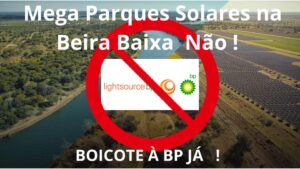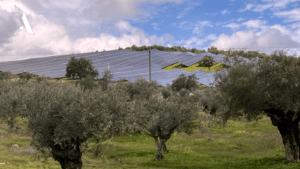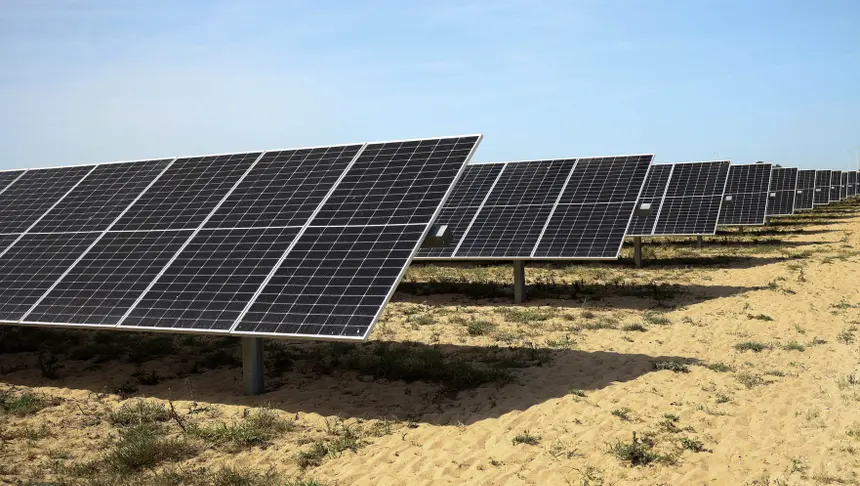
Pressure is amplifying against the massive solar park planned across various municipalities of Castelo Branco.
With just one day left for the ‘public participation’ exercise ahead of an official green light, NGOs, environmentalists, lawyers and civic groups are united in trying to impress what they see as cataclysmic downsides of allowing 1,365,588 photovoltaic panels to smother landscapes rich in biodiversity.
“The project expels woods, forests and everything that lives in them”, explains environmental lawyer Rui Amores. “All in the same of the sun”.
The main ‘collateral damage’ of this €590 million ‘investment’ will be the cutting down of countless protected tree species (cork and holm oaks), the wiping out of “unique plant diversity, including several Mediterranean habitats; the obliteration of habitats to countless species, a number of them already endangered (examples: black stork, black vulture and Iberian imperial eagle) and the installation across valleys and mountains of kilometres of very high voltage power lines imposing rights of way where nothing can grow tall”.
Amores is in no doubt that Sophia, for all the lyrical connotations of the name, spells ‘ecocide’. “Is destroying everything green that we have truly the way to ‘save the planet’,” he asks.
Rewilding Portugal is just one of the 10,190 participations already received, and it too has no doubts: “Although we recognise the urgency and importance of the energy transition, we believe that the project in question does not meet the minimum criteria for territorial, ecological and social sustainability,” it has said in a statement sent to Lusa news agency.
For the association, the Sophia project “represents a model of artificialisation of the territory that is incompatible with the principles of conservation, ecological restoration and territorial cohesion”.
Earmarked for the municipalities of Fundão, Idanha-a-Nova and Penamacor, Sophia will not just impact on nature; the project carries significant and irreversible impacts on communities that have been investing in ecological regeneration and nature tourism.
Environmentalists, and NGO’s like Quercus, have based their positions against on a detailed analysis of the official data from the Environmental Impact Study (EIS) and an assessment of the ecological, social and territorial risks that the project represents for the various municipalities.
“The lack of transparency in this process is a serious aspect that should have been addressed earlier”, adds Rewilding Portugal.
“The lack of clarity about the origins and intentions of the investment raises legitimate doubts about its strategic and environmental framework.”
Calling for the complete rejection of the Sophia project and the associated Very High Voltage Lines (VHVL), the association adds that rejecting this project does not mean rejecting solar energy, but rather demanding responsible planning, transparency and ecological justice.
“Let’s have the courage to make these decisions, because large-scale solar power plants, if poorly located, replace living ecosystems with dead surfaces, creating ecological deserts in a country that needs to be renaturalised, reconnected and restored.”
This message gels entirely with that of Aware Algarve the group that has been systematically calling on people to ‘make their voices heard; scrutinise assumptions behind large scale projects; demand access to studies that reveal the true cost of connection, and defend landscapes and communities. “The future of the region, and of Portugal’s transition, depends on a public that refuses to remain silent”, says the group that has just released a new statement on what it calls “the invisible load pulsing through the green boom”.
“Across the surface, the transition gleams. Solar fields stretch across once productive farmland, wind turbines sweep the ridge lines, and data-centres hum at the edge of the grid. But beneath this skin of progress, the pulse of consumption is quickening faster than the electricity grid can adapt.
“The grid was built for steady, local rhythms. Now it must absorb energy that comes in surges and lulls, pushing electricity across long distances, and feeding industrial consumers that never rest. The strain shows everywhere, in grids that struggle to balance the flow, in watersheds that cool the machinery, and in rural lands that bear the physical scars of the transition.
“In Portugal, the pressure points are multiplying. The Sophia Solar Park, a massive €590 million project in the district of Castelo Branco, has already drawn over 10,000 public responses on the Participa portal. Together with the wind farms of the Serra do Caldeirão and the vast Microsoft AI data-centre (€8.6 billion investment) planned for the Port of Sines, these projects expose and amplify the same invisible load, dragging new infrastructure across the land as the system carrying it strains ever harder.
“Each project is approved quickly in isolation, as if it were a world of its own. Yet together they redraw Portugal’s energy map, turning whole regions into corridors for large-scale energy infrastructure.
“What no one counts, because the system doesn’t require it, is the cost of connection. The substations, high-voltage lines, and distribution routes that carry the electricity these projects will consume or deliver. The structures on the hillsides are the visible part, the real footprint lies in the grid built to serve them.
“In medicine, you measure blood pressure to understand strain. In energy, the equivalent is a Grid Impact Assessment (GIA), a diagnostic test showing how each new load affects the grid. Some countries use some form of GIA in their connection process, even if the name varies.
“The UK, for example, has temporarily paused grid-connection applications while the system operator reforms its impact-study procedures. In France, grid-connection rules (Article 342-2 of the Code de l’énergie) require that the transmission operator carry out a binding technical analysis of a proposed generator or load’s effects on the grid before a connection offer is made.
“Portugal follows the same logic. REN, the transmission operator, and E-REDES, the distribution operator, perform the technical studies that fulfil this function, yet the detailed results remain largely inaccessible to the public.
“Under the Aarhus Convention, keeping such information out of public reach contradicts the principle of transparency. Article 2(3) explicitly defines data on energy use, emissions, infrastructure, and their impacts as environmental information, material that citizens have the right to access. Without it, the system’s most vital signs remain hidden.
“The symptoms of neglect are visible. Hillsides cleared for access roads give way under heavy rain. Riverbanks stripped of cover flood more easily after storms. Towns already burdened by ageing infrastructure now face the added pressure of industrial development undertaken without local participation. Public budgets flow endlessly into recovery instead of prevention. A fiscal equivalent of treating heart attacks instead of lowering the blood pressure that causes them.
“A genuine green strategy would begin with restoration, not expansion. It would strengthen the system’s vital organs; our forests, soils, watersheds, and local grids, so that the pulse of energy could move without destroying the body it inhabits. Every euro spent repairing preventable damage is a heartbeat taken from the future.
“The invisible load is the strain placed on the land, the grid, and the communities that hold the transition together. If we ignore it, the pulse of the green boom risks becoming the heartbeat of exhaustion. Faster, weaker, unsustainable.
“The question now is whether we can restore the system before it fails.
“This is why the Sophia Solar Park consultation matters. It is not just about one project in one district. It is a test of whether citizens can still intervene when the infrastructure beneath their feet is reshaped without clarity, accountability, or public oversight.
There is one day left: the consultation closes tomorrow (November 20). It can be accessed through this link:
https://participa.pt/pt/consulta/a-csf-de-sophia-e-as-lmat-associadas