CARE dubs it a “disguised industrial operation threatening local autonomy and future of rural Portugal”
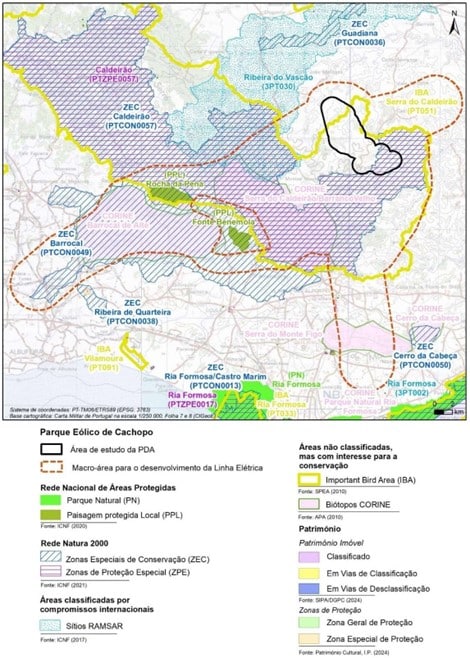
There are just five days left to run for the public participation process on a proposal for another massive wind farm project in the Serra do Caldeirão. Pressure group CARE sees it as a plan that threatens the very future of rural Portugal.
Demanding that all responsible authorities reject the blueprint for Cachopo Wind Farm, the group has issued a passionate press release, warning that “what is being sold to us as a renewable energy project is, in truth, a disguised industrial operation that threatens local autonomy, fragile ecosystems, and the future of rural Portugal.
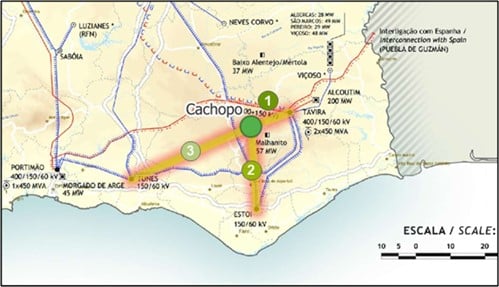
“Though framed in the language of sustainability, this project is a top-down imposition, not a participatory process. The public is shown three “options” for the LMAT (Linha de Muito Alta Tensão) high-voltage line — yet all routes cut through Tavira, Estoi, and Tunes. This is not consultation; it is coercion dressed up as choice”, says the release.
“One of the most insidious tactics here is forcing the public to object to a single route — like the one through Tunes, which clearly damages ecologically sensitive land making it seem as though the others are acceptable. But none of these routes are acceptable.
“The Estoi route targets land already defended from a failed solar project, and the Tavira option lacks basic environmental information.
“We are being asked to choose blindly and that is not participation. It is manipulation. The correct response is not to vote for one route over another, but to reject the entire premise of this so-called choice.
“From our point of view, the entire Cachopo Wind Farm is being proposed in the wrong location, and this ‘route selection’ process is little more than a smokescreen to legitimise an already-made decision. We refuse to validate it.
“This isn’t participatory planning. It is a bureaucratic trap, a rigged game pretending to be a choice. And to top it off, the public is been given only 20 days to respond. Twenty days! For a project of this size? Twenty days is an insult. This isn’t a wind farm for Portugal. It’s a power funnel for foreign markets.
“We’re being asked to give up our landscape, biodiversity, and local economy for a hydrogen fantasy that won’t benefit us — only others.
“Buried on page 40 of the proposal by Madoqua IPP, S.A., it is spelled out clearly: this wind farm is being built to power the production and export of hydrogen and ammonia to Northern Europe.
“At the centre of all this is CCDR, I.P. — the regional agency that is supposed to protect land and plan development in the public interest. But what we’re seeing is something else entirely: a CCDR that rubber stamps projects tailored to private interests. When it approves a corridor of LMAT lines through Tavira, Estoi, and Tunes without real alternatives or listening to residents, that’s not planning — that’s imposition.
“As Álvaro de Campos once confessed: “Tenho em mim todos os sonhos do mundo.” (“I have within me all the dreams of the world.”) But dreams without voice, without land, and without justice are easily bought and sold. And that is what this project threatens to do — strip the people of their say while calling it progress. And this isn’t a one-off. The Cachopo Wind Farm is just one piece of a much larger industrial strategy quietly spreading across the country.
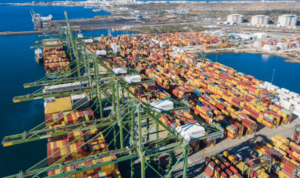
“At the centre of the puzzle is the Port of Sines, being positioned as the main export hub for hydrogen, ammonia, and other synthetic fuels.
“Electricity from inland wind farms like Cachopo is carried by high-voltage LMAT lines to Sines, where it is used in heavy industrial processes to make so-called “green” hydrogen and synthetic products. And then? It all gets shipped straight to Northern Europe. Meanwhile, we’re left with the lines over our backyards, turbines on our ridges, and the costs on our bills”.
“Even the “green” label is misleading, says the group. “Producing hydrogen eats up huge amounts of water, creates local toxic waste, and wastes over half the original energy.
“The public pays, private interests profit
“While foreign investors pocket the profits, it is the Portuguese taxpayers who foot the bill. These ventures rely on public subsidies, EU recovery funds, and national incentives, all paid for through our taxes and buried fees on electricity bills.
“We’re all financing a system that gives us nothing back, just higher costs and ruined landscapes.
“Where the Profits Go
“So who benefits from the Cachopo Wind Farm? Not the communities of Tavira, Estoi, or Tunes. Not rural Portugal. The profits from this industrial project flow up the chain — to foreign investors, offshore funds, and multinationals tied to hydrogen export schemes based in Northern Europe.
“At the heart of it is a supply model built for export, not local resilience. The electricity generated in our hills doesn’t lower bills in our villages — it powers hydrogen production for foreign markets. The jobs created are few and temporary, the environmental costs are permanent.
“This is not green growth — it is green extraction. A model where rural landscapes are sacrificed to supply distant industries, while the economic return bypasses the very regions being impacted.
“This is not sustainability. It is a transfer of public wealth into private hands. We are being asked to choose blindly and that is not participation. It is a way of deceiving us.
“A Blueprint for Energy Colonisation
“This is bigger than just one wind farm. It is about turning Portuguese land into an industrial corridor for others.
“Sines is the shipping port, and everything inland — the mountains, the valleys, the villages — becomes part of the supply chain. In the process, environmental rules are bent and community rights are stripped away.
“Cachopo is the test run. A dangerous precedent for how future infrastructure will be designed — and forced through.
“Operation Influencer: A Green Flag for Corruption
“And all of this unfolds against the backdrop of Operation Influencer — a corruption scandal exposing shady deals between politicians, developers, and public agencies, with the Port of Sines at the centre.
“Now the same tactics are creeping inland: backroom decisions shaped by foreign capital, not the public good. The public is being pushed aside while powerful interests rewrite the rules of Portugal’s so-called energy transition.
“This is not climate justice. It is opportunism in green clothing. It is not a transition. It is a takeover.
“In the beautiful words of Sophia de Mello Breyner Andresen: “Pertencer a um lugar é uma forma de felicidade.” (“To belong to a place is a form of happiness.”) This is the happiness we are fighting to defend — the right to belong, to be heard, and to protect what is ours.
“We demand that all responsible authorities issue a definitive and binding rejection of the Cachopo Wind Farm project.
“We urge everyone reading this to speak out against the proposed project that threatens our environment, community, and way of life. Submit your objection today and help protect our natural heritage. Every voice matters—make yours heard before it’s too late!
CARE is a citizens’ committee dedicated to protecting and preserving one of the last remaining natural areas in the Eastern Algarve. Further information can be found on the Aware Algarve Facebook page.
The public participation process can be accessed via this link