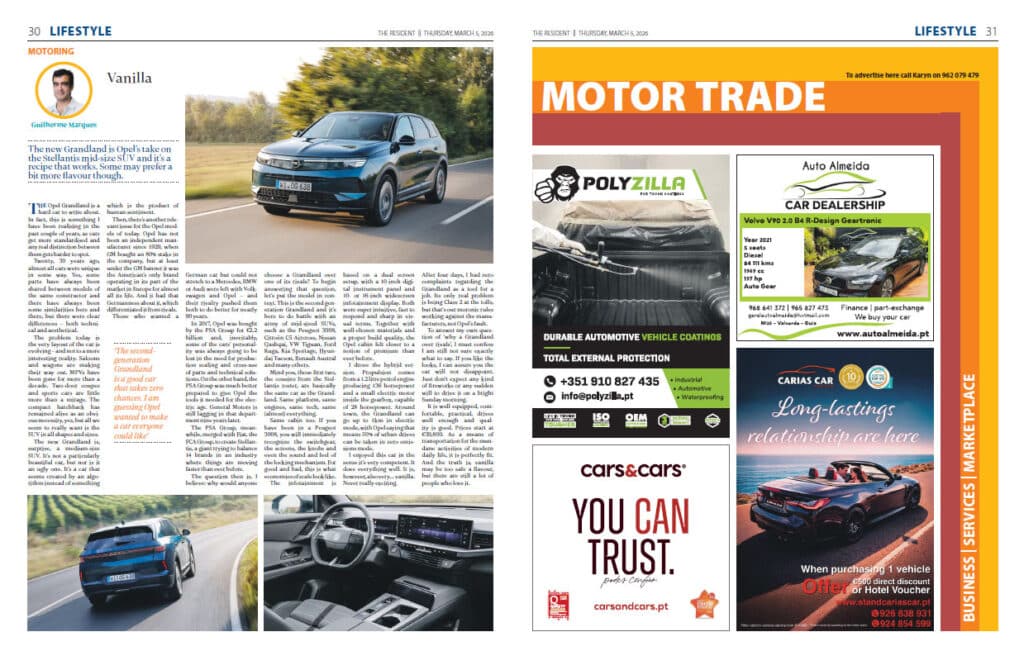
The Opel Grandland is a hard car to write about. In fact, this is something I have been realising in the past couple of years, as cars get more standardised and any real distinction between them gets harder to spot.
Twenty, 30 years ago, almost all cars were unique in some way. Yes, some parts have always been shared between models of the same constructor and there have always been some similarities here and there, but there were clear differences – both technical and aesthetical.
The problem today is the very layout of the car is evolving – and not to a more interesting reality. Saloons and wagons are making their way out. MPVs have been gone for more than a decade. Two-door coupes and sports cars are little more than a mirage. The compact hatchback has remained alive as an obvious necessity, yes, but all we seem to really want is the SUV in all shapes and sizes.
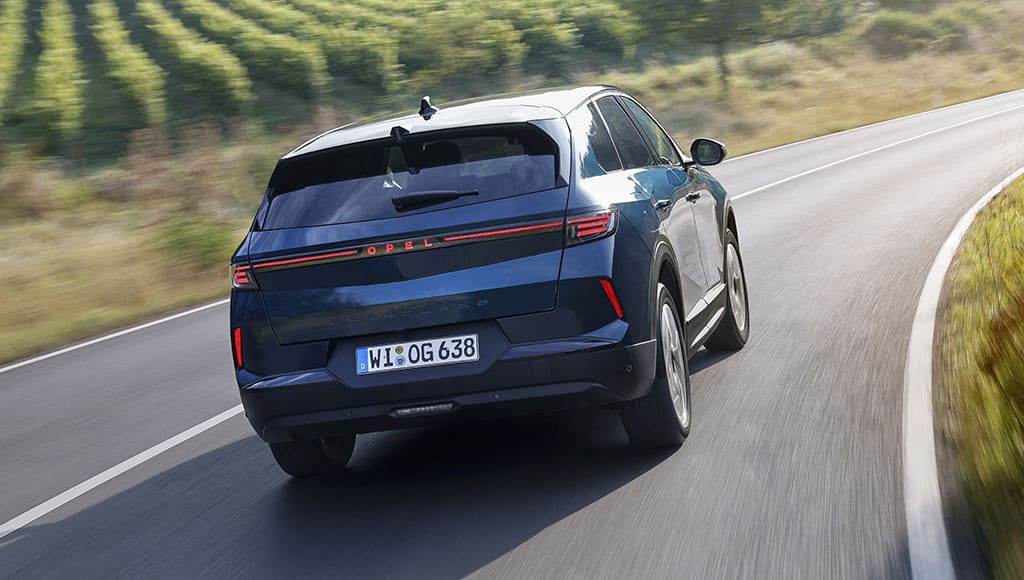
The new Grandland is, surprise, a medium-size SUV. It’s not a particularly beautiful car, but nor is it an ugly one. It’s a car that seems created by an algorithm instead of something which is the product of human sentiment.
Then, there’s another relevant issue for the Opel models of today. Opel has not been an independent manufacturer since 1929, when GM bought an 80% stake in the company, but at least under the GM banner it was the American’s only brand operating in its part of the market in Europe for almost all its life. And it had that Germanness about it, which differentiated it from rivals.
Those who wanted a German car but could not stretch to a Mercedes, BMW or Audi were left with Volkswagen and Opel – and their rivalry pushed them both to do better for nearly 90 years.
In 2017, Opel was bought by the PSA Group for €2.2 billion and, inevitably, some of the cars’ personality was always going to be lost in the need for production scaling and cross-use of parts and technical solutions. On the other hand, the PSA Group was much better prepared to give Opel the tools it needed for the electric age. General Motors is still lagging in that department nine years later.
The PSA Group, meanwhile, merged with Fiat, the FCA Group, to create Stellantis, a giant trying to balance 14 brands in an industry where things are moving faster than ever before.
The question then is, I believe: why would anyone choose a Grandland over one of its rivals? To begin answering that question, let’s put the model in context. This is the second generation Grandland and it’s here to do battle with an army of mid-sized SUVs, such as the Peugeot 3008, Citroën C5 Aircross, Nissan Qashqai, VW Tiguan, Ford Kuga, Kia Sportage, Hyundai Tucson, Renault Austral and many others.
Mind you, those first two, the cousins from the Stellantis roster, are basically the same car as the Grandland. Same platform, same engines, same tech, same (almost) everything.
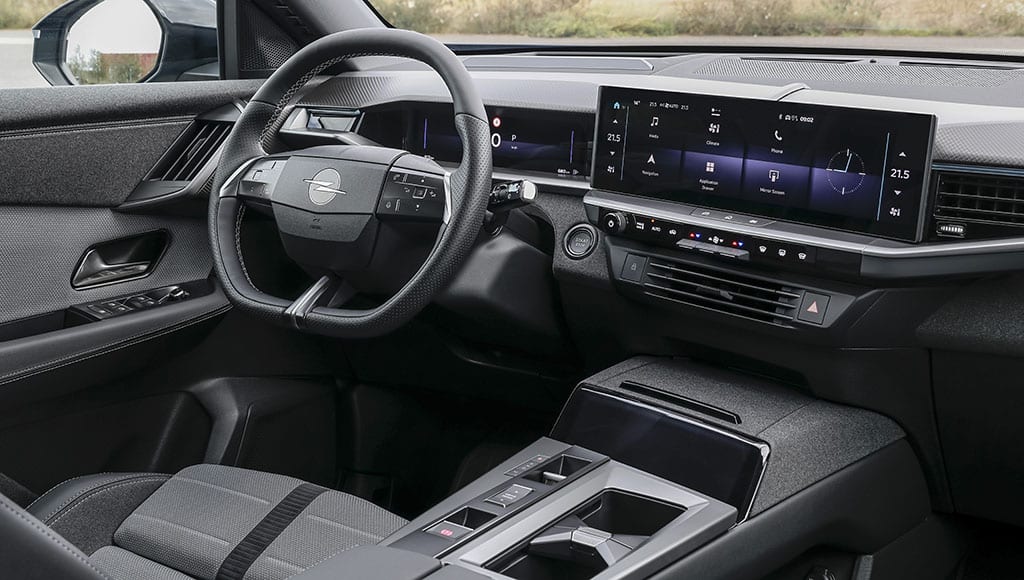
Same cabin too. If you have been in a Peugeot 3008, you will immediately recognize the switchgear, the screens, the knobs and even the sound and feel of the locking mechanism. For good and bad, this is what economies of scale look like.
The infotainment is based on a dual screen setup, with a 10-inch digital instrument panel and 10- or 16-inch widescreen infotainment display. Both were super intuitive, fast to respond and sharp in visual terms. Together with well-chosen materials and a proper build quality, the Opel cabin felt closer to a notion of premium than ever before.
I drove the hybrid version. Propulsion comes from a 1.2 litre petrol engine producing 136 horsepower and a small electric motor inside the gearbox, capable of 28 horsepower. Around town, the Grandland can go up to 1km in electric mode, with Opel saying that means 50% of urban drives can be taken in zero emissions mode.
I enjoyed this car in the sense it’s very competent. It does everything well. It is, however, also very… vanilla. Never really exciting.
After four days, I had zero complaints regarding the Grandland as a tool for a job. Its only real problem is being Class 2 at the tolls, but that’s our moronic rules working against the manufacturers, not Opel’s fault.
To answer my own question of ‘why a Grandland over rivals’, I must confess I am still not sure exactly what to say. If you like the looks, I can assure you the car will not disappoint. Just don’t expect any kind of fireworks or any sudden will to drive it on a bright Sunday morning.
It is well equipped, comfortable, practical, drives well enough and quality is good. Prices start at €39,800. As a means of transportation for the mundane activities of modern daily life, it is perfectly fit. And the truth is, vanilla may be too safe a flavour, but there are still a lot of people who love it.
Read more from Guilherme Marques about motoring: Volvo still
MOTOR TRADE | Business, Services, Marketplace – CLICK HERE