Crossing the line or dividing opinions might certainly be an outcome of this conversation but let me assure you that my intention is purely driven by a desire to understand what lies behind the culinary phenomenon of a picanha cut, and to learn how to treat it in the kitchen with utmost respect.
I had never come across picanha before arriving to Portugal, and I must confess that our relationship was not ‘love at first sight’. Having had some unfortunate early experiences of receiving an overcooked version, I have categorised this cut as ‘challenging’ and filed it away into a ‘no, thank you’ pile.
My efforts to avoid it, however, were constantly thwarted. Picanha kept coming at me as an emphatic admirer asking for a second date. A visit to a local butcher, I see picanha. A trip to a churrasqueira, I see picanha. An invitation to a friend’s BBQ, I see picanha. If it is everywhere, I thought, there must be something to it! Well, as it turns out, there is a lot.
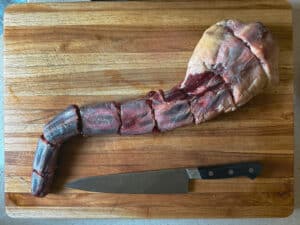
Picanha is a beloved Brazilian cut that has been brought to Portugal by the very Brazilians who chose to make a home in Europe. In fact, it is so popular in its home country that one can hardly imagine a family gathering or a friendly get-together without it. Known outside the Portuguese-speaking world as a rump cap, a top sirloin cap or culotte, it is the cut of the biceps femoris muscle of the cow, located near the tail.
Its name derives from the Portuguese word picar, meaning ‘to prick’ or ‘poke’, referring to the way gauchos (South American cowboys) used a pole called picana to prod cattle. The spot where the cattle was prodded is exactly the location of the cut.
A thick layer of fat on one side and its triangular shape are the distinctive features of picanha. They are also a homage to the Brazilian butchery techniques. In Europe, for example in France, the equivalent of picanha is often included in other cuts, like a larger rump steak or a top sirloin with the fat significantly trimmed.
It’s naturally lean and the dark red meat is also unique due to the direction of the meat grain. Unlike other steaks that are more linear and run in one direction, the grain of picanha runs in a curved, fan-like pattern due to its shape and muscle structure.
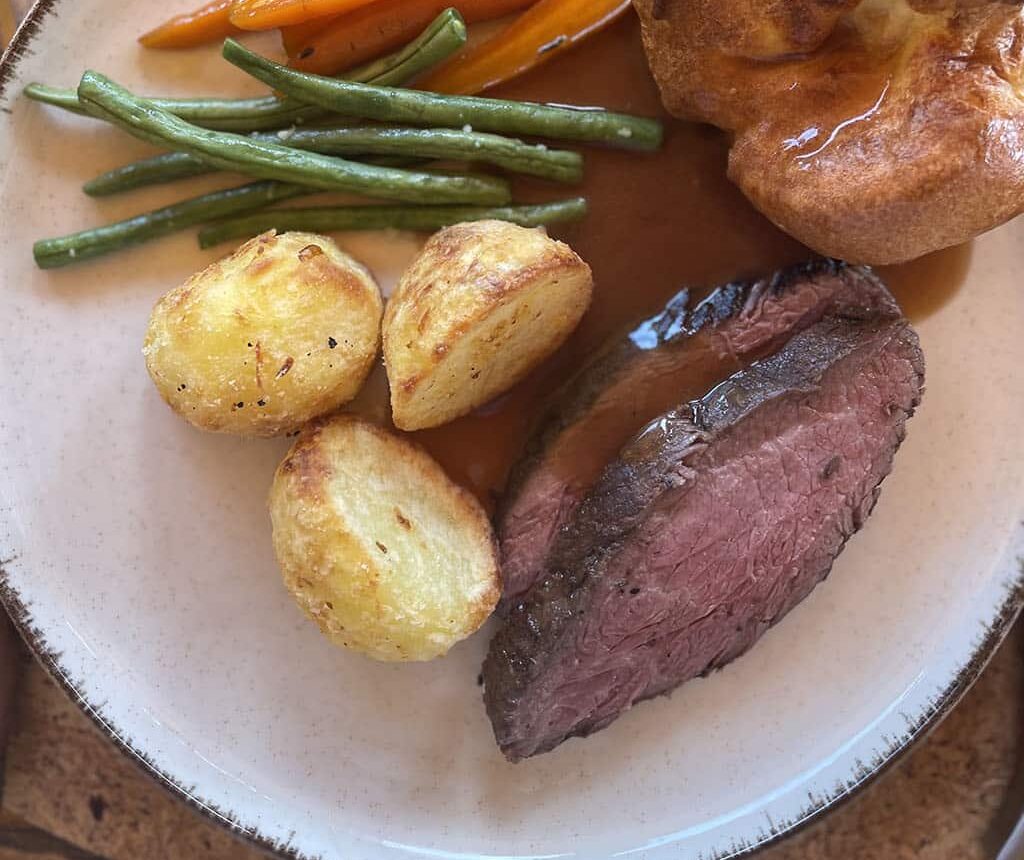
To achieve tenderness, picanha must be sliced against the grain, especially when serving. The grain’s curve means the angle of the cuts needs to be constantly adjusted ensuring that the final cut performed by a consuming carnivore goes against the grain. If sliced with the grain, picanha can be tough and chewy, as the long muscle fibres remain intact (most likely the reason for my unpleasant experience).
So, if picanha is prepared for steaks, the steak portions need to be cut lengthwise, for when it arrives on the plate, the final cut goes against the grain. This creates small slices of steak rather than the usual shape.
However, if it is destined for the traditional churrasqueira barbecue skewers, it is prepared by cutting across the grain. The meat is then folding it into a C-shape with the fat cap on top and pierced through. When it arrives to the diner, it is sliced from the skewer into fine strips going, again, against the grain.
The fat cap of picanha also plays an important role. It imparts rich flavour and additional tenderness as the meat bastes in it during cooking. Coincidentally, or not, the fat can penetrate deeper into the lengthy fibres of picanha rendering the meat luscious and juicy. Served with sides like feijoada (bean stew), farofa (toasted cassava flour), vinagrete (Brazilian salsa) and rice, in Brazil it is nothing short of a food icon.
Picanha’s simplicity resonated with Portugal’s love for robust, minimally seasoned dishes like bacalhau (cod) or grilled sardines. Its versatility also allowed it to be adapted into Portuguese menus, where it appears alongside batatas fritas (fries), arroz de feijão (bean rice), piri-piri, local cheeses and vinho verde.
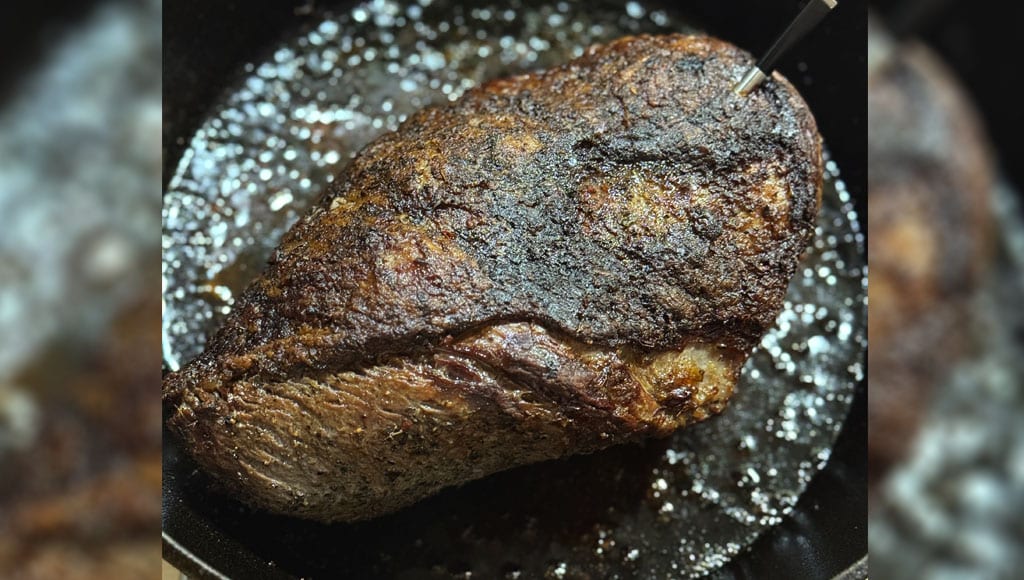
As my relationship with picanha took on a positive turn, I have discovered that aside from barbecuing, it can also be cooked as a roast. I have tried doing it in two ways – oven-roasting and sous vide cooking.
When cooking in an oven, two things are essential for getting the best results: rendering the fat cap of the meat as much as possible and controlling its internal temperature. In my experience, it should be cooked around 50ºC and given a good time to rest.
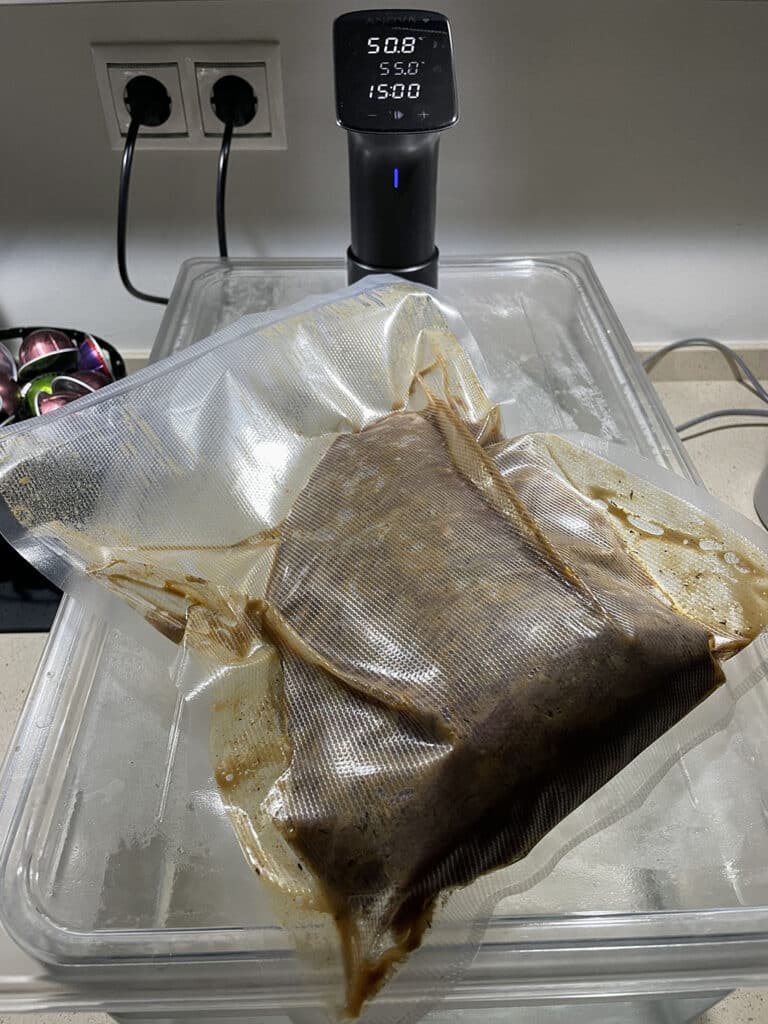
When cooking sous vide, I used a recipe that submerged vacuum-packed picanha for a 15-hour water bath at 55ºC. For that, I have trimmed a bit of the fat. Though as delicious as it is, after the bath, the meat only required a quick flash searing in the pan. Hence, I didn’t want to overcook it through the lengthy rendering. In both cases, picanha’s flavour was enhanced by an overnight dry rub of a mixture of salt and pepper. Deliciously tender and buttery, the result was a perfect feast of joy and flavour on both occasions.