To read from the start click here.
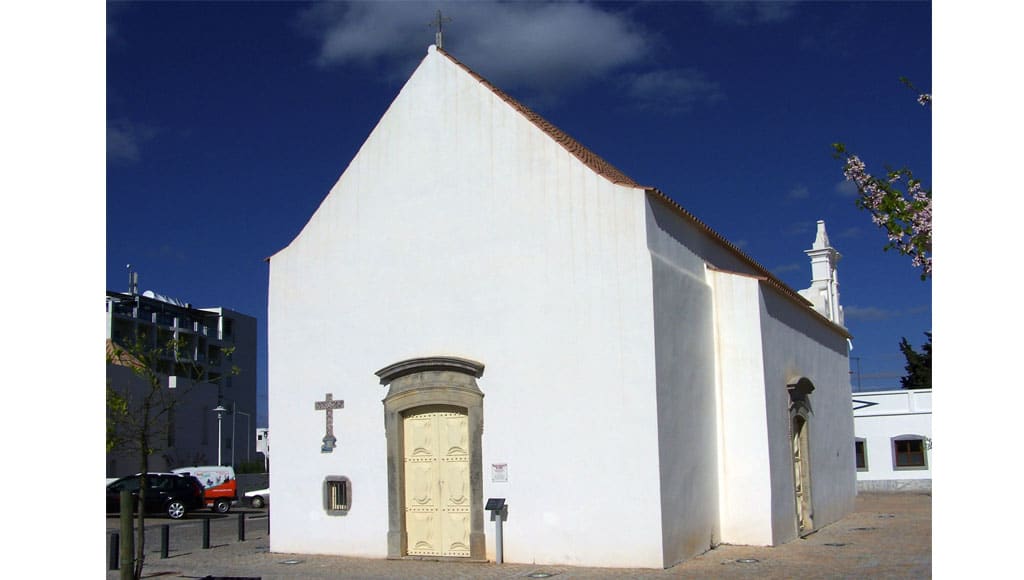
The quadrangle of buildings containing this chapel was one of the two residences permitted to the Governor of the Algarve and, after the Great Earthquake of 1755 had destroyed his residence in Lagos, he moved to Tavira, and he used Santa Ana as his private chapel.
At the Implantation of the Republic, the chapel became state property and was bought by the Câmara (town hall) in 1936. It has since been restored twice, most recently in 2006, and it now serves as a small concert hall.
Next to the main altar, there is a small grave under a grey slab. The occupant is a five-month-old British baby, Henrique Hawker Gamage Williams, who died in 1818. It is extremely unusual to find a British grave in a Portuguese church because Anglican Britons were considered by the Portuguese Roman Catholic church to be heretics.
Henrique’s father was, in 1818, Colonel of the 14th Infantry Regiment stationed in Tavira, and at that time, he probably lived in the residence of the Governor of the Algarve. It is possible that he used his military authority to ensure the burial of his child, or perhaps even permitted Henrique to be baptized as a Catholic to ensure an appropriate tomb.
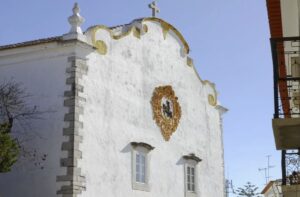
Next to the fire station, the Ermida de São Roque began life as a late Gothic building (i.e., early 1500s), at a time when the cult of São Roque was very popular in Portugal. It is sometimes referred to as the Chapel of Nossa Senhora do Rosário.
The Ermida was remodelled around 1755 by Diogo Tavares de Ataíde, who added the baroque features. São Roque became the patron of the Tavira Infantry Regiment and, after the regiment was disbanded in the 1830s because of its doubtful loyalty to the Queen, D Maria II, the building was used less and was finally abandoned in 1862.
Its religious artefacts were transferred to its parish church of Santiago. Tavira Câmara then used the building as a depository and later as a municipal kennel. During the restoration of 2016/18, frescoes were exposed on the wall around the altar, but this chapel has not yet been re-opened to the public.
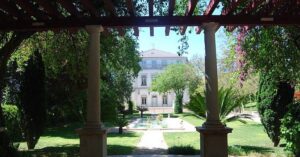
The Chapel of Nossa Senhora da Conceição belonged to Palacete Vaz Velho, the large house opposite the bus station, and it was deconsecrated in 1975. Next to the road, the archway topped with a cross indicates the access driveway to the chapel. The site has now been restored as Colégio Charm House. On the left road towards Fonte Salgada in the hamlet of Capelinha is the Chapel of Nossa Senhora dos Prazeres, now used as an agricultural store.
I suppose that this large and gaunt building was a part of the patrimony of the Andrade family. In 1852, Manuel Joaquim Tavares Pais de Sousa e Andrade was raised to the rank of Barão da Capelinha, and he also owned the large palacete on the northern side of Praça Dr António Padinha in Tavira, which is currently becoming another hotel.
A number of Tavira chapels has been demolished over the years. Nossa Senhora do Loreto was owned by the Corte Real family. It was from the palacete attached to this chapel that King D Sebastião witnessed a mock battle in the river, fought with oranges, between Christians and Moors.
The palacete and chapel were replaced by the public Jardim do Coreto in the 1880s. Santo António da Praça at the southern end of the Roman bridge was demolished in 1885 to make way for the Praça da República. There is no record of the crowded nature of this area, but the clearance effected in the 1880s has bequeathed a wonderful open space next to the river in the centre of the town.
The site of the chapel attached to the Recolhimento de São João Baptista in Corredoura is now occupied by Minipreço. Similar to the Bernardas, the Recolhimento was an early refuge for women, founded in 1747; it suffered the same fate as the other religious houses in 1834, and finally closed its doors when the last inmate died in 1878.
As it occupied a valuable site in the town centre, the buildings were soon auctioned. The chapel became the first home of the bombeiros and was eventually demolished in 1973. Next door to it on Corredoura was the chapel of Nossa Senhora da Caridade which was also connected with the shelter for young women. The last record we have of this chapel is of a visit made by Bishop Gomes de Avelar in 1798. The Ermida de São Domingos in the Assêca valley was in practice a farm building and was demolished just before the millennium.
The five new churches of Maná, Adventista do 7º Dia, Evangélica Pentecostal, Cristã Jesus é Vida and the Kingdom Hall of the Testemunhas de Jeová typically use existing buildings. None of these belongs to the Catholic church.
Within the two Tavira parishes today, there is a total of 19 consecrated and eight deconsecrated buildings and five demolished chapels in addition to the five new churches of different beliefs.
Conclusion
The history of this charming town can be accurately traced through the history of its churches. When the town was prosperous and wealthy, its inhabitants thought little of creating more chapels and churches, most of them sponsored by Confrarias, or Brotherhoods.
Conversely after the suppression of the monasteries and the removal of the seat of regional government to Faro, the town underwent an existential crisis.
The 1800s saw the gradual abandonment of many of the smaller chapels, and the relative poverty of the town ensured that the buildings were maintained only with difficulty, and in the 1960s and 1970s, the loss of the rich tuna industry was a major economic blow to Tavira and the maintenance of its churches.
The economic success brought mainly by the tourist industry, but also by the immigration of retirees from Northern Europe, and Portugal’s membership of the EU, has put a fresh spring into the step of Tavira. Churches and chapels are being restored to their former glory, some by the Câmara with European funding, while others are being restored privately.
José Saraiva’s comment (he said in 1987 that there were 37 churches in Tavira) has proved difficult to justify. It is right that Tavira should be proud of its singularly wealthy religious heritage, and we clearly need guidance to count the 37 churches concerned.
Whether he meant only those in the town, or perhaps in the two town parishes, or perhaps even the whole of the county of Tavira, we have come close to his estimate only by including modern foundations. He clearly included those establishments which had been deconsecrated, and put to other uses, and he must also have included those which had disappeared.
Read more from Peter Booker about Tavira – a dog’s eye view or Three women, Tavira and the Carnation Revolution.