
Describe the cucumber you eat, and I shall tell you where you are from. The first signs of the geographical predilection towards particular types of cucumbers started to become transparent when I moved from Belarus, Eastern Europe to the North of England.
During my early shopping trips, I noticed a certain favouritism towards a particular kind of a cucumber – an elongated, dark green variety, neatly packed into their plastic jackets, which, as I learned later, is known as a Hot House cucumber or an English cucumber. I was familiar with this variety since back at home it was an all-year-round solution to the absence of cucumbers in the winter. But to me, this was not the ‘real cucumber’. The situation begged the question, where did the real one go? The answer took some researching.
Botanically, cucumbers are classified as Cucumis sativus and belong to the Cucurbitaceae family together with zucchini, pumpkin, watermelon, and squash. All members of this family are known for a high-water content and for growing on sprawling, spiky vines with yellow flowers. Having originated in the Himalayas, cucumbers rapidly spread around the world where they adapted to the local milieu. Due to proximity, China was the earliest adopter, but the rest of the world promptly followed. Greeks cultivated the cucumbers, so did Romans. The Roman Emperor Tiberius was a big fan of the cucumbers, demanding their availability for his every meal. Equally was the king of Franks, Charlemagne, who grew them in his gardens in Italy, circa 8th-9th century. It was King Henry VIII who brought cucumbers to England on demand of his Spanish born wife, Catherine of Aragon, and from Spain cucumbers travelled across to the Americas.
Currently, there are somewhere around 100 varieties that can be categorised into Armenian, English, Garden, Gherkin, Kirby, Lemon, and Persian Cucumbers that differ in length (from 3-4 cm to 90 cm); flavour (bitter or sweet); appearance (green, yellow, orange, white and brown) and look and feel (prickly or smooth; straight or curved). The cucumber’s water retentive ability has earned them a high reputation as a kitchen staple. They have been believed to be remedial for skin ailments, particularly redness and inflammation, as well as a source of a vitamin and mineral packed hydration. By the 18th century, the march of cucumbers through the Western World experienced an interruption due to a belief that uncooked vegetables were harmful. The setback was short lived and was completely overcome with the introduction of pickles by Henry J. Heinz in 1876.
Eastern Europe, on the other hand, has never known such an interruption. Having arrived here via Byzantine trade routes, cucumbers quickly acclimatised to the Northern latitudes and gained profound popularity by the 10th century. The short summers in combination of the abundant harvest necessitated the housewives to come up with recipes that could preserve the harvest – pickling was the method of choice. By the 17th century, the pickling methods were perfected and the pickled cucumbers gained the recognition as local superfoods.
For example, in Russia the pickling marinades are taken very seriously. The common ingredients usually include dill, garlic, horseradish, black current leaves, salt and a bit of sugar. Some recipes also use cherry and oak leaves as a flavouring as well as all spice, black pepper and bay leaves. Traditionally, Russian pickles are fermented using a salt brine and rarely use vinegar. As a result, the local culinary language contains the differentiation between two types of pickles – kisliy ogurchik (sour cucumber) and solyoniy ogurchik (salty cucumber).
In addition to cucumbers themselves, the pickling liquid is also consumed. Named rossol, it often serves as a base of soups, sauces, and even some baking goods. In addition, rossol is believed to be a hangover cure, so the local households never throw away the marinade, even if the pickles are gone.
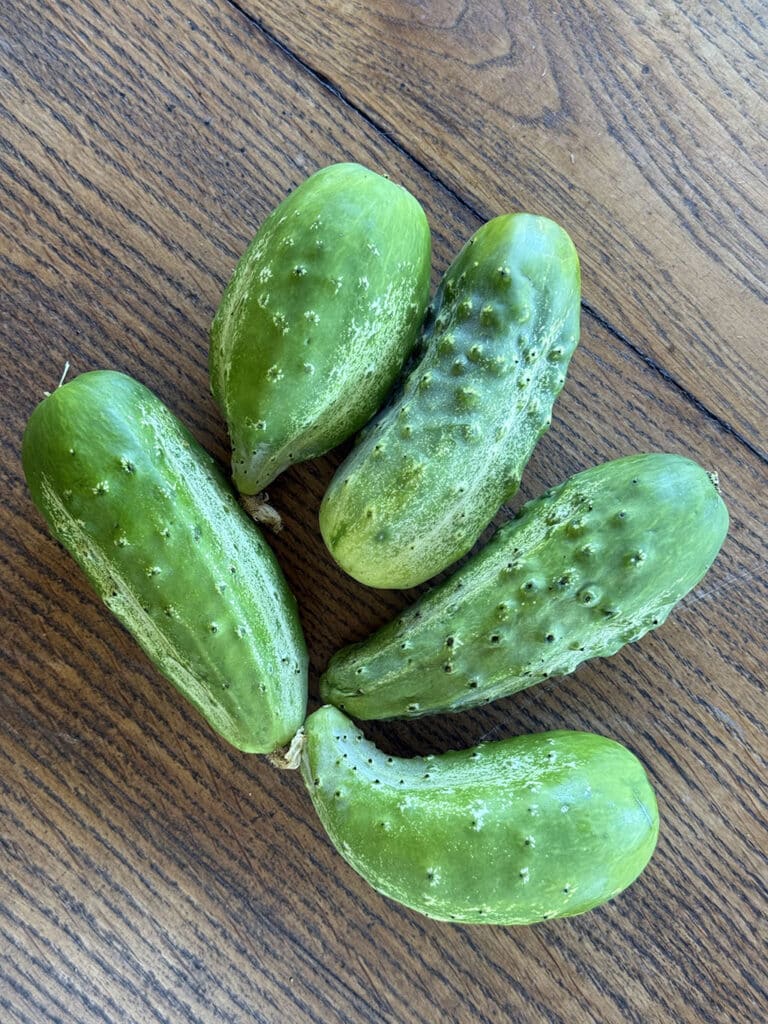
It is this affinity with pickling that has forged the East and West cucumber divide. Whilst the Western world grew progressively fond of varieties that can be easily sliced and consumed fresh, like the Hot House, aka English variety, the Eastern block remained faithful to those that could fit into the pickling jar. Unlike the slicers, pickling cucumbers usually have bumps on their skin along with “spines” that are black. Noted for the small size and warty skins, Gherkins are the typical pickling cucumbers.
Aside from appearance, the two families of cucumber, slicing and pickling, are also quite different in their flavour and texture. Whilst the English cucumbers are mild, slightly sweet with minimal bitterness, Gherkins are robust, tangy and somewhat mildly bitter with a stronger cucumber flavour. With regards to texture, the former are smooth, tender and somewhat softer, whilst the latter are firmer, crunchier and denser in texture.
It appears there is indeed a cucumber divide. Every place has its cucumber!