Welcome to the July night sky. This is the month when the planet Earth is at the point in its orbit when it is the furthest from the Sun. This makes the northern hemisphere summers slightly less hot than they could otherwise be.
The planet Mercury, during the first week of the month, is at its greatest eastern elongation from the evening Sun, but it will be difficult to see very low on the horizon just after the sunset.
The bright planet Venus is close to Uranus during the first week of the month and it will be seen as a morning object rising in the east three hours before sunrise.
The red planet Mars is a low evening object in the constellation of Leo, setting over in the west two hours after the Sun.
The gas giant planet Jupiter appears as a morning object from mid-July, and it will be seen low on the eastern horizon just one hour before sunrise.
The ringed planet Saturn is at the moment in the constellation of Pisces, and it rises over in the east at midnight. Saturn is close to the planet Neptune, and the last quarter Moon is near to them both on the night of the 16th.
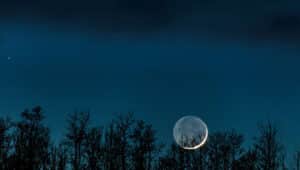
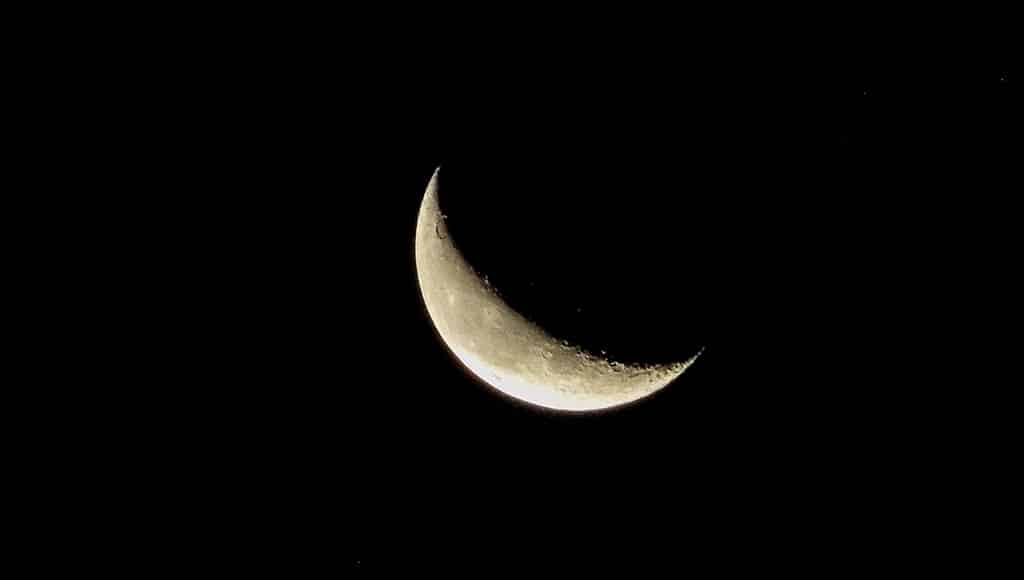
On the 23rd, the thin crescent Moon is near to Jupiter, and on the 28th the Moon is close to the red planet Mars.
On July 30, we have two meteor showers, the first is Delta-Aquarids and the second is Alpha-Capricornids. The Moon is barely visible at this time, but these two showers are not very noticeable.
Overhead during July nights, we have the constellation of Hercules, and it contains the globular cluster M13. This is the brightest in the northern hemisphere sky and well visible in small binoculars.
Also well visible this month are the three stars known as the Summer Triangle. This triangle points south with the star Altair at its lowest point. This star is close to the Sun at only 16 light years distance. It is twice the mass of the Sun and 11 times brighter. It is a very young star just 2% of the Sun.
At the top right-hand of the triangle, we have Vega. This is a white star 25 light years away, and 12% the age of the Sun, and twice its mass, it is 15% brighter. It used to be the northern pole star 14,000 years ago.
The last star of the three is called Deneb and besides being approximately the same brightness of the other two stars, it is in fact much bigger, much brighter and much further away. Deneb is about 200,000 times the luminosity of the Sun and 200 times the radius. This star is just 11 million years old and over 2,000 light years away. It is a blue super-giant star and one of the biggest in our galaxy.
The Moon is at first quarter on the 2nd,full on 10th, last quarter on the 18th and new on July 24.
Camera Obscura
281 322 527 | info@torredetavira.com www.torredetavira.com
To see the July Sky Map, click on the link below