To read from the start click here.
The Religious Foundations
The English use of the words mosteiro and convento show that a monastery is for men and a convent is for women, but the Portuguese use is different.
A mosteiro is a closed order, where the members remain secluded from public gaze for their lifetime; a convento is used by an open order, where the members are supposed to mix with the general public both to collect alms and to evangelise; these orders are often referred to as mendicant orders.
Of the 25 foundations, no fewer than six were in Tavira. One was a mosteiro, a foundation for women, and the other five were male conventos. These five were suppressed in 1834, and the women’s Mosteiro de Nossa Senhora da Piedade remained open on condition that it admit no novices and closed only when its last sister died in 1862.
At the time they were built, these houses built in Tavira were at the edges of the habitation areas of the town. A women’s refuge formed a seventh house. The Recolhimento de São João Baptista was founded in 1747, and was also closed in 1834 even though it did not belong to a religious order.
The six religious houses in the town were, in order of foundation:
Convento de São Francisco – 1312-1834 (Franciscan friars)
Mosteiro de Nossa Senhora da Piedade – 1509-1862 (Cistercian nuns)
Convento de Nossa Senhora da Graça – 1542-1834 (Augustine hermits)
Convento de São Paulo – 1606-1834 (Hermits of St Paul)
Convento de Santo António – 1612-1834 (Hooded friars of piety)
Convento de Nossa Senhora do Carmo – 1745-1834 (Barefoot Carmelites)
Convento de São Francisco 1312-1834
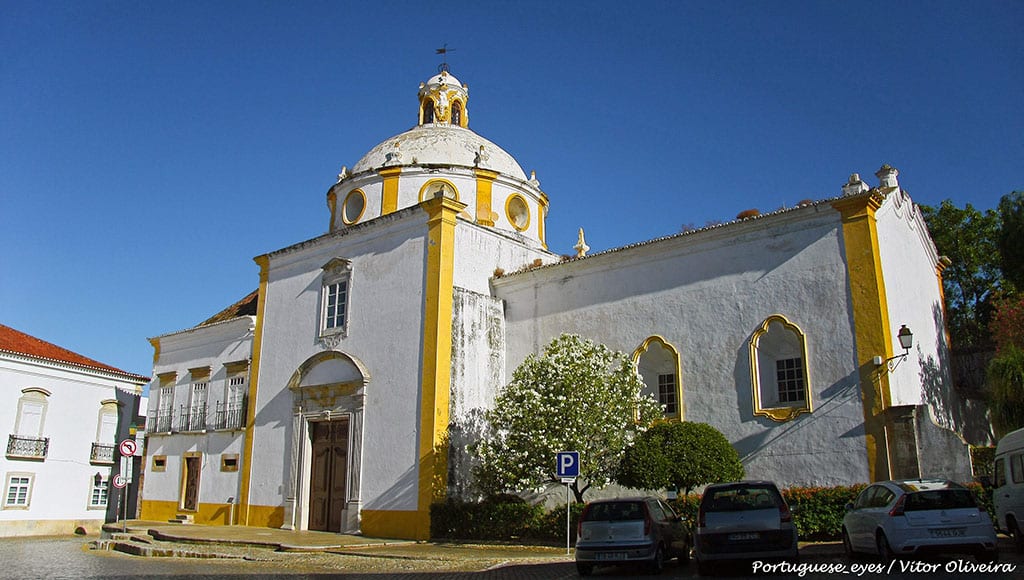
(now Igreja da Ordem Terceira de São Francisco)
The first religious house to be founded in the Algarve was built some distance outside the town walls of Tavira during the reign of D Diniz (1279-1325). It was a Franciscan house and, at times, it was home to 40 friars.
There is a theory that this foundation belonged originally to the Templars, but I do not find the argument convincing. The Order of the Knights Templar was suppressed in 1312, and in 1317, D Diniz created the Order of Christ in Portugal for those Templar knights who had survived.
In 1319, the king ensured by agreement with the Pope that Templar property in Portugal was bestowed on the newly-formed Order of Christ, not on the Franciscans.
The earthquakes of 1722 and 1755 each caused significant damage to the buildings of this convento. It is recorded that the earthquake of 1722 happened on December 27 at six o’clock in the evening, and it made the walls of the refectory shake as the friars were having their supper. Typically, after saying their prayers, they fell to disciplining themselves.
From 1723 until 1755, this Franciscan community held a procession on December 27 to mark the anniversary of the earthquake. After the Great Earthquake which occurred on November 1, 1755, they instead held their procession on the anniversary of the Great Earthquake.
There remains little of the original gothic building, except for the rarely open sacristy. It has a six-sided dome which is supported by gothic capitals decorated with foliage. The adjacent garden retains a small element of the original cloister, in what appear to be two small chapels. One of these chapels has an open lantern above the apex of the vaulting.
This design must be well built, since it has survived for seven centuries. The rest of the church building has been the subject of a great deal of remodelling and reorientation over the ages. This church is remarkable because it has no fewer than three cupolas; one over the entrance, another over the transept crossing, and the third above a disused side chapel.
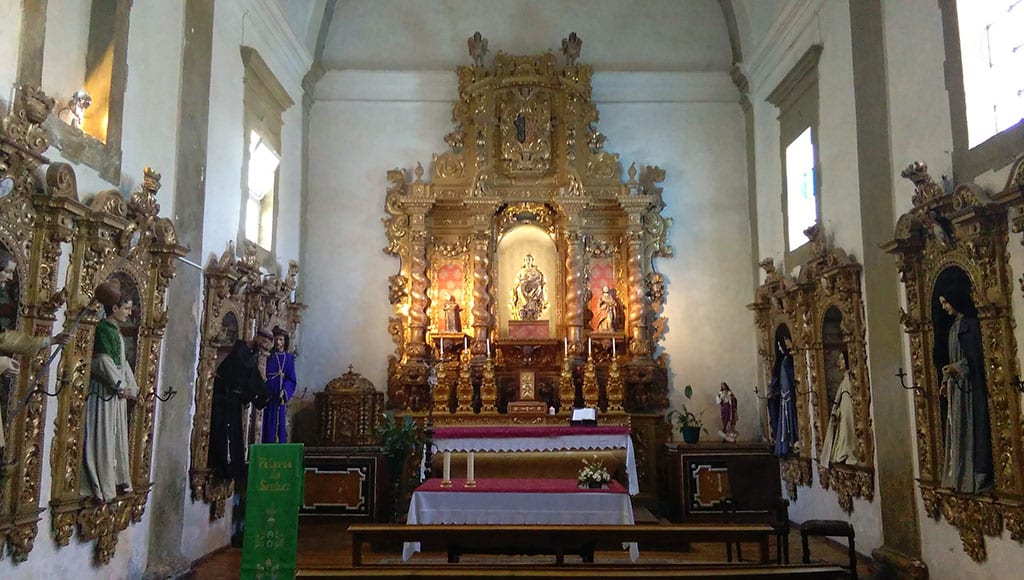
The chapel on the right as you enter the church is an 18th-century construction, and contains no less than 15 holy images, mainly of saints.
The Third Order of São Francisco had come into being in 1670, and when the religious orders were suppressed in 1834, the Third Order acquired the building.
The chapel of the convento was reoriented so that the southern transept housed the high altar as it does today. The chapel then became the church of the Third Order.
Part of the church was damaged in 1843 by a spontaneous collapse, and it suffered further damage from a lightning strike and fire in 1881.
This church is still owned by the Brotherhood of the Third Order of St Francis, and it seems that this brotherhood is now in reduced circumstances and its numbers few and its members elderly. It seems that the cost of the upkeep of the church may be challenging and, for that reason, the church looks unkempt. It is thought that the Câmara (town hall) has plans to aid in its restoration.
In the ground beyond the high altar, there is one of the two 19th-century graveyards in the town, which must have been nearly full by the time the Municipal Cemetery was opened in 1918. The Franciscan cemetery may be glimpsed through the metal gate in the adjoining garden. This public garden was a part of the estate of the convento, and now belongs to the Câmara.
Mosteiro de Nossa Senhora da Piedade 1509-1862 (Cistercian nuns)
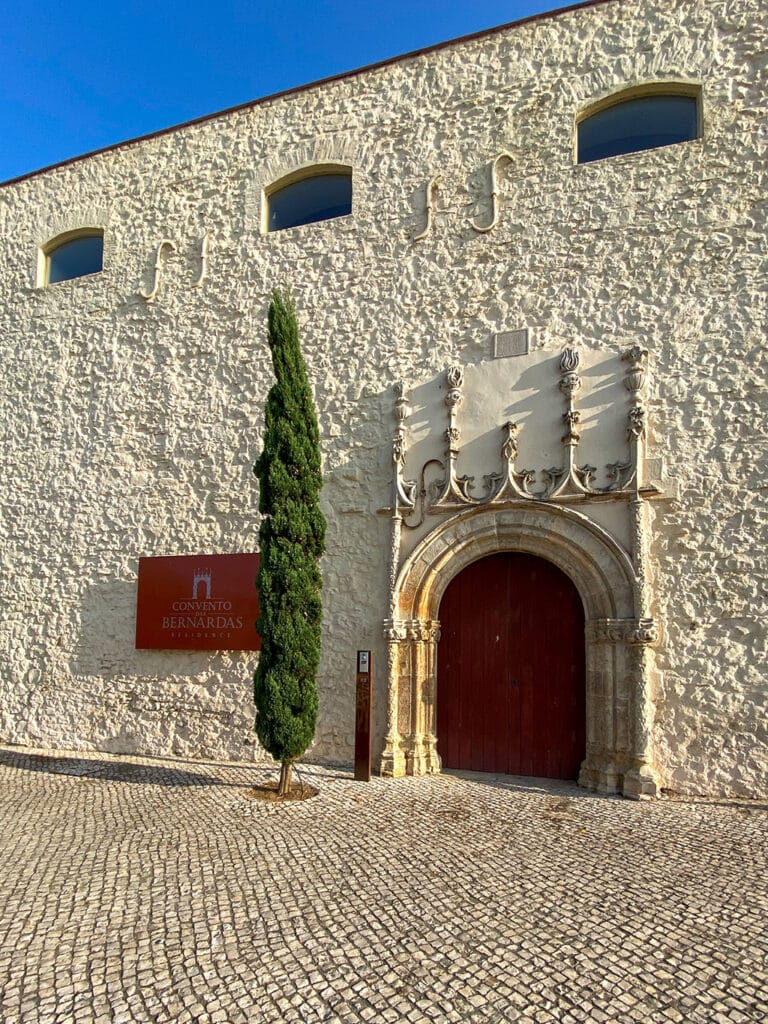
(or Mosteiro das Bernardas or Mosteiro de Santa Clara; now luxury flats)
The mosteiro was founded in 1509 by D Manuel I as a thanksgiving for the successful resistance to the siege of Arzila, a Portuguese fortress in Morocco.
There were four Cistercian houses south of the Tejo: at Portalegre, Setúbal, Évora and this one in Tavira.
This mosteiro is often called the Bernardas, thus paying respect to St Bernard who was so influential in the development of the Cistercian order of St Benedict. With its places for up to 77 occupants, and its cloister in two storeys, this foundation was the biggest of the 25 religious houses in the Algarve.
The house was well endowed, receiving rents from properties in Lagos, Loulé, Albufeira, Castro Marim as well as Tavira.
The nunnery was founded at a location some distance outside the town walls in the Atalaia plain and was ready for occupation by 1530. Most entrants were from the Algarve, and others came from the Alentejo and the Azores.
We know that for those rich enough to pay their way, this nunnery also served as a refugefor women with no male protector, usually orphans or widows. While this arrangement was especially useful to those women whose menfolk had died in the royal service, it was not free, and those women who took advantage of it were expected to pay generously. And they were expected also to dress modestly, without either jewels or silks.
In 1788, there were 28 nuns, two novices and 15 educandas (young women being educated).
The building was heavily damaged in the Great Earthquake of 1755, to the extent that the nuns had to move out while repairs were made. In a cooperative way, the friars of São Paulo moved out of their convento so that the nuns could live there while their mosteiro was being rebuilt.
During the occupation of Portugal by French and Spanish troops (1807/08), this mosteiro was pillaged, although there is no report that any of the sisters was molested.
After the suppression in 1834, all of the nuns of the Algarve were moved to a central house in Faro, but because the Bernardas was the biggest mosteiro in the Algarve, it was soon decided that they should all be housed here.
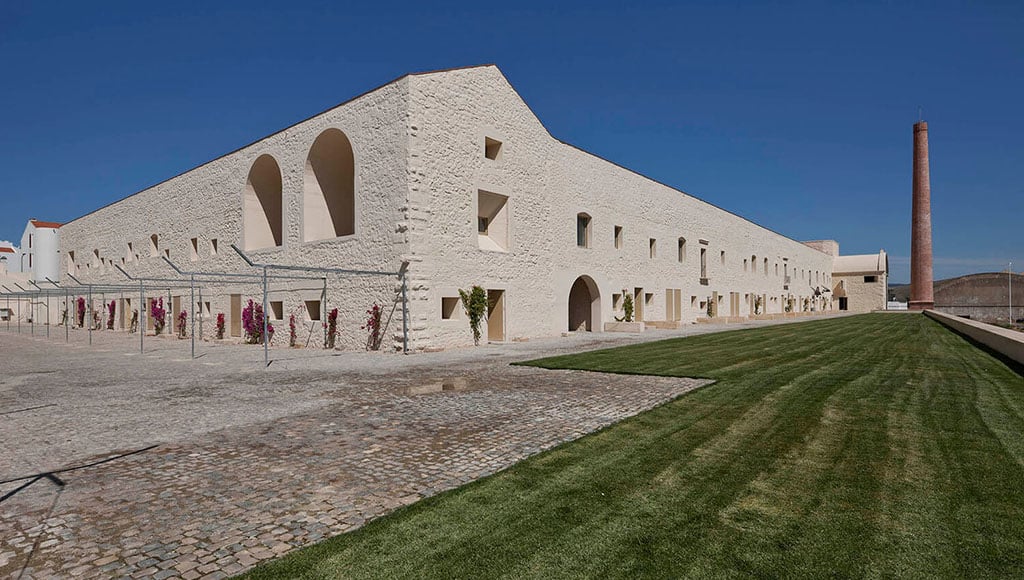
After the last one died in 1862, the site was sold at auction and, in 1890, became the Fábrica de Moagem e Massas a Vapor. It was a flour mill powered by steam (which is the reason for the tall chimney at the corner of the site). This mill operated until 1968, after which it was abandoned.
Huts and shacks had been built against its walls, and only in 2008 was the site cleared so that conversion to the present luxury apartments could begin, and they went onto the market in 2012. The architect was the famous Eduardo Souto de Moura, and the street outside is named after him.
This mosteiro is famous for the Manueline doorway which is typical of the heavily decorated Manueline gothic style. The doorway can be seen from the street, and in common with female houses, it was built into the centre of the side of the nave of the chapel, allowing public access.
The nuns would have attended divine service out of sight behind a grill, while outsiders could attend the service in the main body of the chapel.
To read part 4 click here.
Read more from Peter Booker about Tavira – a dog’s eye view or Three women, Tavira and the Carnation Revolution.