Cepelinai are one of such flavours for me, a distant memory from childhood that I mostly heard about rather than tasted. Being a national dish of Lithuania, which borders Belarus, the place where I grew up, these large potato dumplings have escaped my attention for a long time.
The term “potato dumpling” in English language refers to a wide variety of potato dishes in European cuisine. Austrian kartoffelknödel, German katroffekklösse, Belarusian draniki, Polish pierogi, Ukrainian halushki or Russian vareniki are all variations of a ‘potato plus stuffing’ kind of dish. Asking for one in Vilnius will get you the cepelinai.
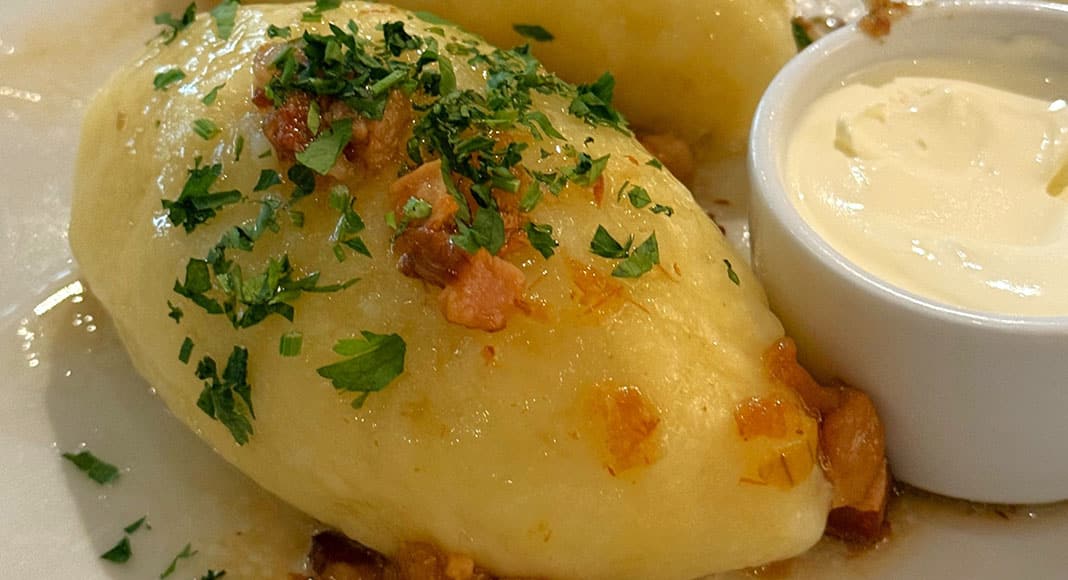
The name cepelinai, or zeppelins, as one might have guessed, comes from its shape. These elongated, oblong-looking dumplings have indeed been re-named for its remarkable resemblance of the Count Ferdinand von Zeppelin’s airship that took to the skies early 1900s. The dish used to be known as didžkukuliai, aka the big dumplings, or dumb-bells.
Interestingly, the dish’s culinary and historical prominence also gains momentum right around that time too. To begin, potatoes were introduced in Lithuania by the King of Poland and Grand Duke of Lithuania John III Sobieski at the end of 17th century. First met with caution, they gained popularity by the end of the 18th century for their ability to feed families as well as for their plentiful harvests on fertile Lithuanian soils.
Judging by the name, one could surmise that cepelinai is a dish with German roots. However, as several sources suggest, it is more likely that its invention can be attributed to the local Jewish population, known as Litvaks.
Litvaks used to manage many hotels and eating establishments in the area around the time between the two great wars, and probably had been forced to exercise some ingredient ingenuity at a time of scarcity.

Cepelinai are a labour of love. Though the basic recipe contains nothing more than potatoes and the stuffing, it is the time and attention that they require that stands out the most. Commonly, cepelinai are filled with pork mince, however, other meats are possible too.
The preparation of the meat is usually kept simple and flavoured merely with finely chopped onions and some fresh herbs. There are also variations of liver-, kidney-, mushroom- or cottage cheese-stuffed cepelinai, all of which are processed in a similar, simplistic fashion.
The secret of the dish is in working the potatoes. The texture of cepelinai is rather glutinous and chewy, so first and foremost, it is essential to choose the kind of potatoes that contain a high amount of starch.
Secondly, the potato dough is a combination of boiled and freshly-grated potatoes, commonly with 1:2 ratio. Adding more boiled potatoes will make the dough softer, and adding more grated potatoes will make it firmer.
To reach the desired consistency, it is recommended for the boiled potatoes to be put through a ricer to ensure velvety and homogenous consistency.
The fresh ones are finely grated and firmly squeezed to remove as much liquid as possible. The liquid is reserved in a bowl to separate the starch that will settle at the bottom. The liquid itself is often used for boiling the cepelinai later; the starch is actually the sought-after ingredient. This reclaimed treasure is added to the boiled and fresh potato mixture to increase the level of viscosity of the dough. This could also be corrected by adding some potato starch powder, and never by adding flour.
To make a cepelinas (singular form), spread the dough onto a palm and add a tablespoon of stuffing in the middle. Close the edges and form an oval, zeppelin-like shaped dumpling. Place it in well salted, boiling water (possibly containing the potato liquid reserved from the earlier steps), and cook for 15-20 minutes after the dumpling surfaces. Serve with a generous dollop of dill-infused sour cream and bacon bits.