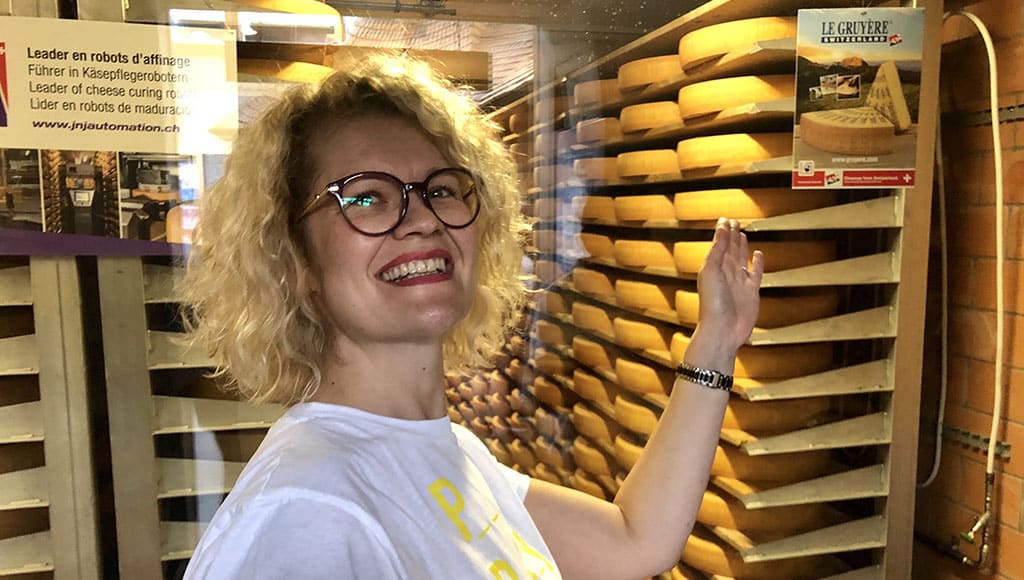
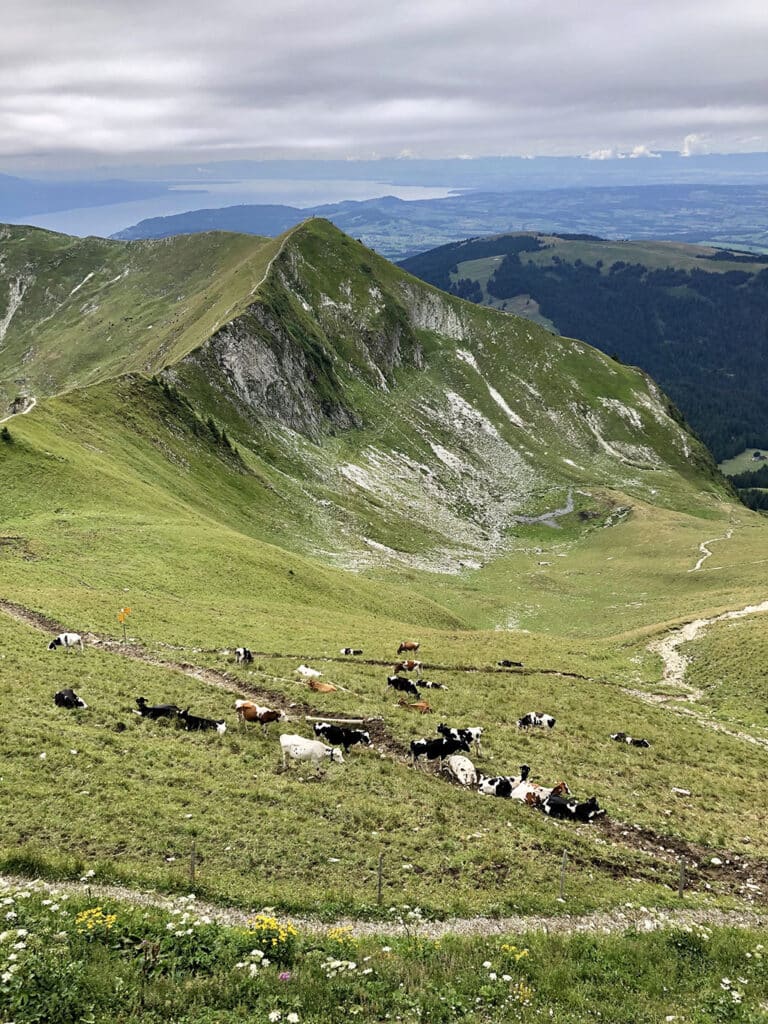
It all begins with the Swiss natural beauty. Its breathtaking mountains and idyllic meadows are not only eye-catching and beautiful, they also form a unique agricultural habitat. The vegetative variety that they offer is what lies behind the unique Swiss cheese production. Harvesting it, however, requires a gentle equilibrium between people, animals and pastures.
Filled with delicious grass, flowers and herbs, the fields welcome grazers, like cows, and lure them into long wanderings up the Alpine slopes. Some animals spend whole summers up in the mountains, which is known amongst the cheesemakers as transhumance, or alpage.
Traditionally, the technique is associated with the cheese called Sbrinz from central Switzerland and was later adopted by other cheese producers. Though there are now high-altitude Emmental, Gruyère and Appenzeller, the total number of all such cheeses combined makes up only a mere 1-2% of the total production of the country.
The high-altitude cheese production is wholeheartedly artisanal, with minimal mechanical aids. Often, herds consist of cows from several owners, and every year owners take turns in caring for them. It involves spending the whole summer together, ensuring the herd’s comfort and safety, and, most importantly, making the cheese right there on site.
Two peculiarities are typical of this type of cheese. Firstly, it has to have a long shelf-life to be transported down the mountain later in the year. Secondly, it needs to be made with very little salt, as it is difficult to haul salt up the mountain.
In cheesemaking, one of the primary uses of salt is to extract moisture (i.e., whey) from the curds, along with preservation and flavour building. A lack thereof has necessitated the Alpine cheesemakers to develop a way to work around that.
At the start, the milk is placed in copper cauldrons that are heated over the wood fire. As the milk curdles, the cheesemaker breaks it into small, rice-size pieces to increase the surface area to extract more moisture. In addition, the curds are stirred vigorously and are cooked at a high temperature (52-55ºC) for an extended period of time.
To continue extraction, the curds are pressed into molds under a heavy weight, as much as 500kg. The resulting wheel is then basted in brine for some time, and left to begin ageing in the local chalet, where the work takes place. Later, it is transported into the valley to complete the ageing journey, lasting on average 12-18 months.
The low-salt environment has another peculiar effect. Since the Alpine cheese is made with unpasteurised milk with very little salt, the meadow’s bacterial cultures, particularly the naturally available propionic bacteria, are retained.
As the cheese ages, the bacteria facilitate fermentation that results in, amongst other things, the formation of CO2. The cheese protein matrix captures this gas, and develops beautiful, big holes known as ‘eyes’.
Whilst some would think that producing delicious cheese might be enough to make a culinary mark on the world, the Swiss have not stopped there. They took their fondness of cheese to the next level and devised two iconic cheese dishes – fondue and raclette.
The classical fondue recipe comes from the French-speaking canton of Fribourg, and in terms of cheese, it uses a blend of equal parts Gruyère and Vacherin Fribourgeois AOP cheese. This is the reason why sometimes it is referred to as moitié-moitié, meaning half-half. The dish gets its name from the French verb fondre, meaning ‘to melt’, capturing its essence perfectly.
Fondue was born around the 18th century when Swiss villagers lived off the stale bread and aged cheese. In attempts to comfort themselves on cold winter days, they would melt up some cheese together with an abundance of garlic, white wine and Kirsch (cherry spirit). Later, fondue was popularised across Switzerland becoming the nation’s favourite, and reaching the status of national dish.
Raclette is a name that also has French roots. The verb racler means ‘to scrape’ and, similar to fondue, it has its own story. Legend has it that one day, somewhere in the mountains that now lie in the canton of Valais, a shepherd called Léon wanted to cook himself a warm meal by melting some cheese.
At the time, it involved placing a head of cheese near the heat source, a hearth or a fire. Generally, this would result in the melting of the whole head. But Léon came up with a technique of scraping the cheese from that roasting head as it melts, hence cooking and enjoying it gradually. This is how raclette was born.
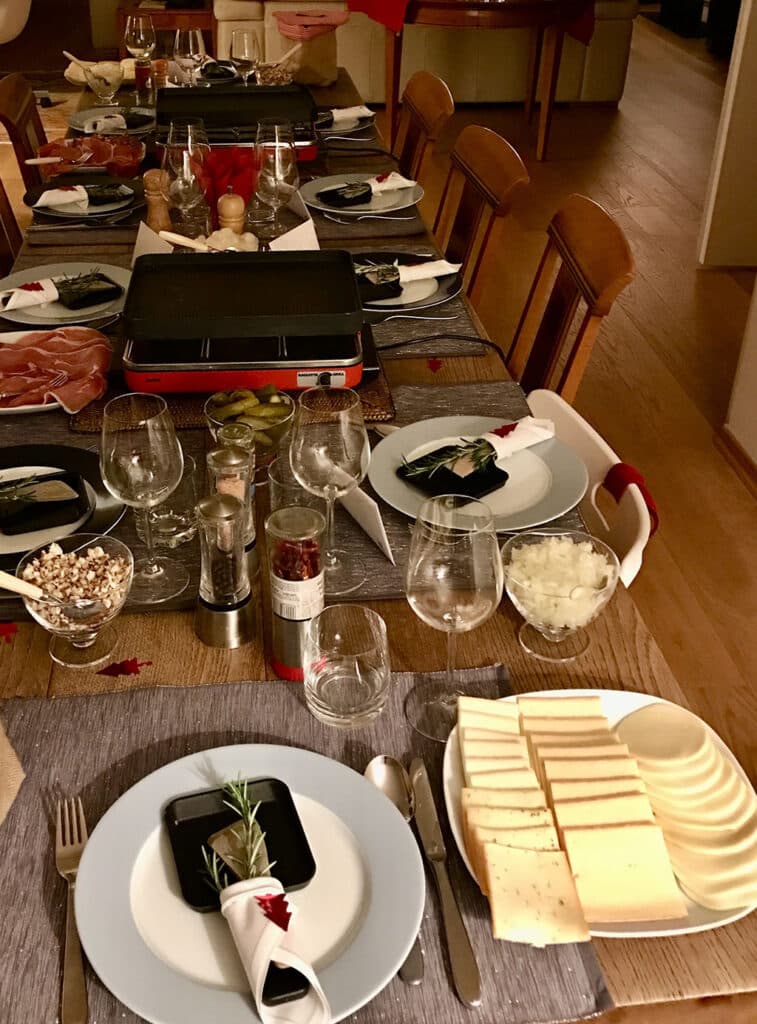
Bowing to the tradition, Switzerland still maintains Léon’s way of cooking raclette. It involves placing half a head of cheese, called demi-meule, under the heat source. Once the top layer is melted, the head is tilted to scrape it off onto potatoes. The cheese that is used for this dish has high melting properties. Commonly, it is a semi-soft cow’s milk cheese, and it is simply called the Raclette cheese. The classical accompaniments to raclette are charcuterie, gherkins, and pickled onions.
A modern way of eating raclette involves an electric raclette grill, where guests, equipped with the individual grilling pans, mix and match a wider set of accompaniments (such as roasted vegetables, mushrooms, nuts, apricots, apple slices, and others) and roast them under the grill together with cheese.
Undoubtedly, this convivial way of eating can warm up and cheer anyone on a cold winter’s day. So can a piece of chocolate, but that we shall leave for the next conversation.