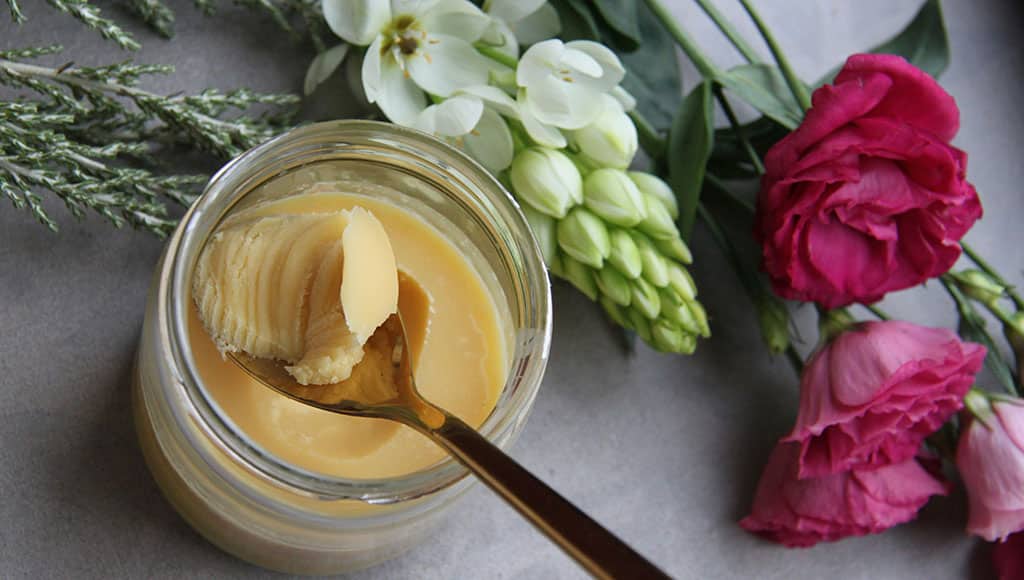
And he gobbled it up, not in moderation, mind you, but in immensely large quantities – stealing it from pots, smearing it on walls, sharing it with other children – and beaming his divine smile while doing so.
In the mythology of the Indian subcontinent, this butter thief with a peacock feather in his hair – blue skinned, wide-eyed and utterly incorrigible – was the country’s first dairy influencer.
He single-handedly established the spiritual status of ghee (which is what butter becomes after a slow and fragrant alchemy) that has now turned into an adopted darling of the Western wellness world.
For quite a while, ghee lived a life of quiet dignity in Indian households. It was poured on rice, added to sweets, massaged into babies, and lit in lamps during prayer as it nourished both the body and the spirit and was an edible metaphor for light itself. No one thought of branding it because ghee was simply there. Like family or gossip, you know?
But then came the modern age with its cholesterol charts and calorie counting and, suddenly, ghee was declared guilty by association. It was labelled “fattening,” a relic of indulgent times, and relegated to the back of the pantry.
Olive oil from mediterranean lands became the new craze, while ghee sulked quietly, smelling faintly of nostalgia.
However, it was not possible to keep the golden diva down for long and, one fine day, ghee got a passport. The details of its migration are a little hazy, but legend says it began when a yoga instructor from California visited Rishikesh, tasted dal tadka with its ghee laced cumin tempering, and had a spiritual awakening!
She flew back home carrying a jar in her suitcase which was wrapped in three layers of bubble wrap and one layer of cultural curiosity. And the rest, dear reader, is history.
Soon, ghee packed its bags, donned sunglasses, and flew business class to the West. There, it received a glamorous makeover. Gone was the steel tin, it now lived in glass jars with labels that said “Ancient Ayurvedic Wonder” and “Small-Batch, Ethically Sourced Goodness.”
The same ghee that once languished quietly next to pickle bottles in messy kitchens was suddenly posing on Instagram beside kale smoothies and quinoa bowls.
Back in the day, ghee lived a humble life. Grandmothers made it at home by melting butter till it sighed into liquid gold and filled the house with an aroma that could calm both cranky children and troubled souls.
But once it landed on alien shores, nutritionists declared it a miracle that was lactose-free, gut-friendly and rich in omega-3s, and cafés started adding it to coffee and selling it as energy fuel.
What our mothers used to stir into porridge became the ingredient-in-chief of bulletproof cappuccinos served in the minimalist cafés of Berlin, Amsterdam, and Copenhagen.
Yesterday, I was reading out the latest wellness article on ghee when my visiting Aunt appeared suddenly from my kitchen.
“You remember?” she questioned, shaking a ghee-smeared ladle at me.
“What?” I asked.
“The Indian rhyme I taught in your childhood,” she probed.
“Which one?” I mumbled.
“The goodness of ghee unlatched,” she prompted.
“No Mom or Dad can match,” I recited automatically.
Read Nickunj Malik’s last article: Staying alive