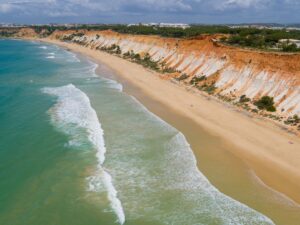
Environment minister Maria da Graça Carvalho has appealed to the “people of the Algarve, and the country” to let work on the desalination plant, to be located near Praia da Falésia in Albufeira, go ahead without further judicial battles.
Visiting ‘renaturalisation’ efforts on the Ancão Peninsula at Faro Beach on Saturday, the minister stressed “there is something I want to transmit, and ask the people of the Algarve, and the country: it is ‘let work begin’. Do not put any more obstacles in our way with injunctions or court cases, because that is preventing the Algarve from having the water it needs to develop,” she said – perpetuating the government mantra that the Algarve’s future water resilience lies in infrastructures such as the desalination plant (when opponents argue the region would have all the water it needs if large monocultures were not encouraged).
Ms Carvalho’s message was that “at the end of 2023, water stored in the Algarve was 24% (of available capacity). Now it is 87%” – but that could change quickly after a long, dry summer with millions of high-season visitors.
Again, opponents would point to the myriad works already effected (repairing leaky dams and municipal mains) as being some of the reasons for increased water capacity (and the minister did acknowledge these). The greatest concerns about the planned desalination plant have always been the pollution it threatens the natural environment (particularly the sea).
The minister’s message, however, was that, as things stand today, the plan for the plant – latest costing of which lies in the region of €108 million – is ready to start moving forwards in February.
If this happens, seawater could start being converted into ‘sweet water’ “by the end of 2026, or beginning of 2027” – and, in the minister’s view, would “help resolve the problem of water in the Algarve for 20 to 30 years”.
As the government has said in the past, the plant will be located in the municipality of Albufeira, integrating the Algarve’s multi-municipal water supply system, under the Regional Water Efficiency Plan.
The project is financed by the Sustainable Operational Programme 2030, with support from the Cohesion Fund and the Environmental Fund, and is designed to produce around 16 million cubic metres (m³) of water per year, with the possibility of generating up to 24 million m³/year in the future.
€800 million invested in water
Maria da Graça Carvalho took advantage of the occasion to recall that the Algarve will be receiving around €800 million in investments to solve ‘the water problem’, from the Recovery and Resilience Programme (PRR), the Sustainable Operational Programme 2030 and the Environmental Fund.
“Some of them, the smaller ones, have already been completed. There is already water from the Wastewater Treatment Plants (WWTP) for reuse,” she said, while the Pomarão water transfer project (another undertaking that has elicited local opposition) is currently out to tender.
The minister also highlighted coordination with Spain and the Alentejo region as “an example of cohesion within our country and with our neighbouring country, with works, savings and everything that the books say should be done in a water crisis – and we managed to solve it, also with the help of the rain,” she added.
Support for the government’s wider water strategy is not consensual and has even seen groups outside the Algarve ‘complain’ that everything being done is to aid agribusiness/ tourism at the expense of the natural environment.
In March last year, the ProTejo movement of citizens dubbed the government’s ‘Water that Unites strategy’ an “environmental and social disaster.
Sources: Barlavento/ Sul Informação