They boarded the river ferry at the railway station at Barreiro and disembarked at the Terreiro do Paço, in central Lisbon, some 40 minutes later and climbed into their landau for the last leg of their journey to the Necessidades Palace.
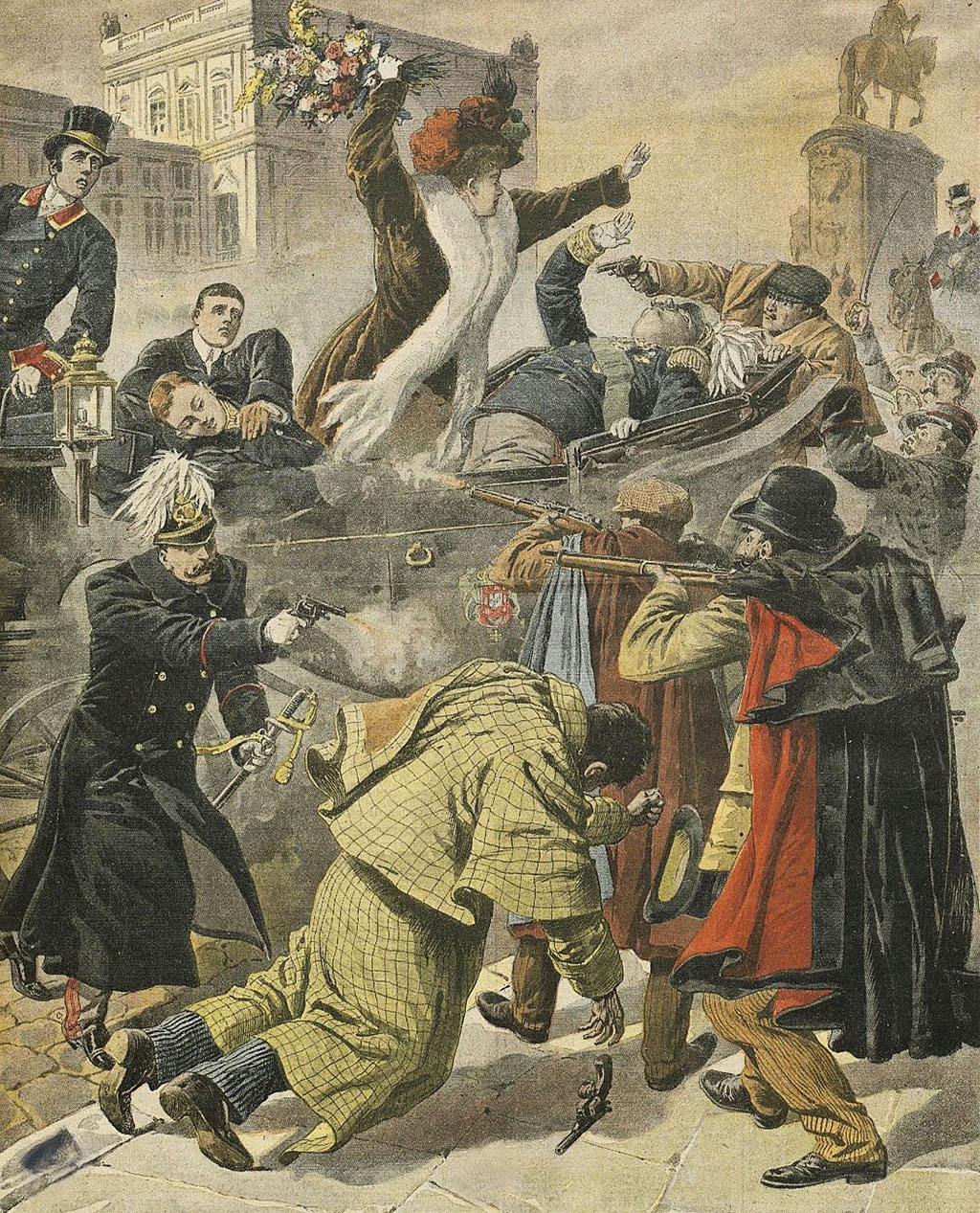
On this winter afternoon, there were few people to witness the events about to unfold. As the open carriage reached the corner of the square, a man leaped onto the running board of the landau and fired two bullets into the back of the king, killing him instantly. His accomplice under the arcade fired his carbine at the crown prince, mortally wounding him. The young D Manuel was hit in the arm, while the Queen bravely lashed out at the assassin with her bunch of flowers.
Both assassins (and an innocent passer-by) were immediately cut down by the royal guard. This precipitate reaction had the effect of preventing an effective investigation into the crimes, since the criminals were now dead. Very few people expressed sorrow for the death of the king, either because they believed this outcome inevitable, or because they thought the royal regime corrupt and unsustainable, or because they were afraid openly to mourn him.
On the other hand, the assassins were publicly praised, and thousands of photographs of their corpses were sold in the streets by newspaper boys calling out, “See the pictures of Buíça and Costa – see the pictures of the martyrs!”
Alfredo Costa was 24, a shop assistant, commercial traveller and a member of a trade union, whereas Manuel Buíça (32 years old) was a teacher at a private school, the son of a priest and an outspoken republican conspirator. The assassination of Portugal’s king sent shock waves through Europe, where every country bar three was ruled by a monarchy.
Two questions arise from these events in Lisbon. Why was the king so unpopular? And secondly, who were the assassins, and why did they strike at this time?
The problems of the King
D. Carlos had come to the throne in 1889 as the elder son of D. Luís. He was 26 years old, good looking and the archetype of a popular prince. In the 19 years of his monarchy, he managed to achieve a decline in popularity, astonishing even considered from today’s standpoint, although much of his unpopularity was not of his own making.
The first disaster occurred soon after he came to the throne. Patriotic Portuguese desired to connect Angola and Mozambique across southern Africa as shown in the so-called Pink Map. Great Britain had other ideas and peremptorily ordered Portugal to vacate the area (now Zambia and Zimbabwe). Portugal had no option but to obey the British Ultimatum, but if the king could not protect Portugal’s rights against a fellow sovereign nation, what use was he? The first unsuccessful uprising in favour of a republic took place in Porto on January 31, 1891.
It became common knowledge later that Britain and Germany entered bilateral negotiations for the dismemberment of Portugal’s African colonies, and the king’s lack of influence over his fellow monarchs led to even greater unpopularity.
In Portugal itself, the government was based on the British constitutional model but had become a completely ineffective rotating two-party system, which led to increasing political frustration.
In May 1907, the king decided to call on João Franco as Prime Minister in order to break the deadlock, but he was essentially a dictator governing without consulting the parliament. Seeking to neutralize the threat of violence by the republican carbonária, Franco’s methods of repression only succeeded in arousing greater opposition and more men rushed to join the republican opposition and the carbonária.
Franco had reconfirmed the unpopular tobacco monopoly in 1906, and he legitimized extraordinary payments from general taxation to the king (they were called adiantamentos and were very unpopular). This controversial move aroused immense opposition, which became extremely heated when it was discovered that D. Carlos had used some of this money to buy houses in Lisbon for two of his mistresses.
D. Carlos was openly called a criminal, the thief of the kingdom, since the subsidies paid to the royal family were greater than those of royals in other kingdoms, and Portugal at the time was experiencing successive bankruptcies. D. Carlos knew that he was a potential target for discontent, and he remarked to Franco: “We are standing before a fire we want to extinguish, and you cannot put it out by throwing on more firewood.”
The second attempted coup (the Municipal Library Elevator Coup) took place on January 28, 1908, in Lisbon and was the real reason that the king had left the capital for Vila Viçosa.
The Carbonária
The two assassins belonged to the Carbonária, a secret society operating in Italy, France, Spain, Brazil and Portugal. Its aims were to get rid of traditional monarchies, by violent means if necessary, including terrorism and violent attacks, even murder. It was opposed to the Catholic Church, and its internal structure was similar to that of the Masons.
The first branch of the Carbonária in Portugal was created in 1826 by students in Coimbra with the objective of opposing the absolutism of the usurper D. Miguel. Its most recent foundation was in 1896, and its overriding objective was to eliminate the monarchy and to establish a republic in Portugal. It accepted applicants from all social classes and its cellular structure was such that individual sections of 20 members had no knowledge of members of other sections.
Members were initiated secretly and usually in abandoned buildings, and a new applicant would know neither by whom he had been initiated, nor where the initiation had taken place. Each novice then had to prove himself to established members in terms of daring and at a secret special event.
Members recognized each other by means of signs, such as the use of tu in conversation. Alfredo Costa wrote in one letter, “Tentar esmagá-lo (o opressor) num justificado impulso de revolta é um dever de todos nós.” (Trying to crush him (the oppressor) in a justified impulse of revolt is a duty for all of us.)
In 1907 and 1908, there was a rash of conspiracy and bomb-making in Lisbon, but the fractured and secret nature of the Carbonária meant that there was no coordinated effort, and there was a considerable number of accidents among the bomb-makers themselves.
The plot of January 28 against Franco failed because the ineffective conspirators did not find him – if they had been better organized, perhaps they would have targeted Franco, and the regicide might have been avoided. But the attack on the royal family on February 1 was successful, even though the two assassins lost their lives.
Later the same year, a procession of over 22,000 people paid respects at the graves of the two regicides, proclaiming them benefactors of the nation.
The murders of the king and the crown prince portended the establishment of the republic 32 months later.
In the next article, we shall examine the foundation of the republican party, and how it took advantage of the deadly action perpetrated by the Carbonária.
Read more from Peter Booker about D João II (1455-1481–1495) or Dona Maria Amélia, the last Queen Consort of Portugal.