To read from the start click here.
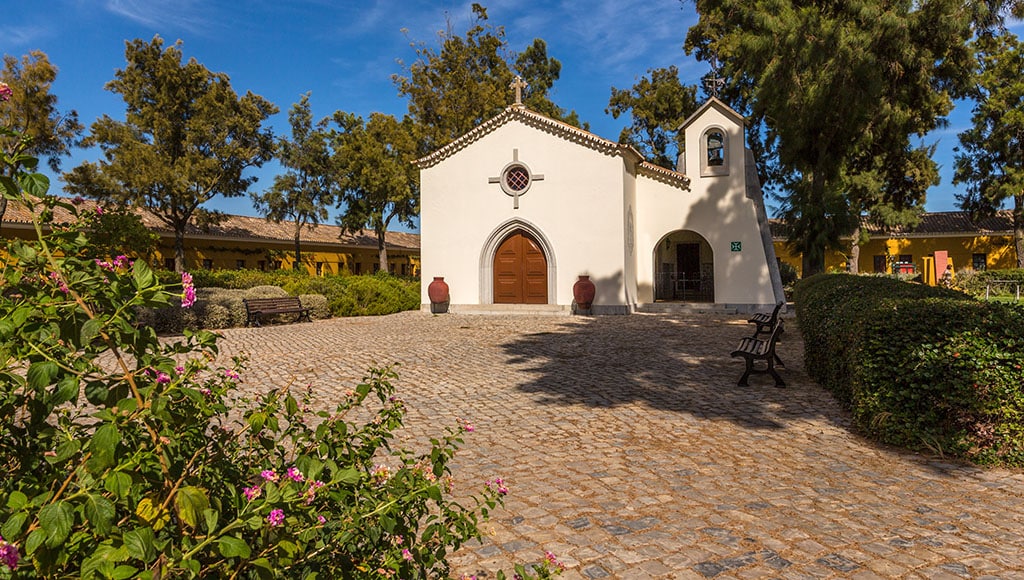
The modern Capela de Nossa Senhora da Conceição in the grounds of the Hotel Vila Galé Albacora is the fishermen’s chapel from the old tuna fishing camp (in Portuguese, the arraial).
By 1926, the Câmara (town hall) had at last managed to make an opening in the sand island (called the bar) at Quatro Águas, and Tavira fishing boats could then head directly out to sea from the river, avoiding the long diversion in the direction of Cacela Velha. This great advantage brought with it unforeseen and disastrous consequences.
The sea began to advance on the arraial of the main tuna fishery called Medo das Cascas, situated on the sand island, and eventually swallowed it completely. The owners of the Armação of Medo das Cascas then built the arraial which now forms the hotel.
This new tuna fishing camp was opened in 1945 and was called Arraial Ferreira Neto after one of the directors of the tuna fishing business. On the southern external wall of the hotel building, large capital lettering still shows ARRAIAL FERREIRA NETO.
As a part of the modern facilities, the company built a school for the fishermen’s children and, for their spiritual consolation, maintained the chapel, which still looks well.
The complex buildings were used to house those Portuguese who returned from their collapsed African empire in 1974/5 and, after considerable refurbishment, the complex became a hotel after 2005. Its rooms are fashioned out of the housing originally intended for fishermen and their families.
This hotel must be one of the very few in the world with its own functioning chapel, and it also houses the small museum of tuna fishing.
The Ermida de Santa Margarida is situatedon the old road to Santa Catarina just outside the town limit, but well within the parish boundary. This small chapel honours Saint Margaret, who was 15 years old when she suffered martyrdom in the year 290.
The chapel dates from the end of the 17th century and belonged to the now extinct Confraria de Santa Margarida. Small, with a single nave, its façade was remodelled in the 19th century but kept its original doorway. The chapel used to attract pilgrims on Saint Margaret’s day, which falls on July 20.
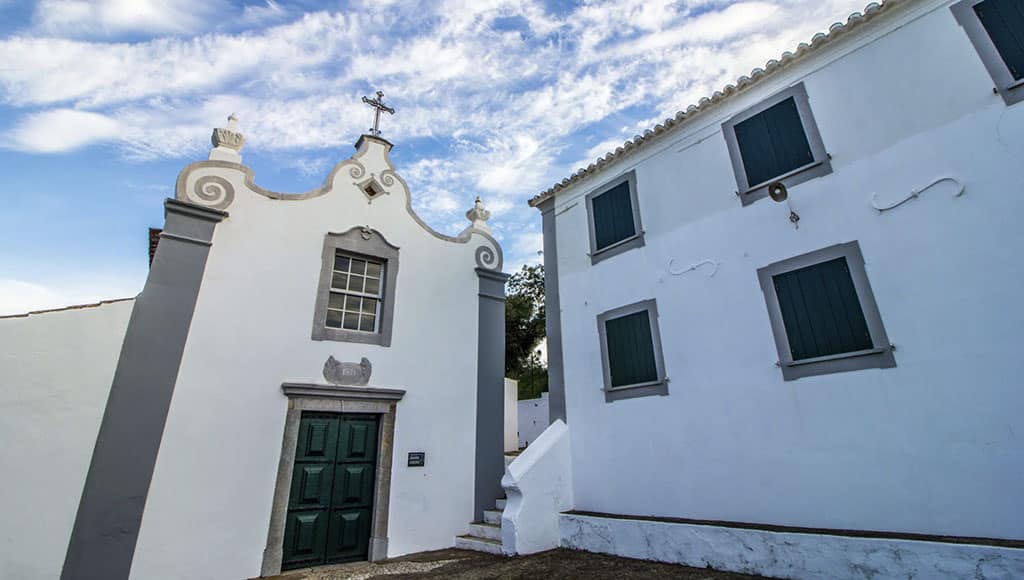
Some way to the north-west of the town lies the Ermida de Nossa Senhora da Saúde. Still within the parish, this old chapel was the original home of the Paulist friars, who moved into the town in 1606 to build the Convento de São Paulo, now the Igreja de São Paulo Eremita, and they afterwards continued to maintain this hermitage in the countryside. This chapel originated in the 15th century and was heavily damaged in the Great Earthquake of 1755.
Reconstructed as a sanctuary with a new altarpiece, it was dedicated to Nossa Senhora da Saúde (Our Lady of Health) and has since been maintained by the Confraria de Nossa Senhora da Saúde, which came into being in 1862.
The Igreja Matriz de Santa Luzia is a one-off, because Santa Luzia used to form a part of the parish of Santiago. There was a hermitage in this location before 1577, and this building was repaired, and added to, but eventually was so run-down that it was demolished to provide space for a new church, which opened in 1960. As the village grew, it eventually became its own parish in 1984.
On the other side of the carpark at Aldi on the outskirts of the town, a dilapidated structure houses two more of Tavira’s chapels. On the far side of this semi-detached arrangement, the chapel or Ermida de São Pedro dates from the early 17th century and was a target for celebrations on St Peter’s Day, June 29.
The building has a single nave, and a small chancel. The carved insignia of the crossed keys in low relief over the door were created in the 1800s, and are allusive to St Peter, and to his successor the Pope.
Semi-detached at the altar end with São Pedro is the Ermida do Senhor do Calvário, or Nossa Senhora das Angústias. This building also dates from the early 17th century. Its patron day is September 15, and large numbers of pilgrims used to gather here from all over the Algarve, and even from Andalucia. The chapel was remodelled in the early 1800s, when it assumed its present appearance.
The last time that pilgrimages to these chapels took place was on the Sábado de Aleluia (the Saturday after Good Friday) in 1919. These two joined chapels look sad, forlorn and neglected, sandwiched as they are between Aldi and the municipal cemetery, and their restoration would be costly. But it is probable that the church in Portugal has more pressing demands on its funds.
There is a good number of deconsecrated religious buildings in the town, the first of which is the Capela de São Sebastião opposite the municipal library. Chapels to São Sebastião were usually built at the edge of towns because São Sebastião is the saint who protects against infectious diseases, especially the bubonic plague.
St Sebastian was condemned to death by Emperor Diocletian but survived the wounds inflicted by arrows at his execution. Perhaps his survival explains the fact that he is also the patron saint of archers.
The original chapel is from the 15th century but was reconstructed in 1745 under the direction of Diogo Tavares de Ataíde. The Confraria de São Sebastião persuaded King D José to give the profits of the local fair of São Francisco towards the decoration of this building, and the extensive and expensive wall paintings of the life of São Sebastião were executed in 1759 by a local artist.
There was such a need for protection from disease that one of the major religious processions in the town was that of São Sebastião, which annually processed to the Igreja Matriz de Santa Maria on January 19, and back to the chapel through the streets of the town on the 20th. During one of the cholera epidemics of the mid-19th century, the Câmara decided to hold an extra protective procession, but had then to cancel it because there had been so many deaths that there were not enough men to form the procession.
The chapel was confiscated by the First Republic in 1911, and its fine paintings began to rot with mould. After acquisition by the Câmara in 1936, it has since been restored twice, most recently less than 10 years ago. Like the Capela de Santa Ana, this chapel is now used for small concerts, or for lectures and presentations when the library is not available.
To read part 9 click here.
Read more from Peter Booker about Tavira – a dog’s eye view or Three women, Tavira and the Carnation Revolution.