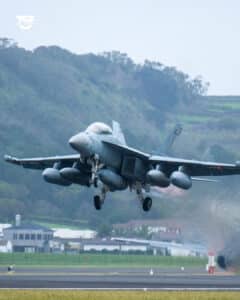
Since the announcement earlier this week that the “largest and most lethal” U.S. drones expected to land at Lajes airbase “within hours”, there has been an administrative flurry of questions and papers – as Portugal has established that it does not want any U.S. aircraft leaving the base in order to conduct part of the war effort over Iran.
AAN, Portugal’s aeronautical authority, has now given what is being reported as the “technical okay” for MQ9 Reapers to land at Lajes – “but only from Sunday.
Still missing, apparently, is the conclusive ‘okay’ that must come from the Ministry of Foreign Affairs.
The administrative to-ing and fro-ing comes in the context that it is obvious that these attack drones will be ‘supporting the United States’ aerial attacks on Iran’. No one could pretend that they will be doing anything else.
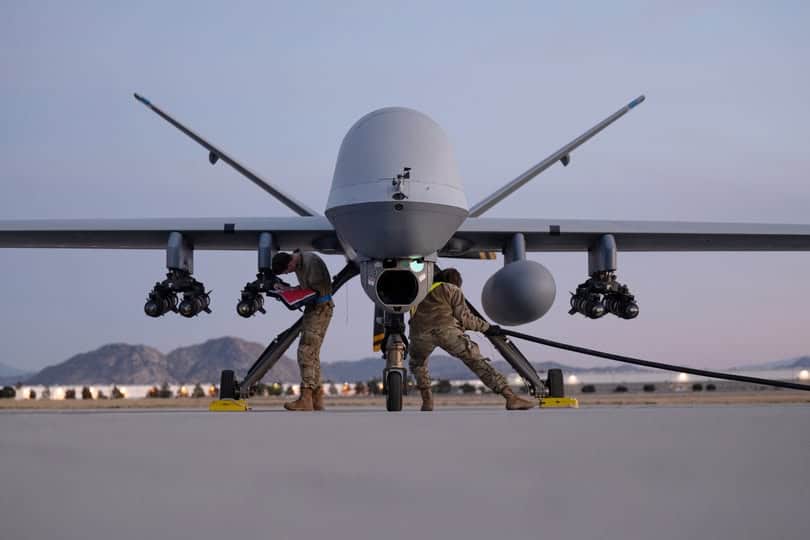
But to ‘comply’ with Portugal’s ‘stipulations’ over the U.S. use of Lajes, the Reapers will be leaving Lajes for Amman, in Jordan, where they will be ‘loaded’ (with the deadly missiles).
In SIC’s perspective, “the Lajes base in the Azores will serve as a logistics hub, for maintenance and refueling of these war machines that are arriving in Portugal for the first time.”
There are expected to be a maximum of four MQ9s arriving in total, and there is already a ‘north American team at the base, ready to work on them.’
Bloco de Esquerda, unsurprisingly, is not comfortable with this situation. MP Fabian Figueiredo has pointed out that “the MQ-9 Reaper is the deadliest unmanned aerial vehicle in the US arsenal, designed explicitly for attack missions and targeted killings”.
Figueiredo has sent a number of questions to defence minister Nuno Melo, and minister of Foreign Affairs, Paulo Rangel. In the questions addressed to minister Rangel, the MP seeks to understand how these aircraft can possibly fit the conditions announced by Rangel at the start of the war, when he said that Lajes can only be used in response to an attack, in the sense of defence or retaliation; any action must be necessary and proportional, and can only affect military targets
In Figueiredo’s mindset, Portugal’s ‘tacit authorisation’ for the passage through Lajes of these aircraft highlights “double standards that place Portugal in the dangerous position of acting as a logistical support base for a potentially illegal war” – at a time when other countries, such as Spain, have blocked the use of their national infrastructure for an operation that violates international law.
Figueiredo’s point is a hugely valid one, and explains the umming and aahing that has gone on behind the scenes since the Reapers’ arrival in Lajes was announced, last Monday.
As it is, these very large drones will be arriving ‘in containers’, for assembly in Lajes, even though they could easily fly there.
MQ-Reapers – also known as Predator Bs – were developed by General Atomics Aeronautical Systems, and have a number of purposes, beyond precision/ surgical attacks. They can also be used for intelligence gathering/ reconnaissance. They have an autonomy of flight for 27-hours, and are operated remotely by two people.
According to noticiasaominuto earlier this week, MK9s can “transport a load of 1,700 kg, and each drone costs more than 48 million million euros”.
Brazilian site G1 adds that each Reaper can be equipped with up to eight laser guided missiles – and were equally used in Iran in 2020, and Venezuela, earlier this year.
Source: SIC Notícias